

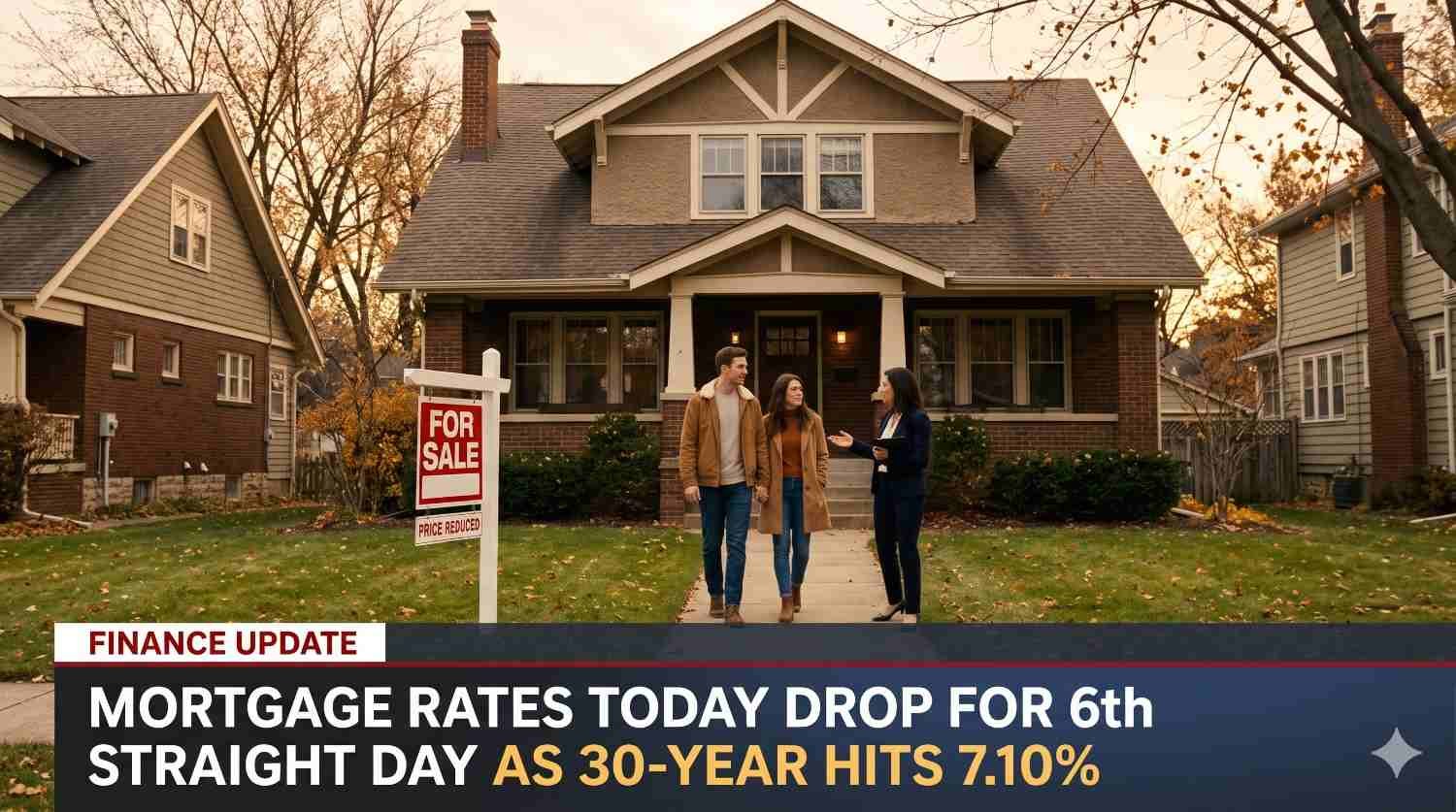
WASHINGTON — Homebuyers hunting for breathing room just caught a six-day break: mortgage rates today dropped to 7.10% for a 30-year fixed conventional loan on November 27, 2026, down from 7.28% one week ago. On a $400,000 mortgage, that 18-basis-point retreat slices $49 off your monthly payment and trims $17,539 in lifetime interest.
Shorter-term borrowers saw an even sharper dip, with the 15-year fixed average sliding 23 basis points in seven days to 6.23%. Yet bond markets flashed a warning sign by Friday afternoon as the 10-year U.S. Treasury yield climbed back to 4.93%–4.94%, signaling that this Thanksgiving-week discount could vanish before the Federal Reserve meets on December 8–9.
Key Financial Takeaways (At a Glance):
- Who Is Impacted: US homebuyers, 2026 refinancers, and homeowners exiting high-rate adjustable loans.
- Official Rate Benchmark: 30-year fixed at 7.10% (7.144% APR); 15-year fixed at 6.23% (6.300% APR); FHA 30-year at 6.57%.
- Key Deadlines: December 9, 2026, at 2:00 PM EST FOMC rate decision; January 1, 2027, new $855,400 conforming loan cap.
- Governing Bodies: Federal Reserve, FHFA, CFPB, HUD/FHA, VA, and IRS.
- Average Dollar Impact: $17,539 saved over 30 years versus last week on a $400,000 loan; $73,875 gap between 640 and 740+ FICO tiers.
- Smart First Move: Request standardized Loan Estimates from at least three lenders within a single 14-day rate-shopping window.
Mortgage Rates Today: Official Rules, Federal Policies, and What Just Changed
Three major federal policy shifts collided this week to rewrite how mortgage rates today are priced and underwritten. First, mortgage lenders do not peg home loans directly to the Federal Reserve’s overnight rate; they track the 10-year Treasury yield and mortgage-backed security (MBS) spreads. After retreating from its October 5 peak of 5.31%, the 10-year yield dipped into Thanksgiving before rebounding to 4.933% on Friday, putting fresh upward pressure on lender rate sheets.
Second, the Federal Reserve held its federal funds target range steady at 3.75% to 4.00% on October 28, 2026, following a 10-2 vote where two officials dissented in favor of a quarter-point hike. Because October consumer inflation ran hot, bond traders are closely watching whether policymakers tighten again or hold firm at their December 8–9 FOMC meeting.
Third, the Federal Housing Finance Agency (FHFA) dropped two landmark announcements on November 24, 2026. Under the Housing and Economic Recovery Act (HERA), the 2027 baseline conforming loan limit for Fannie Mae and Freddie Mac rises $22,650 to $855,400 (up 2.72% from 2026’s $832,750 limit), while the high-cost ceiling jumps to $1,283,100. In special statutory areas—Alaska, Hawaii, Guam, and the U.S. Virgin Islands—the 2027 ceiling reaches $1,924,650.
Caption: Federal Housing Finance Agency 2027 conforming limit hikes and Federal Reserve policy expectations are actively reshaping late-2026 US mortgage pricing.
Underwriter’s Reality Check: Many large lenders begin funding loans under next year’s $855,400 conforming limit weeks before January 1. If you are borrowing between $832,750 and $855,400 right now, ask your loan officer whether you can avoid jumbo underwriting and its 7.31% average rate.
Federal Protections, Government Programs, and Mortgage Rates Today Requirements
Behind every advertised rate sits a strict web of federal statutes and underwriting formulas governing mortgage rates today across conventional and government-backed loans. Under the Truth in Lending Act (TILA / Regulation Z) and RESPA, lenders must deliver a binding three-page Loan Estimate within three business days of your application and a Closing Disclosure at least three business days before closing.
Inside the underwriting black box, four variables dictate whether you receive the headline 7.10% rate or a costly risk-adjusted surcharge:
- Credit Scoring Overhaul: On November 24, 2026, the FHFA formally approved an implementation timeline for FICO Score 10T, mirroring its rollout of VantageScore 4.0. Lenders delivering loans to Fannie Mae and Freddie Mac can currently choose either Classic FICO or VantageScore 4.0—and 37% of Fannie Mae Desktop Underwriter applications in September 2026 already included VantageScore 4.0, which rewards documented on-time rent payments.
- FICO Pricing Tiers: Conventional loans generally require a 620 minimum score, with elite pricing reserved for 740–779 and 780+ tiers. FHA loans accept scores down to 580 with 3.5% down (or 500–579 with 10% down), while VA and USDA programs set no statutory minimum—though most banks apply a 620 lender overlay.
- Debt-to-Income (DTI) Cutoffs: Standard conventional front-end housing DTI caps sit around 28%–36%, while back-end total DTI generally tops out at 45% (or up to 50% with strong Automated Underwriting System findings and six months of liquid cash reserves). FHA guidelines allow back-end DTI ratios up to 56.9% with compensating factors.
- Government Backing Rules: FHA 2026 loan limits stand at $541,287 (low-cost floor) and $1,249,125 (high-cost ceiling), backed by HUD. Eligible veterans using VA loans pay zero down and zero monthly mortgage insurance, subject to a one-time VA funding fee of 2.15% on first-time zero-down purchases (waived for veterans with service-connected disability ratings).
Understanding federal rules is only half the equation—because comparing last year’s numbers against 2026 pricing reveals a massive gap hidden inside lender rate sheets.
2025 vs. 2026 Rate, Fee & Eligibility Matrix (Side-by-Side Breakdown)
While this week’s six-day retreat feels welcome, zooming out shows how sharply borrowing costs shifted between late 2025 and November 2026. According to Freddie Mac’s Primary Mortgage Market Survey as of November 25, 2026, weekly 30-year averages sit nearly a full percentage point higher than a year ago.
| Loan Category / Metric | Late Nov. 2025 Benchmark | Nov. 27, 2026 Rate (APR) | Min. Credit Score (Typical) | Max Back-End DTI | Typical Upfront / Insurance Fee |
| 30-Year Fixed Conventional | 6.23% (Freddie Mac PMMS) | 7.10% (7.144% APR) | 620 (740+ for best tier) | 45%–50% | PMI if LTV exceeds 80%; 0%–1% origination |
| 15-Year Fixed Conventional | 5.51% (Freddie Mac PMMS) | 6.23% (6.300% APR) | 620 (740+ for best tier) | 45%–50% | PMI if LTV exceeds 80%; 0%–1% origination |
| 30-Year FHA (HUD) | ~6.05%–6.20% range | 6.57% (7.770% APR) | 580 (3.5% down) / 500 (10%) | Up to 56.9% | 1.75% upfront MIP + 0.50%–0.55% annual MIP |
| 30-Year VA Loan | ~6.00%–6.15% range | 6.64% (6.808% APR) | No VA floor (620 bank overlay) | 41%+ (residual income) | 2.15% first-use funding fee (below 5% down) |
| 30-Year USDA Rural | ~6.10%–6.25% range | 6.93% (varies by lender) | 640 (GUS automated) | 41% (44% w/ waivers) | 1.00% upfront guarantee + 0.35% annual fee |
| 30-Year Jumbo Loan | ~6.55%–6.75% range | 7.31% (varies by lender) | 700–720+ | 43% (strict reserves) | 6–12 months liquid cash reserves |
| FHFA Conforming Cap (1-Unit) | $806,500 (2025) | $832,750 (2026) / $855,400 (2027) | Enterprise Standard | Per DU / LPA | Zero jumbo pricing hit under cap |
| FHA Floor / Ceiling (1-Unit) | $524,225 / $1,209,750 | $541,287 / $1,249,125 (2026) | HUD Standard | Per FHA TOTAL | 2027 HUD update due Dec. 2026 |
Look closely at the third row of that matrix—it exposes a trap that catches thousands of first-time buyers checking mortgage rates today. On paper, an FHA 30-year mortgage advertises a tempting 6.57% interest rate, which is 53 basis points cheaper than a conventional loan. Yet its real APR explodes to 7.770%—more than 62 basis points higher than conventional financing—because of mandatory upfront and annual Mortgage Insurance Premiums (MIP).
Credit unions and online nonbank lenders also diverge wildly in this environment. Member-owned credit unions regulated by the NCUA frequently waive junk origination fees and price portfolio 5/6 adjustable-rate mortgages near 6.65%. Meanwhile, big retail banks often advertise artificially low rates that quietly bundle 0.65 to 1.00 discount points ($2,600 to $4,000 out of pocket on a $400,000 loan).
Those basis-point differences look small in a table, but wait until you see what they do to a real American family’s net worth over a full loan term.
Real-World Dollar Math: Exact Cost & Savings Scenarios for American Borrowers
To translate mortgage rates today into hard household dollars, consider three American buyers financing an identical $400,000 mortgage (a $500,000 home with 20% down, excluding local property taxes and homeowners insurance). Every dollar below reflects exact 30-year and 15-year amortization math using November 27, 2026 market rates.
| Borrower Profile ($400,000 Loan) | Interest Rate | Monthly Principal & Interest | Total Interest Paid | Difference vs. Borrower B (740+ FICO) |
| Borrower A: 640 FICO (30-Yr Conv. w/ LLPA) | 7.85% | $2,893 | $641,602 | +$205/mo (+$73,875 lifetime cost) |
| Borrower B (Last Week): 740+ FICO (30-Yr) | 7.28% | $2,737 | $585,266 | +$49/mo (+$17,539 lifetime cost) |
| Borrower B (Today): 740+ FICO (30-Yr) | 7.10% | $2,688 | $567,727 | Baseline ($0) |
| Borrower C (Today): 740+ FICO (15-Yr) | 6.23% | $3,425 | $216,559 | +$737/mo (-$351,168 interest saved) |
The numbers tell an unmistakable story. Simply lifting a credit score from 640 to 740 before applying eliminates Fannie Mae and Freddie Mac’s steepest Loan-Level Price Adjustments (LLPAs), saving Borrower B $73,875 in pure interest over 30 years. Even waiting one week—locking at 7.10% instead of last Friday’s 7.28%—keeps $17,539 inside your household budget.
Borrower C’s 15-year fixed strategy requires an extra $737 per month in cash flow, which strains tighter budgets. Still, cutting the amortization clock in half at 6.23% erases $351,168 in lifetime interest—nearly enough to buy a second home outright.
Caption: Side-by-side amortization comparisons reveal how a 100-point FICO jump or a 15-year term reshapes total US homeownership costs.
Hidden Lender Traps, Tax Consequences, and Overlooked Edge Cases
Most affiliate rate tables stop at monthly payments, leaving borrowers blindsided at the closing table. Even when mortgage rates today look favorable, five fine-print traps can quietly wipe out your savings:
- Permanent FHA MIP vs. Cancelable PMI: Under the Homeowners Protection Act of 1998, conventional borrowers can demand Private Mortgage Insurance (PMI) cancellation at 80% loan-to-value (LTV) and receive automatic termination at 78% LTV. By contrast, FHA borrowers who put less than 10% down pay annual MIP for the entire 30-year life of the loan unless they refinance into a conventional mortgage.
- Prepaid Discount Point Traps: Online quote widgets routinely display rates like 6.375% by embedding nearly 1.00 discount point ($3,750 to $4,000 upfront) plus $1,995 in lender fees. If you refinance within 36 to 48 months, you will never hit your break-even point and you forfeit that cash permanently.
- 2026 IRS Tax Rules (OBBBA Changes): Under the One Big Beautiful Bill Act of 2025 (OBBBA), the IRS permanently retains the $750,000 acquisition debt cap ($375,000 married filing separately) for itemized mortgage interest reported on Form 1098. Two major 2026 tax perks help buyers offset 7% rates: mortgage insurance premiums (PMI and FHA MIP) paid after December 31, 2025, qualify as deductible mortgage interest on Schedule A, and the temporarily expanded $40,000+ SALT deduction cap (indexed 1% higher in 2026 for households below roughly $505,000 MAGI) makes itemizing viable again.
- 1099 / Self-Employed & Retiree Hurdles: Self-employed borrowers submitting Form 1099-NEC and Schedule C are underwritten on two-year net taxable income after write-offs—meaning aggressive business deductions can trigger a denial even with healthy bank balances. Retirees on fixed Social Security or pension income can ask underwriters to “gross up” nontaxable income by 15% to 25%, or use asset-depletion formulas on 401(k) and IRA holdings.
- Forgiven Debt & Military Caps: Borrowers negotiating a short sale or loan modification should watch for Form 1099-C, which can treat canceled mortgage debt as taxable income unless federal insolvency exclusions apply. Active-duty military families, meanwhile, hold statutory protection under the Servicemembers Civil Relief Act (SCRA), capping interest at 6% on mortgages originated before entering active duty.
Readers tracking federal housing policy updates, updated rate schedules, and ongoing consumer finance alerts can review centralized federal breakdowns at SarkariResultine.com/us. Once you know every hidden fee and tax rule, executing your loan application in the right order determines whether you capture the lowest rate on the street.
Step-by-Step Approval & Savings Blueprint: Exact Moves to Make Right Now
Walking into a single retail bank and accepting its first quote is the single most expensive mistake in American real estate. Follow these six exact underwriting steps before signing a rate lock:
- Pull All Three Official Credit Reports First: Visit AnnualCreditReport.com—the sole federally mandated portal under the Fair Credit Reporting Act (FCRA)—to audit Equifax, Experian, and TransUnion free of charge. Dispute erroneous late payments and pay revolving credit card balances below 10% utilization 30 to 45 days before applying.
- Exploit the FICO Rate-Shopping Window: Under FICO and VantageScore scoring models, multiple mortgage hard inquiries submitted within a 14-to-45-day window count as a single credit pull. Gather written Loan Estimates from at least one FDIC-insured bank, one NCUA-insured credit union, and one wholesale mortgage broker on the exact same business day to compare mortgage rates today fairly.
- Ask Specifically About VantageScore 4.0 Rent Credit: If you have a thin credit file or a borderline 660–715 score but 12+ months of clean electronic rent payments, ask your lender if they run VantageScore 4.0 through Fannie Mae Desktop Underwriter. Rent-history inclusion can lift thin-file borrowers into a cheaper pricing tier without paying down extra debt.
- Assemble a Clean Underwriting Packet: Gather two full years of federal Form 1040 tax returns (all schedules), W-2s or 1099-NEC statements, 30 days of pay stubs, and 60 days of complete bank statements (every page, including blank ones). Never deposit undocumented cash or finance a vehicle before closing; lenders pull a refreshed credit report and employment verification hours before funding.
- Audit Section A of Your Loan Estimate Line by Line: Ignore teaser monthly estimates and compare Box A (Origination Charges) alongside the APR on page 3. Demand a zero-point “par rate” quote from every lender so you can isolate genuine rate differences from disguised upfront fees.
- Negotiate a Float-Down Option or Escalate Violations: Ask whether your 30-day or 45-day rate lock includes a one-time “float-down” clause if market rates drop another 25 basis points before closing. If a lender alters locked terms illegally or violates TILA/ECOA disclosure rules, file a formal federal complaint directly with the Consumer Financial Protection Bureau (CFPB).
Timing that rate lock properly now comes down to four dates circled in red on every Wall Street mortgage desk’s calendar.
2026–2027 Key Financial Deadlines, Fed Calendar & What Happens Next
Bond volatility rarely stays quiet in December, and upcoming federal milestones will dictate where mortgage rates today head into spring 2027:
- December 8–9, 2026 — Federal Reserve FOMC Decision: Policymakers release their final 2026 interest rate verdict, Summary of Economic Projections (SEP), and updated “dot plot” on Wednesday, December 9, at 2:00 PM EST, followed by the Chair’s press conference at 2:30 PM EST. Any surprise hike above the 3.75%–4.00% band—or hawkish 2027 inflation guidance—could snap 30-year mortgage rates swiftly back above 7.35%.
- December 2026 — HUD 2027 FHA Loan Limit Release: Following FHFA’s November 24 announcement, HUD typically publishes updated 2027 FHA floor and ceiling caps in early-to-mid December for case numbers assigned on or after January 1, 2027.
- January 1, 2027 — $855,400 Conforming Limit Takes Legal Effect: Fannie Mae and Freddie Mac officially adopt the $855,400 baseline and $1,283,100 high-cost ceiling nationwide, lifting loan caps in all but 24 US counties.
- February 22, 2027 — Expanded VantageScore 4.0 Manual Underwriting: Fannie Mae’s updated eligibility rules formally permit manually underwritten conventional loans using VantageScore 4.0 alongside Classic FICO, ahead of full FICO Score 10T integration.
Lock Now or Float? If you are closing within 30 to 45 days, locking today’s 7.10% rate—ideally with a float-down rider—protects your budget against Friday’s 10-year Treasury bounce to 4.94% and December 9 FOMC headline risk. Borrowers closing 60+ days out can float cautiously while keeping an eye on upcoming inflation prints, knowing they can always refinance later if yields cool in mid-2027.
Official Government Resources & Primary Financial Verification Links
Verify every benchmark, loan limit, and lender credential directly through primary federal sources before acting on mortgage rates today:
- FHFA 2027 Conforming Loan Limit Lookup & Official Release — Official county-by-county 2027 Fannie Mae and Freddie Mac loan caps.
- Federal Reserve FOMC Calendar & Policy Statements — Live federal funds rate statements, minutes, and December 8–9 meeting schedules.
- Consumer Financial Protection Bureau (CFPB) Owning a Home Tools — Loan Estimate explainers, rate-checking guides, and formal lender complaint portal.
- HUD / FHA Official Loan Limits & Housing Counseling — Official FHA floor/ceiling lookup and HUD-approved free homebuyer counselors.
- VA Home Loan Funding Fee & Eligibility Portal — Verified 2026 VA funding fee schedules and disability waiver rules.
- AnnualCreditReport.com (Federally Authorized Portal) — Free weekly credit reports from Equifax, Experian, and TransUnion.
- IRS Home Mortgage Interest & Form 1098 Guidance — Official Schedule A deduction rules and 2026 OBBBA updates.
- FDIC BankFind Suite — Verify lender federal deposit insurance and bank charter status.
Frequently Asked Questions (People Also Ask)
Why did mortgage rates today drop for six straight days even though the Fed did not cut rates?
Long-term mortgage rates today follow the 10-year U.S. Treasury yield and bond investor demand for mortgage-backed securities, not the Federal Reserve’s overnight funds rate. Bond yields eased from their October high of 5.31% into Thanksgiving week, allowing lenders to trim 30-year averages from 7.28% down to 7.10% despite the Fed holding at 3.75%–4.00%.
Can I still qualify for a mortgage in late 2026 with a 580 to 620 credit score?
Yes, borrowers with scores between 580 and 619 qualify for HUD-backed FHA loans with just 3.5% down, while a 620 score unlocks conventional loans and most VA/USDA lender programs. You can also ask lenders to evaluate your file using VantageScore 4.0, which incorporates positive rent history under updated FHFA rules.
How much does shopping multiple mortgage lenders hurt my credit score?
Shopping multiple lenders causes minimal credit impact—usually fewer than five points—provided you submit all applications within a concentrated 14-to-45-day window. Under FICO and VantageScore deduplication rules, every mortgage inquiry pulled inside that window registers as a single hard inquiry on your credit file.
Is mortgage interest and PMI tax-deductible on 2026 federal tax returns?
Yes, for taxpayers who itemize deductions on Schedule A using Form 1098. Under the One Big Beautiful Bill Act of 2025, interest remains deductible on up to $750,000 of qualified mortgage debt ($375,000 if married filing separately), and qualifying PMI or FHA MIP premiums paid after December 31, 2025, are also deductible.
Are there prepayment penalties if I lock 7.10% now and refinance in 2027?
Standard conforming conventional, FHA, VA, and USDA mortgages prohibit prepayment penalties under federal Qualified Mortgage (QM) rules enforced by the CFPB. You can refinance or make extra principal payments at any time without penalty, though you should still factor in 2% to 3% in standard refinance closing costs when calculating break-even math.
Editorial Financial Disclosure: Mortgage rates, APRs, federal loan limits, and IRS tax rules cited in this report reflect verified data as of November 27, 2026, and are subject to daily market change; this article is strictly for informational purposes and does not constitute personalized financial, tax, or legal advice.














Leave a Reply