


Top high-yield savings accounts are paying up to 5.00% APY right now, yet millions of Americans still leave cash rotting at 0.01% in brick-and-mortar megabanks. After the Federal Reserve held its benchmark range at 3.75%–4.00% on October 28, 2026, your choice of bank directly decides whether you keep over $1,400 in annual interest or hand it straight back to Wall Street.
Direct Answer: As of November 2026, the best FDIC-insured online savings options pay 4.20% to 4.40% APY with zero teaser gimmicks—and up to 5.00% APY on six-month promotional tiers—compared to the 0.39% APY FDIC national average. Every dollar of interest is taxed as ordinary income on IRS Form 1040, making after-tax comparisons essential before moving cash.
Quick Key Takeaways:
- Federal Rate Floor: The Federal Reserve held the federal funds target range at 3.75%–4.00% (effective rate 3.88%) heading into the December 8–9, 2026 FOMC meeting. Market Chameleon
- Megabank Penalty: Leaving $35,000 at 0.01% APY earns $3.50 a year, while a 4.27% APY online account generates $1,494.50 gross.
- Insurance Ceiling: Standard FDIC and NCUA protection covers $250,000 per depositor, per insured institution, per ownership category. FDIC
- Tax Trap: Banks issue IRS Form 1099-INT once annual interest hits $10, and high-tax-state savers often net more from state-tax-exempt U.S. Treasury Bills yielding 4.34%–4.42%.
- Zero Credit Hit: Opening a deposit account triggers a ChexSystems review, never a hard FICO Score 8 credit inquiry.
Late-2026 Market Snapshot: Top High-Yield Savings Accounts, Caps & Rules
After twenty years pricing consumer deposits and auditing bank balance sheets, I can tell you one dirty secret about late-2026 deposit rates. Online banks are splitting into two camps: clean ongoing yields near 4.20%–4.27% APY and flashy 4.35%–5.00% APY promotional tiers designed to slash your rate the minute you stop watching.
| Account / Institution | Verified Late-2026 APY | Min. Balance for Top APY | Hidden Fees / Fine Print | Best For |
|---|---|---|---|---|
| Axos ONE® Savings (Member FDIC) | 5.00% APY (6-mo promo; 4.21% ongoing) | $1,500 monthly direct deposit + $1,500 daily balance | Drops to 1.00% APY base if requirements slip; $249,999.99 cap on 4.21% tier | Active paycheck switchers chasing max promo yield |
| Vio Bank Online Savings (Member FDIC) | 4.40% APY (3-mo promo tier) | $100 to open | $0 monthly fee; up to 6 monthly withdrawals; promo resets after 90 days | Short-term cash parking with low entry bar |
| CIT Bank Platinum Savings (Member FDIC) | 4.35% APY (6-mo code BOOST60; 3.75% base) | $5,000 balance ($100 to open) | Balances under $5,000 earn sharply lower base rate; promo expires Dec 15, 2026 | Mid-sized emergency funds over $5,000 |
| Peak Bank Envision Savings (Member FDIC) | 4.27% APY (Standard ongoing) | $100 to open | $0 monthly fee; no direct-deposit hoops or promo cliffs | Set-and-forget savers wanting zero gimmicks |
| EverBank Performance® Savings (Member FDIC) | 4.20% APY (Standard ongoing) | $0 minimum | $0 monthly fee; external transfers capped at 50/month | High-balance reserves with clean liquidity |
| Wealthfront Cash Account (Program Banks) | 3.55% APY | $1 minimum | Fintech sweep (up to $8M pass-through FDIC); unlimited transfers | Checking-savings hybrid & large cash sweeps |
| FDIC National Average / Big Banks | 0.39% APY avg (0.01%–0.04% megabanks) | $0–$300 | Monthly maintenance fees ($5–$12) if balance minimums aren’t met | Branch-only cash deposits (never long-term storage) |
Notice how the Federal Reserve’s H.15 daily release anchors everything in that table. With the effective federal funds rate sitting at 3.88% following September’s 25-basis-point hike and October’s hold, banks cannot sustainably pay 5.00% APY forever without funding the gap out of their marketing budget.
When an online bank advertises a 0.60%–0.80% APY boost above the 4.20% wholesale floor, check the expiration calendar first. Most Savers forget to move cash when the teaser clock runs out—which is why understanding the exact after-tax dollar math matters far more than chasing a headline number.
Real American Case Study & Exact USD Math Breakdown
Headline APYs lie when you ignore the IRS and your state revenue department. Let’s run the exact late-2026 numbers for a single W-2 professional earning $85,000 per year with a $35,000 emergency fund parked for 12 months.
Under IRS Revenue Procedure 2025-32, the 2026 standard deduction for single filers is $16,100, leaving $68,900 in taxable income. That places every dollar of bank interest squarely inside the 22% federal marginal tax bracket ($50,401 to $105,700).
- Default Mistake (Megabank at 0.01% APY): Earns $3.50 gross interest per year. After federal tax, you pocket $2.73—losing over $1,200 in real purchasing power against 3.70% year-over-year inflation.
- Austin, Texas Saver (Peak Bank at 4.27% APY, 0% State Tax): Earns $1,494.50 gross interest. Subtract $328.79 in 22% federal income tax, and you keep $1,165.71 net (a 3.33% after-tax yield).
- San Diego, California Saver (Same 4.27% APY, 9.3% State Tax): Earns $1,494.50 gross interest. Subtract $328.79 federal tax plus $138.99 California income tax, and you keep $1,026.72 net (a 2.93% after-tax yield).
- The CFP Arbitrage (3-Month U.S. Treasury Bill at 4.34% Yield): Earns $1,519.00 gross interest. Because Treasury interest is legally exempt from state and local income tax, the California saver pays $334.18 federal tax and $0.00 state tax—pocketing $1,184.82 net, or $158.10 more than the savings account.
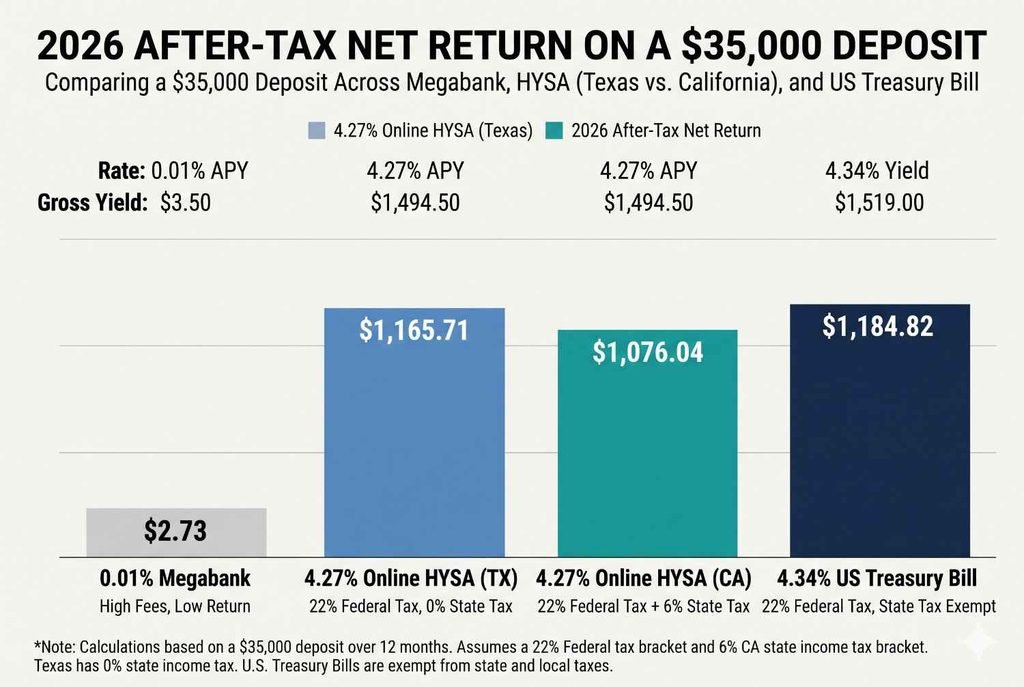
That $158.10 gap widens dramatically if you hold $100,000 for a home down payment in California or New York. Even more importantly, your legal safety net changes completely depending on whether you hold funds at a direct bank, a credit union, or a fintech app.
Official US Federal Rules, Protections & State-by-State Nuances
Before wiring a dime, verify which federal statute actually shields your cash and how IRS rules interact with your broader 2026–2027 wealth plan. You can check any bank’s live charter directly on the FDIC official website before submitting your Social Security number.
Federal Deposit Insurance & Brokerage Shields
- FDIC Coverage (12 U.S.C. § 1821): Insures up to $250,000 per depositor, per FDIC-insured bank, per ownership category. A married couple holding one joint account gets $500,000 in coverage ($250,000 each), plus separate $250,000 buckets for individual and revocable trust accounts. FDIC+ 1
- NCUA Share Insurance: Mirrors the exact $250,000 federal backing for federally insured credit unions, verifiable via the National Credit Union Administration.
- SIPC Protection: Brokerage cash-management accounts carry $500,000 in securities coverage (including a $250,000 cash sub-limit), protecting against broker insolvency—never market losses.
- FDIC Modernization Watch (FIL-63-2026): On October 30, 2026, the FDIC issued a Notice of Proposed Rulemaking (12 C.F.R. § 360.9) to speed large-bank deposit determinations. Remember that FDIC insurance never covers the bankruptcy of a non-bank fintech middleman if its ledger breaks down. FDIC
2026–2027 IRS Tax Rules, Forms & Wealth Caps
Interest earned in high-yield savings accounts is taxed as ordinary income—never at preferential 0%, 15%, or 20% long-term capital gains rates. Banks must send IRS Form 1099-INT by January 31, 2027 if you earned $10 or more, and you must report even smaller amounts on Form 1040 by April 15, 2027.
Before parking excess cash in taxable bank accounts, cross-check your 2026 and 2027 tax-advantaged ceilings on IRS.gov (you can also track full bracket changes inside our US tax brackets and deductions hub):
- Standard Deduction: $16,100 Single / $32,200 Married Filing Jointly for 2026 (Rev. Proc. 2025-32), rising to $16,600 Single / $33,200 MFJ for 2027 (Rev. Proc. 2026-35).
- 401(k) & 403(b) Limits: $24,500 in 2026, increasing to $25,500 in 2027 (Notice 2026-66). Age 50+ catch-ups climb from $8,000 to $8,500, while SECURE 2.0 Ages 60–63 Super Catch-Ups jump from $11,250 to $11,750. IRS (.gov)+ 1
- Traditional & Roth IRA (Form 5498): $7,500 under age 50 ($8,600 age 50+) for both 2026 and 2027. Roth MAGI phase-outs sit at $153,000–$168,000 Single ($242,000–$252,000 MFJ) for 2026, rising to $158,000–$173,000 Single ($250,000–$260,000 MFJ) for 2027. Fidelity Investments
- HSA Limits (Form 8889): $4,400 self-only / $8,750 family in 2026, rising to $4,500 / $9,000 in 2027 (plus $1,000 catch-up at age 55+). Fidelity Investments
- SECURE 2.0 & Filing Access: Required Minimum Distributions (RMDs) begin at age 73, eligible 529 plans allow up to $35,000 in lifetime tax-free Roth IRA rollovers, and early retirement withdrawals carry a 10% penalty unless an IRS exception applies. Households with AGI of $89,000 or below can file federal returns at zero cost via IRS Free File. IRS
State-by-State Tax & Banking Nuances
- Texas & Florida (0% State Income Tax): Every dollar of bank interest avoids state taxation, making 4.20%–4.40% APY accounts cleanly competitive with short-term Treasuries.
- California (Up to 13.3%+ State Tax): Taxes savings interest heavily as ordinary income; savers in the 9.3% bracket or higher usually beat HYSAs using Treasury bills or California-specific municipal money market funds.
- New York (State + NYC Local Tax): Combined state and city rates can clip 10%–14% off your bank yield, making state-exempt federal Treasury products essential for large reserves.
Even with federal rules on your side, banks quietly reject thousands of applicants every month—so run an underwriter self-check before you apply.
Are You Ready? 5-Point US Underwriter Self-Check Scorecard
Give yourself 1 point for each item you pass below before opening one of late 2026’s high-yield savings accounts:
- Clean ChexSystems Record: Zero unpaid overdraft charge-offs, bounced-check closures, or fraud flags on your ChexSystems or Early Warning Services (EWS) consumer report over the last five years.
- Liquidity Separation: You already keep 1 month of bill-pay cash in a checking account so 1–3 business day ACH transfer delays never trigger late fees.
- High-Interest Debt Cleared: You aren’t earning 4.25% APY in savings while paying 22%–29% APR on revolving credit card balances (outside a bare-minimum $2,500 emergency starter buffer).
- FDIC Cap Verification: Your total deposits across all linked accounts at the same chartered bank stay at or under $250,000 per ownership category. FDIC
- Tax Withholding Buffer: You’ve accounted for 1099-INT ordinary income tax so you don’t get hit with an IRS underpayment surprise next April.
Score 5/5: You’re cleared to open and fund today. Score 3 or lower: Fix your ChexSystems file or pay off high-APR credit cards before chasing yield, and check what paperwork the bank’s Patriot Act compliance desk will demand next.
Required US Eligibility & Paperwork Checklist
Under the USA PATRIOT Act (31 U.S.C. § 5318) Customer Identification Program, online banks verify your identity digitally—and a single mismatch can freeze your opening deposit for weeks. Gather these exact items before clicking “Apply” on any of the high-yield savings accounts in our comparison table:
| Verification Category | Exact US Requirement / Document | Underwriter Insider Tip |
|---|---|---|
| Taxpayer ID | Valid SSN (most online banks) or ITIN (select banks like Capital One, Alliant, and local credit unions) | Never submit an ITIN on an SSN-only application—it triggers an automated fraud freeze. |
| Residency & Age | Age 18+ with a physical US residential street address (no P.O. boxes or mail forwarding centers) | Ensure your address matches your driver’s license and Form 1040 history exactly. |
| Government Photo ID | Unexpired US Driver’s License, State ID, or US Passport | Upload glare-free images; blurry corners cause manual compliance holds. |
| Funding Account | Existing US checking account routing + account number (or Plaid instant login) | Verify micro-deposits ($0.01–$0.99) within 3 days so ACH links don’t expire. |
| Income / Source Proof | Optional for standard balances; W-2, 1099-NEC, Schedule C, or 2 years of Form 1040 for $50,000+ AML reviews | Wiring large house proceeds? Alert the bank’s compliance team first to avoid a 10-day hold. |
| Screening Bureaus | ChexSystems & EWS banking history (no hard FICO pull) | Temporarily unfreeze your ChexSystems security freeze 24 hours before applying. |
Having clean paperwork stops approval delays, but it won’t protect you from the subtle fine-print clauses that cost American savers hundreds of dollars a year.
Hidden Fine Print & Traps Affiliate Sites Won’t Tell You
Commission-driven comparison blogs get paid when you click “Open Account,” which is why they bury five expensive fine-print traps in footnote #9. Watch out for these exact pitfalls:
- The Teaser-Rate Cliff: Accounts advertising 5.00% APY (like Axos ONE®) or 4.35% APY (like CIT Bank Platinum) rely on 6-month promotional boosts or steep $1,500–$5,000 thresholds. Miss one monthly direct deposit, and your yield can crater to 1.00% APY without an email warning. CNBC
- Fintech Pass-Through Freeze Risk: Non-bank apps advertising 4.50%–7.75% APY or sweep networks aren’t chartered banks. As high-profile middleware collapses proved, FDIC insurance only triggers if the underlying partner bank fails—not if the fintech app freezes your funds during a ledger dispute.
- Silent Regulation D Withdrawal Caps: Although the Federal Reserve suspended the federal six-withdrawal rule in 2020, many banks—including Vio Bank, CIT Bank, and EverBank—still enforce 6 monthly withdrawal limits or charge excessive-transaction fees. CNBC
- New-Account ACH Hold Traps: Pushing $20,000 into a brand-new online bank from an external checking account often triggers a 5 to 7 business day liquidity hold under Regulation CC funds-availability policies. Always test with a $500 transfer first.
- The Cash Bonus Tax Surprise: Sign-up bonuses ($200–$500) are not tax-free rebates—banks classify them as taxable interest on Form 1099-INT, slicing 22%–37% right off the headline payout.
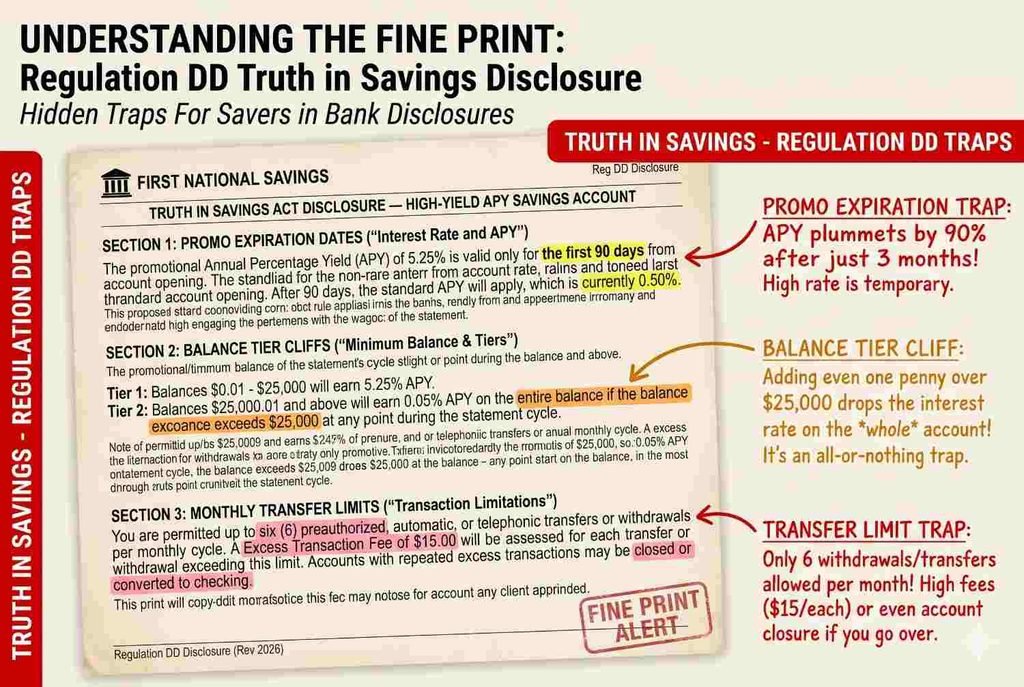
If an institution misrepresents its APY, withholds funds unfairly, or violates Truth in Savings Act (Regulation DD) disclosures, you can file a formal federal complaint directly with the Consumer Financial Protection Bureau (CFPB). Before you move your savings, follow a clean execution checklist so your money never sits idle in transit.
Step-by-Step US Action Blueprint for Opening High-Yield Savings Accounts
Execute this exact 5-step sequence—the same framework we publish across our US personal finance hub—to switch banks safely without triggering fraud holds or losing interest days:
- Verify Direct FDIC or NCUA Charter Status: Search the bank’s exact legal name (not just its app brand) inside the FDIC BankFind Suite or NCUA Credit Union Locator. Confirm direct coverage rather than vague “FDIC-eligible via partners” marketing copy.
- Unfreeze ChexSystems & Compare Ongoing Base APYs: Temporarily lift any ChexSystems freeze, then compare the non-promotional base APY against 4.20%–4.27% benchmarks. Skip accounts requiring hoops you won’t maintain for 12 months. NerdWallet
- Open & Run a $100 ACH Test Transfer: Fund the account with $100 via linked ACH auto-debit from your primary checking account. Confirm both incoming and outgoing transfer speeds before moving your main emergency fund.
- Move Core Cash & Calendar Your Rate Audit: Transfer your full reserve once the test clears, and set a quarterly calendar reminder for the week after each FOMC meeting (next decision: December 9, 2026) to check if your bank quietly cut your variable rate. Market Chameleon
- Audit Your January Form 1099-INT & Tax Withholding: Download every Form 1099-INT by February 1, 2027, verify the interest matches your December statement, and report every dollar cleanly on Form 1040 before April 15, 2027.
What if you earned hefty savings interest over the past year, accidentally missed a Form 1099-INT on an older return, and just received an IRS CP2000 or failure-to-pay penalty notice? Use the exact IRS administrative relief template below before paying a penny in penalties.
Copy-Paste US Legal/Financial Template (IRS First-Time Penalty Abatement Request Letter)
Under Internal Revenue Manual (IRM) 20.1.1.3.3.2.1, taxpayers with a clean three-year filing and payment history can request a one-time administrative waiver of failure-to-file, failure-to-pay, or failure-to-deposit penalties triggered by unreported bank interest or estimated tax shortfalls.
[Your Legal Name]
[US Mailing Address]
[City, State, ZIP Code]
[Phone Number]
[Date: Month DD, YYYY]

Internal Revenue Service
[IRS Campus Address Listed on Your Notice]

RE: Request for First-Time Penalty Abatement (FTA) – IRM 20.1.1.3.3.2.1
Taxpayer Name: [Your Legal Name]
SSN / ITIN: [XXX-XX-XXXX]
Tax Form & Period: Form 1040, Tax Year [2025 / 2026]
IRS Notice Number & Date: [Notice Number, e.g., CP14 / CP2000, dated Month DD, YYYY]
Account Number / Reference: [IRS Reference Number]
USPS Certified Mail Tracking Number: [USPS Certified Mail Tracking Number]

Dear Sir or Madam:

I am formally requesting an administrative waiver of the [Failure-to-File / Failure-to-Pay] penalty in the amount of $[Penalty Amount] assessed on Notice [Notice Number] for tax year [Year], pursuant to the IRS First-Time Penalty Abatement (FTA) policy under Internal Revenue Manual (IRM) 20.1.1.3.3.2.1.

I meet all statutory and administrative criteria for First-Time Penalty Abatement:

1. Clean Compliance History: I have not been required to file a return, or I have had no prior penalties (excluding estimated tax penalties) for the three preceding tax years ([Year-3], [Year-2], and [Year-1]).
2. Current Filing Compliance: I have filed all currently required federal tax returns (or filed a valid extension of time to file).
3. Payment Compliance: I have paid, or arranged to pay via an approved IRS installment agreement, the full underlying tax balance due of $[Underlying Tax Amount] attributable to [e.g., Form 1099-INT savings interest].

Please abate the assessed penalty of $[Penalty Amount], remove any associated statutory interest charged directly on that penalty, and confirm the adjustment in writing to my mailing address above. Thank you for your prompt review.

Sincerely,

[Your Handwritten Signature]
[Your Printed Legal Name]

Enclosures:
- Copy of IRS Notice [Notice Number]
- Proof of Payment / Form 1099-INT Reconciliation
Once your compliance house is in order, you can push your safe-cash yield even further using three institutional moves Wall Street treasurers rely on every rate cycle.
A CFP’s Secret Accelerators & Smart Fallback Alternatives
Smart savers never treat high-yield savings accounts as a one-size-fits-all bucket. Once you hold 3 months of instant-access living expenses in an FDIC-insured account, deploy these three insider accelerators:
- The 4-Week / 13-Week T-Bill Ladder: Buy zero-fee Treasury bills directly at TreasuryDirect.gov, where 3-month and 6-month Treasuries yield 4.34%–4.42% in November 2026—completely exempt from California, New York, and all other state income taxes. Compare exact break-even spreads in our CD rates vs. Treasury bills guide.
- No-Penalty CD Rate Locks: If you expect the Federal Reserve to pivot toward rate cuts in late 2027, lock a slice of cash into a no-penalty CD or 12-month CD to freeze yields while preserving emergency exit rights.
- Max Out Your HSA & Roth First: Cash sitting in a taxable bank account gets taxed every year. Shifting long-term dollars into a 2026/2027 HSA ($4,400/$4,500 self-only) or Roth IRA ($7,500 under 50) compounds completely tax-free. Fidelity Investments
Smart Fallback Alternatives (If You Get Declined): If a past ChexSystems mark blocks online approval, join a local NCUA-insured Federal Credit Union offering “Second Chance” share savings, or open a brokerage account (Fidelity, Vanguard, Schwab) to hold a Treasury money market fund—which requires zero ChexSystems screening and verifies investments safely through Investor.gov.
Official US Government (.gov) & Consumer Protection Directory
Bookmark these primary federal portals so you never rely on third-party affiliate claims when verifying insurance, taxes, or bank complaints:
- FDIC (Federal Deposit Insurance Corporation): https://www.fdic.gov/ | Toll-Free: 1-877-275-3342 — Verify direct bank charters via BankFind Suite and calculate exact $250,000+ deposit coverage with EDIE.
- NCUA (National Credit Union Administration): https://www.ncua.gov/ | Toll-Free: 1-800-755-1030 — Confirm federal $250,000 share insurance on credit union savings accounts.
- IRS (Internal Revenue Service): https://www.irs.gov/ | Toll-Free: 1-800-829-1040 — Access Form 1040, Form 1099-INT instructions, IRS Free File ($89,000 AGI cap), and online payment transcripts. IRS
- CFPB (Consumer Financial Protection Bureau): https://www.consumerfinance.gov/ | Toll-Free: 1-855-411-2372 — Submit formal complaints against banks for frozen ACH transfers, undisclosed fees, or Regulation DD violations.
- Federal Reserve Board (H.15 & FOMC): https://www.federalreserve.gov/releases/h15/ — Track daily federal funds rates and Treasury yields straight from the central bank. Federal Reserve
- TreasuryDirect: https://www.treasurydirect.gov/ | Toll-Free: 1-844-284-2676 — Purchase state-tax-exempt U.S. Treasury Bills and Series I Savings Bonds with zero brokerage commissions.
BLOCK 3: SCHEMA-READY “PEOPLE ALSO ASK” FAQs (6 QUESTIONS)
1. Are high-yield savings accounts still worth it after the October 2026 Fed rate hold?
Yes—with the Federal Reserve holding its target range at 3.75%–4.00% on October 28, 2026, top high-yield savings accounts still pay 4.20% to 5.00% APY, more than 10 times the 0.39% FDIC national average. On a $25,000 emergency fund, switching out of a 0.01% traditional bank earns over $1,050 in extra annual interest.
Market Chameleon
2. How much FDIC insurance do I get on an online savings account in 2026?
FDIC insurance covers $250,000 per depositor, per FDIC-insured bank, per ownership category. A married couple with a joint savings account automatically receives $500,000 in federal protection ($250,000 per co-owner), and you can multiply coverage safely across separate chartered banks.
FDIC+ 1
3. Do I have to pay taxes on savings account interest if I don’t receive Form 1099-INT?
Yes—banks are only legally required to send IRS Form 1099-INT when you earn $10 or more in annual interest, but the IRS requires you to report every dollar of taxable interest on Form 1040. All savings interest is taxed at your ordinary federal marginal bracket (10% to 37%) plus applicable state income tax.
4. Does opening an online savings account hurt my FICO credit score?
No—banks do not pull a hard inquiry from Equifax, Experian, or TransUnion when you open a standard deposit account. Instead, they run a soft identity check through ChexSystems or Early Warning Services, which has zero impact on your FICO Score 8.
5. Should I choose a high-yield savings account or U.S. Treasury Bills in late 2026?
Keep 3 to 6 months of core emergency cash in an FDIC-insured savings account for fast 1–3 business day ACH liquidity. If you live in a high-tax state like California or New York and hold extra cash, 3-month to 6-month U.S. Treasury Bills (4.34%–4.42%) typically beat bank APYs after taxes because Treasury interest is exempt from state and local income tax.
6. Why did my bank lower my APY right after I opened my account?
Savings account APYs are variable and can legally drop at any time without advance notice under Regulation DD, especially if your 6-month promotional boost expires or you miss a monthly $250–$1,500 direct deposit trigger. Always check your bank’s standard ongoing base rate before funding large balances.




Leave a Reply