

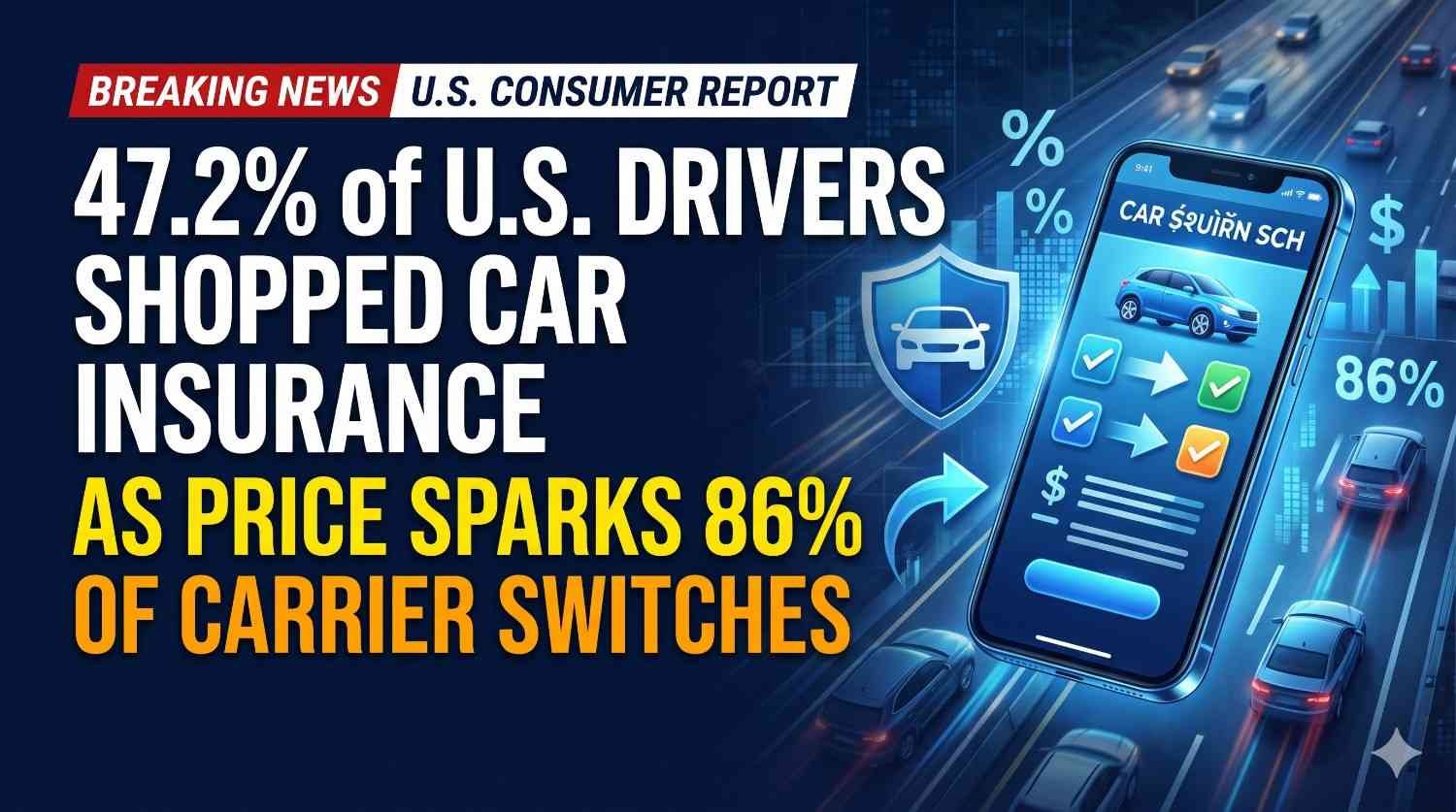
ATLANTA — U.S. auto insurance shopping rates remained pinned near historic highs in November 2026, with 47.2% of active personal auto policies shopped at least once over the prior 12 months. Newly released Q3 2026 tracking from LexisNexis Risk Solutions shows quarterly shopping rose 0.7% year-over-year while new business grew 3.2%.
The data arrived on November 12, 2026, at 8:30 a.m. EST alongside a fresh Bureau of Labor Statistics inflation report showing motor vehicle insurance climbed 0.7% in October. Together, the releases confirm that lingering affordability stress has turned comparison shopping into a permanent habit for American households.
Key Takeaways (Fast Facts):
- Who: Millions of U.S. motorists, led by price-sensitive first-year policyholders.
- What: 47.2% of in-force auto policies were shopped in the past year.
- When: Q3 2026 data released November 12, 2026.
- Where: Nationwide across all 50 states and Washington, D.C..
- Why: 86% of switching drivers cite high premiums as their main trigger.
- Key Metric: First-year customers now account for 40% of all lost policies.
Auto Insurance Shopping Rates: What Triggered the Official Shift
According to the LexisNexis U.S. Insurance Demand Meter, 47.2% of U.S. auto policies in force were shopped during the 12 months ending September 30, 2026. That figure matched Q2 2026 and sat just 0.1 percentage point beneath the all-time peak of 47.3% recorded in Q1.
LexisNexis tracks roughly 90% of U.S. consumer insurance shopping transactions and kept both shopping volume and new-policy growth in its “Warm” tier for a third straight quarter. Non-standard auto shopping surged 5.4% in Q3 after contracting 9% in Q2, signaling renewed pressure on higher-risk drivers.
Price remains the dominant catalyst even as headline rate hikes cool from the 17% national surge recorded in 2024. Separate October 2026 consumer polling by LexisNexis found that 86% of switchers left for lower premiums, while 72% of active shoppers remain open to changing carriers.
Caption: Federal inflation filings and Q3 2026 industry tracking documents highlight sustained consumer policy churn across U.S. personal auto insurance markets.
Policyholder loyalty has eroded across multi-line households that insurers once considered insulated from turnover. Roughly one-third of bundled customers switched providers over the past year, matching non-bundled switchers, while 40% of bundled shoppers said they were willing to split their home and auto policies.
Federal Regulations and Auto Insurance Shopping Rates Precedents
Under the McCarran-Ferguson Act (15 U.S.C. §§ 1011–1015), state insurance commissioners hold primary authority over rate filings, policy cancellations, and solvency rules. Through the National Association of Insurance Commissioners (NAIC), state regulators are also piloting artificial intelligence auditing frameworks in 2026 to scrutinize algorithmic pricing models.
At the federal level, Title V of the Dodd-Frank Act empowers the U.S. Department of the Treasury’s Federal Insurance Office (FIO) to monitor nationwide auto market affordability. Meanwhile, the October 2026 Bureau of Labor Statistics CPI release confirmed that motor vehicle insurance ticked up 0.7% monthly, leaving cumulative costs 47.7% above pre-inflation levels.
Federal consumer law also shapes how insurers price quotes during heightened auto insurance shopping rates. Under the Fair Credit Reporting Act (FCRA) (15 U.S.C. §§ 1681–1681x), enforced by the Federal Trade Commission (FTC) and Consumer Financial Protection Bureau (CFPB), carriers using credit-based insurance scores must issue formal adverse action notices whenever credit data triggers a higher quote.
Data Breakdown & Comparative Matrix (2025 vs. 2026 Standards)
| Key U.S. Auto Insurance Metric | 2025 / Prior Benchmark | November 2026 Verified Standard | Direction & Consumer Impact |
| 12-Month Policy Shop Rate | Record-building surge (pre-47.3% Q1 peak) | 47.2% of in-force policies (Q3 2026) | Near all-time high; persistent churn |
| Annual Full-Coverage Average | Double-digit 2024–2025 rate spikes | $2,637/year ($682 minimum coverage) | Stabilizing near 1%–3% growth |
| BLS Motor Vehicle Insurance CPI | +11.3% YoY entering 2025 | +0.7% MoM (Oct. 2026); -5.0% YoY to Sept. | Monthly uptick despite YoY cooling |
| First-Year Policy Churn Share | Elevated post-pandemic turnover | 40% of all lost policies; over 50% of exits | Steepest retention drop in Year 1 |
| Non-Standard Shopping Growth | -9.0% contraction (Q2 2026) | +5.4% growth (Q3 2026) | Sharp rebound among high-risk drivers |
| States With Positive Shop Growth | 42 states (Q2 2026) | 28 states (Q3 2026) | Growth narrowing, volume stays high |
The comparative matrix reveals a widening gap between moderating headline inflation and lingering household bill shock. Even though auto insurance shopping rates have slowed in year-over-year percentage growth, nearly half of America’s insured drivers still actively tested the market over the past 12 months.
Insurers face an unprecedented retention trap among newly acquired customers. Over any 60-day stretch, half of lost policies move directly to a competing carrier, and 96% of drivers who switched in the past year say they will switch again if renewal prices rise.
Real-World Impact: What This Means for American Households
To measure how elevated auto insurance shopping rates translate into real household cash flow, consider a two-driver suburban family insuring two sedans under standard full coverage. At the November 2026 national full-coverage benchmark of $2,637 per vehicle, this household faces a baseline annual renewal of $5,274.00, or $439.50 per month.
Rather than accepting automatic renewal, the household collects four apples-to-apples quotes with identical 100/300/100 liability limits. Switching to a rival underwriter quoting 15% below their incumbent cuts $791.10 immediately, lowering the annual bill to $4,482.90.
Next, the couple raises collision and comprehensive deductibles from $500 to $1,000—a move the Insurance Information Institute notes can trim those physical-damage portions by over 40%—saving another $310.00 annually across both cars. Paying semi-annually via ACH rails removes $72.00 in monthly installment fees, cutting total annual costs to $4,100.90 for a verified net savings of $1,173.10 per year ($97.76 per month).
Caption: Comparing multi-carrier quotes and adjusting deductibles can trim over $1,100 annually from a two-vehicle U.S. household budget in late 2026.
Regional and Demographic Breakdown Across the States
Geographic price disparities remain stark across U.S. jurisdictions in late 2026. New York leads the nation in full-coverage costs at $4,031 annually, followed closely by Nevada above $4,000, Louisiana near $3,950, and Florida between $3,100 and $3,800 due to dense traffic, storm losses, and litigation.
By contrast, drivers in Idaho ($1,443 to $1,473), Vermont ($1,491 to $1,506), and Maine ($1,631 to $1,651) enjoy the lowest annual full-coverage averages nationwide. More than half of U.S. states are projected to register modest rate reductions in 2026, led by Iowa (-6.19%), Minnesota (-5.29%), and Arkansas (-4.70%).
Young families and households adding teenage motorists absorb the heaviest strain, with July 2026 six-month policies containing a teen driver averaging $3,078 nationwide. With 27% of drivers unable to afford their current deductible and 56% factoring premiums into car-buying decisions, consumers tracking household policy shifts and income opportunities on SarkariResultine.com can pair budget planning with regular coverage audits.
Step-by-Step Actionable Checklist: How to Prepare Before the Deadline
- Audit your renewal notice 30 to 45 days early. Pull your current declarations page before automatic billing triggers, verifying liability limits, uninsured motorist coverage, and current deductibles so every competing quote matches identically.
- Pull free weekly credit and CLUE claims reports. Request your Equifax, Experian, and TransUnion files through the CFPB-authorized AnnualCreditReport.com guidance portal and dispute reporting errors that inflate credit-based insurance scores in the states permitting credit rating.
- Request three to five competing quotes across channels. Compare direct digital underwriters, captive exclusive agents—which saw 4.5% Q3 shopping growth—and independent brokers to capture divergent 2026 state rate filings.
- Test unbundling and usage-based telematics discounts. Ask for standalone auto quotes alongside bundled estimates, since 40% of bundled shoppers are exploring separation, and check pay-per-mile programs if you drive under 500 miles monthly.
- Eliminate gap risk before canceling your old policy. Confirm written bind confirmation and an effective date on the new policy first so you never trigger a coverage lapse penalty, and keep $1,000 liquid before raising deductibles.
Critical Timeline, Enforcement Dates & What Happens Next
Heightened auto insurance shopping rates typically cool during November and December as holiday spending crowds out financial errands. LexisNexis analysts caution that persistent household affordability strain and automated AI agentic comparison tools could break that seasonal pattern through year-end.
- Q1 2026 (January–March): Annual U.S. auto policy shopping hits an all-time record of 47.3% of policies in force.
- Q2 2026 (April–June): Shopping holds at 47.2% across 42 states posting positive growth, while non-standard shopping temporarily dips 9%.
- October 22, 2026: LexisNexis Consumer Study confirms 86% of switchers cite price and 56% factor insurance into vehicle purchases.
- November 12, 2026: BLS releases October CPI (+0.7% monthly auto insurance uptick) and LexisNexis publishes Q3 Demand Meter (47.2% shop rate).
- December 2026 – Q1 2027: Semi-annual winter policy renewals hit millions of households alongside ongoing NAIC state-level AI pricing reviews.
Carriers entering 2027 face a narrow margin for error as state regulators scrutinize algorithmic underwriting and rate-adequacy filings. Drivers who re-shop ahead of winter renewal cycles stand to capture targeted state rate cuts before underwriting standards tighten again.
Official Primary Sources & Verification Links
- Bureau of Labor Statistics — Consumer Price Index Summary (October 2026)
- LexisNexis Risk Solutions — Q3 2026 U.S. Insurance Demand Meter Release
- Federal Trade Commission — Fair Credit Reporting Act (15 U.S.C. §§ 1681–1681x)
- Consumer Financial Protection Bureau — Free Credit Reports & Adverse Action Rights
- U.S. Department of the Treasury — Federal Insurance Office Personal Auto Report
- National Association of Insurance Commissioners — Consumer’s Guide to Auto Insurance
Frequently Asked Questions (People Also Ask)
Why are auto insurance shopping rates so high in November 2026?
Elevated auto insurance shopping rates reflect cumulative rate inflation that left premiums 47.7% above pre-surge baselines despite slower 2026 hikes. With 86% of switchers citing price, nearly half of U.S. drivers now treat semi-annual comparison shopping as a routine budget defense.
Does shopping for car insurance quotes hurt my FICO credit score?
No, requesting auto insurance quotes triggers a soft credit inquiry that does not affect your FICO Score 8 or FICO Score 9. Under federal FCRA rules, you can also request a free credit report within 60 days if an insurer issues an adverse action notice.
Is bundling home and auto insurance still cheaper in 2026?
Bundling still unlocks multi-policy discounts of 10% to 30% at major carriers, but steep standalone rate gaps can erase those savings. LexisNexis found that roughly one-third of bundled shoppers switched insurers in 2026 after discovering cheaper unbundled combinations.
Which states have the highest and lowest car insurance rates in 2026?
New York ($4,031), Nevada ($4,000+), Louisiana ($3,950), and Florida ($3,100–$3,800+) carry the steepest annual full-coverage averages in 2026. Idaho ($1,443–$1,473), Vermont ($1,491–$1,506), and Maine ($1,631–$1,651) offer the lowest statewide full-coverage premiums.
Can I switch car insurance carriers in the middle of my policy term?
Yes, you can switch insurers at any time without waiting for renewal, and your prior carrier must refund unused prepaid premiums on a pro-rata or short-rate basis per state rules. Always activate your new coverage first to prevent an uninsured lapse on your driving record.





Leave a Reply