

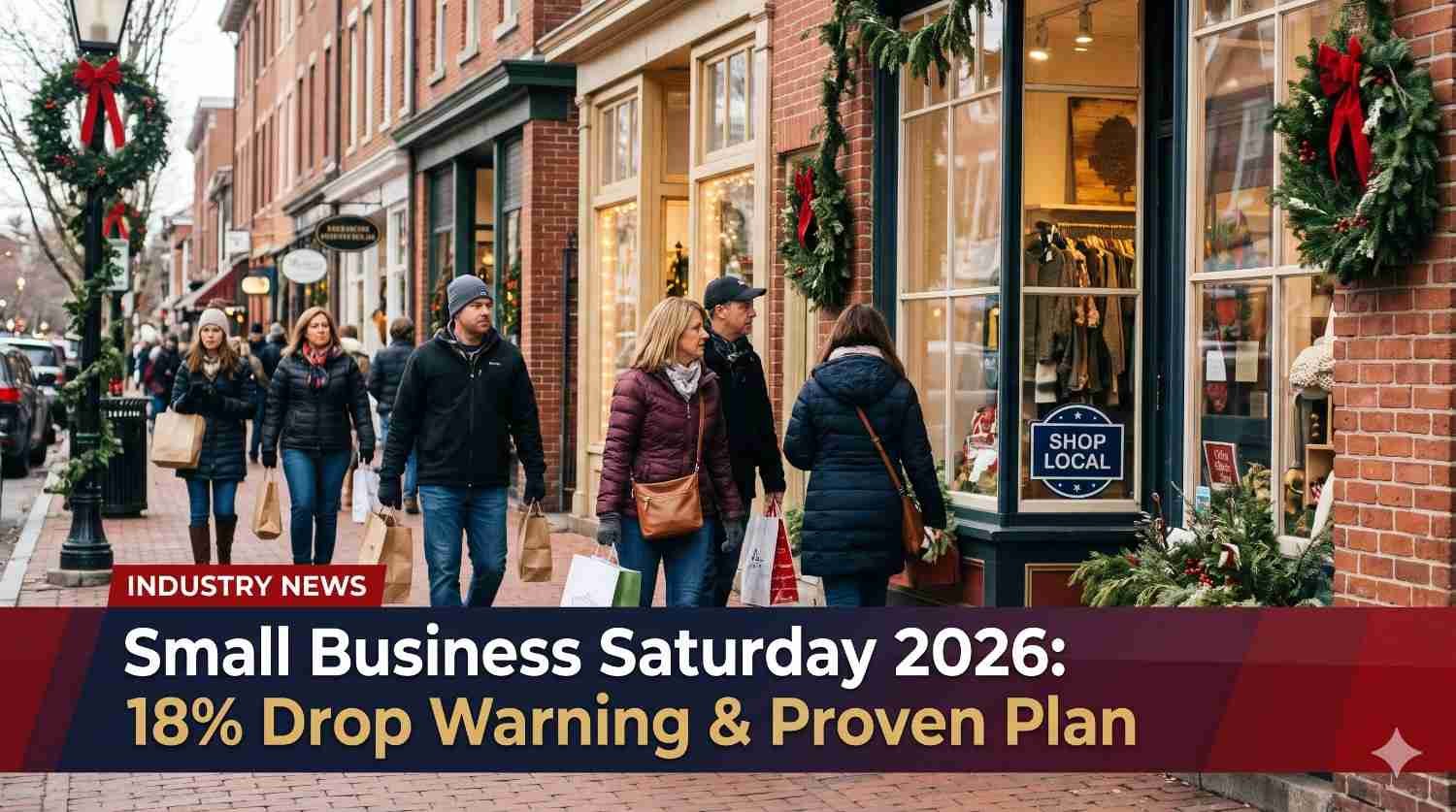
WASHINGTON — Main Street merchants opening their doors for Small Business Saturday 2026 face a harsh financial reality that glossy holiday press releases quietly gloss over. Estimated event spending plunged roughly 18% in 2025—sliding from $22 billion in 2024 down to $18 billion—even as big-box chains pulled holiday deals weeks earlier.
With American Express’s once-universal cardholder statement credit long gone, local owners can no longer count on subsidized foot traffic to rescue thin Q4 margins. Worse, retailers who slash prices by 30% while carrying underinsured holiday stock risk losing $10,000 to $25,000 in avoidable coinsurance penalties, payroll audit bills, and missed federal tax write-offs before December 31.
Key Policy & Compliance Takeaways (At a Glance)
- Who Is Impacted: Over 36.2 million US independent businesses, brick-and-mortar shops, restaurants, and online merchants.
- Official Benchmark: Event spending dropped from $22 billion (2024) to $18 billion (2025), while 2026 holiday sales are forecast at $1.013 trillion.
- Effective Dates: Event runs Saturday, November 28, 2026; IRS Section 179 deadline is December 31, 2026 (11:59 PM EST).
- Governing Agencies: SBA, IRS, NAIC, State Departments of Insurance, DOL, and FTC.
- Estimated Dollar Impact: $12,000+ in preventable insurance claim cuts and $3,600+ in immediate tax savings.
- Immediate Action: Audit BOP peak-season limits, replace deep discounts with gift-card bundles, and lock in 2026 IRS deductions.
Small Business Saturday 2026: Official Rules, Regulatory Shifts, and What Sparked Them
American Express launched Small Business Saturday in 2010 to boost card usage after the financial crisis, and the U.S. Small Business Administration (SBA) joined as an official co-sponsor in 2011 alongside a US Senate resolution. Early foot traffic surged because American Express paid cardholders a $25 statement credit to shop locally.
That direct subsidy did the heavy lifting. American Express trimmed the universal credit to $10 in 2013 and eliminated it across the board by 2015, replacing it with sparse, targeted card offers. Without a built-in rebate, the annual headline figures—based on consumer self-reported polls rather than verified point-of-sale receipts—softened sharply from $22 billion in 2024 to $18 billion in 2025.
Underwriter’s Reality Check: Surveyed intent does not pay commercial rent. While 88% of Americans say they plan to shop small this holiday season—the highest reading since 2012—60% already started buying before early November, siphoning impulse spending away from a single Saturday.
Still, the broader pool of holiday cash is expanding. The National Retail Federation projects November–December 2026 US retail sales will climb 4.2% to a record $1.013 trillion, with 182.7 million shoppers active across Thanksgiving weekend. Meanwhile, Shopify merchants alone processed $14.6 billion during the 2025 Black Friday–Cyber Monday stretch, proving independent brands can still win when they stop mimicking Walmart discounts.
Independent retail owners across the United States face tighter commercial underwriting scrutiny and major 2026 federal tax rule updates heading into the peak holiday weekend.
Federal Mandates, State Insurance Laws, and Small Business Saturday 2026 Standards
Behind the holiday promotions sits a major overhaul of federal tax, lending, and labor rules that directly govern Q4 cash flow. Under Public Law 119-21—enacted on July 4, 2025—Congress made the 20% Section 199A Qualified Business Income (QBI) deduction permanent for sole proprietorships, partnerships, and S-corporations.
For tax year 2026, the Internal Revenue Service (IRS) raised the Section 179 equipment expensing cap to $2,560,000, with phase-outs starting at $4,090,000 and 100% bonus depreciation available on qualifying property. IRS Publication 1099 also confirms two huge compliance shifts for 2026: third-party payment platforms report Form 1099-K only when gross payments exceed $20,000 and 200 transactions, while the general reporting floor for vendor payments (such as Form 1099-NEC) jumped from $600 to $2,000.
Federal lending and state insurance rules carry equal weight this weekend:
- SBA Capital Caps: Eligible US merchants can access SBA 7(a) loans up to $5 million, SBA 504 debenture financing up to $5.5 million for manufacturing or energy projects, and SBA Microloans up to $50,000 (averaging $15,399 in FY 2026) for holiday inventory and working capital.
- State Insurance Oversight: Under the McCarran-Ferguson Act, commercial Business Owner’s Policies (BOP) and Workers’ Compensation rates remain regulated by state agencies—including the California CDI, Florida OIR, Texas TDI, and New York DFS—rather than Washington.
- Federal Labor & Consumer Rules: Seasonal holiday staff remain strictly subject to Fair Labor Standards Act (FLSA) overtime standards enforced by the U.S. Department of Labor (DOL), while holiday gift-card expiration and fee disclosures fall under Federal Trade Commission (FTC) and state consumer statutes.
Knowing those statutory limits is step one. Seeing how 2025 and 2026 costs, tax thresholds, and coverage gaps stack up side by side reveals exactly where unprepared retailers bleed profit.
2025 vs. 2026 Cost, Coverage & Compliance Matrix (Side-by-Side Breakdown)
Commercial carriers and federal tax laws shifted meaningfully between last holiday season and today. Review every threshold below before launching weekend promotions or signing year-end vendor invoices.
| Category / Regulatory Metric | 2025 Benchmark | 2026 Official Standard | Financial Impact on Local Owners |
| Small Business Saturday Spend | $18B estimated (down ~18% from $22B in 2024) | $118B projected full-season small-shop spend | Single-day reliance fails; full-season retention wins |
| US Holiday Retail Forecast | 186.9M Thanksgiving weekend shoppers | $1.013T total (+4.2%); 182.7M weekend shoppers | Higher total dollars chasing value and experience |
| IRS Section 179 Expensing | Lower prior-year inflation cap | $2,560,000 max ($4,090,000 phase-out) + 100% bonus | Immediate write-off on POS, displays, and fixtures |
| Section 199A QBI Deduction | Scheduled to sunset Dec 31, 2025 | Permanent 20% deduction ($400 active min.) | Locks in lower effective rate for Schedule C & 1120-S |
| Form 1099-K / 1099-NEC Floor | $600 vendor reporting threshold | 1099-K: $20,000 + 200 txns; Vendor 1099: $2,000 | Cuts small-vendor paperwork; tax liability unchanged |
| SBA Working Capital Limits | $5M 7(a) / $50K Microloan cap | $5M 7(a) / $50K Microloan (8%–13% typical APR) | Cheaper than 35%+ merchant cash advances |
| Holiday BPP Insurance Limit | Flat annual limit (coinsurance trap) | ISO CP 12 30 Peak Season (+25% seasonal boost) | Eliminates catastrophic holiday coinsurance cuts |
| Promotional Margin Strategy | Reactive 25%–30% Black Friday price cuts | Gift-card bonuses & curated gift-with-purchase | Protects gross margins and drives January return visits |
Two numbers in this matrix catch veteran underwriters off guard every November. First, Adobe forecasts Cyber Week discounts peaking near 30% off across major chains. When a local retailer operating on a 50% keystone margin matches that 30% discount, gross profit per sale collapses by more than half before credit card interchange fees even clear.
Second, 70% of US small-business owners report that holiday sales directly dictate their 2027 growth plans, yet most still insure their store shelves using a static year-round Business Personal Property (BPP) limit. Carrying 40% extra holiday merchandise for Small Business Saturday 2026 without triggering an endorsement turns a minor electrical fire or burst pipe into a five-figure coverage penalty.
Wait until you see the exact dollar math when two identical Main Street retailers hit the same weekend with opposite playbooks.
Real-World Dollar Math: Exact Claim, Premium, or Tax Scenarios for Americans
Consider two single-location US home-goods LLCs heading into Small Business Saturday 2026 with identical $40,000 weekend merchandise targets (50% cost of goods), $160,000 standard BPP coverage, an 80% coinsurance clause, and a $2,500 deductible. Both stock up to $250,000 in Replacement Cost Value (RCV) inventory for November and suffer a $60,000 sprinkler-pipe water loss in their back stockroom.
- Owner A (Unprepared Discount Playbook): Slashes storewide prices 30% to match big-box ads, generating $28,000 in gross revenue against $20,000 in inventory cost and $840 in card fees—leaving $7,160 in gross profit. Because Owner A never added a seasonal endorsement, the 80% coinsurance clause requires $200,000 in coverage ($250,000 × 80%). The carrier applies the coinsurance penalty formula—($160,000 carried ÷ $200,000 required) × $60,000 loss minus $2,500 deductible—paying just $45,500 and sticking Owner A with $14,500 out of pocket. Owner A delays buying new point-of-sale terminals until January, capturing $0 in 2026 Section 179 tax relief.
- Owner B (Protected Margin & Compliance Playbook): Holds retail prices firm and offers a $10 January bonus card with every $50 gift card sold (47% of holiday shoppers specifically want gift cards). Gross revenue hits $40,000, leaving $16,400 in gross profit after $20,000 inventory cost, $1,200 card fees, and $2,400 in estimated bonus-card redemption cost. Owner B previously added the ISO CP 12 30 Peak Season Endorsement (+25% BPP boost to $200,000 from October 1 through January 15) for $225 in extra premium. That clears the 80% coinsurance hurdle cleanly, yielding a $57,500 claim payout ($60,000 − $2,500 deductible). Owner B also installs $15,000 in POS hardware and display fixtures before December 31 and claims Section 179 on Form 4562, trimming 2026 federal tax by $3,600 at a 24% marginal bracket.
The Net Dollar Gap: Owner B finishes the season $24,615 ahead of Owner A—combining $9,240 in stronger weekend profit, $11,775 in net insurance claim savings ($12,000 coinsurance penalty avoided minus $225 endorsement premium), and $3,600 in immediate IRS tax savings.
Comparing holiday margin strategies, commercial property coinsurance penalties, and year-end IRS equipment deductions illustrates how administrative decisions outweigh raw foot traffic.
Hidden Exclusions, State-by-State Traps, and Overlooked Edge Cases
Even experienced retailers overlook policy jacket exclusions that wipe out holiday profits overnight:
- Actual Cash Value (ACV) Depreciation Holdbacks: Standard BOPs often pay ACV upfront and withhold Replacement Cost depreciation until damaged fixtures are physically replaced. If your lease lacks cash reserves, that temporary holdback can stall reopening during December’s peak weeks.
- Seasonal Payroll Audit Surprises: Workers’ Compensation premiums are estimated upfront and audited after policy expiration based on actual W-2 payroll and NCCI class codes. Hiring seasonal cashiers in high-enforcement states like California, New York, or Florida—or misclassifying weekend helpers as Form 1099-NEC contractors—triggers steep back-premium bills, state stop-work orders, and DOL back-overtime fines.
- Cyber Liability & POS Skimming Exclusions: Basic Commercial General Liability (CGL) policies strictly exclude data breaches, ransomware, and fraudulent e-commerce chargebacks. A single holiday POS breach exposes merchants to PCI-DSS fines and state breach-notification costs unless standalone Cyber Liability is attached.
- Commercial CLUE & Loss-Run Penalties: Filing two small, preventable slip-and-fall or minor water claims stays on your commercial loss-run history for 3 to 5 years, pushing renewal rates up 20% to 40% or forcing distressed property risks into expensive state residual markets and surplus-lines carriers.
- Online-Only & Solo LLC Edge Cases: E-commerce sellers running home-based fulfillment often violate homeowners policy business-property sublimits (frequently capped at $2,500 on-premises). Meanwhile, solo LLCs earning over $201,750 single ($403,500 joint) in Specified Service Trades face 2026 Section 199A QBI phase-outs across the newly widened $75,000/$150,000 range.
Merchants navigating shifting federal compliance deadlines, small-business policy changes, and regulatory notices alongside Small Business Saturday 2026 can monitor ongoing government updates and consumer alerts at SarkariResultine.com/us while verifying filings directly with state agencies.
Knowing where the financial landmines sit matters little without immediate execution. Here is the exact six-step playbook to run over the next 72 hours and through year-end.
Step-by-Step Protection & Compliance Playbook: Exact Actions to Take Now
Execute these six operational moves in order to lock in holiday margins and bulletproof your commercial risk profile:
- Activate Your Free Google “Small Business” Badge & Ditch Blanket Discounts: Independent US merchants with annual revenue under $10 million can enable the official “small business” attribute inside Google Business Profile and Google Merchant Center so local shoppers spot them immediately on Search and Maps. Replace storewide 30% markdowns with margin-protecting gift-card bonuses, free local pickup, or tiered gifts with purchase.
- Audit Your BOP Declarations Page for Coinsurance & Peak Season Coverage: Pull your commercial property declarations page today and check your BPP limit, coinsurance percentage (80%, 90%, or 100%), and whether ISO CP 12 30 (or your carrier’s automatic 25% seasonal increase clause) is active. If your current stock exceeds your limit, call your broker immediately to request a mid-term limit endorsement and verify Extra Expense / Business Income coverage.
- Document Inventory & Front-Entrance Safety Before Foot Traffic Peaks: Record a 3-minute timestamped smartphone video walking through every stockroom shelf, display case, and POS station, then store it in cloud backup to substantiate RCV claims instantly. Inspect entrance mats, icy sidewalks, and aisle clearance under Occupational Safety and Health Administration (OSHA) housekeeping standards to prevent slip-and-fall CGL claims.
- Place Qualifying Section 179 Upgrades “In Service” Before December 31: If you need POS hardware, commercial shelving, security cameras, or qualifying work vans over 6,000 lbs. GVWR, remember the strict IRS rule: equipment must be physically delivered and placed in service—not merely ordered—by December 31, 2026, to claim up to $2,560,000 on Form 4562.
- Reconcile Seasonal W-2 Payroll, Sales Tax, and Form 1099 Records: Classify every holiday floor associate on W-2 payroll rather than risking 1099 misclassification penalties, and log holiday hours accurately to satisfy FLSA overtime rules. Track vendor payments against the new $2,000 2026 Form 1099-NEC threshold, and remember that businesses filing 10 or more aggregated information returns must e-file under Treasury Decision 9972.
- Verify Carrier Stability & Escalate Unfair Claim Delays Properly: Before your next commercial renewal, look up your insurer’s complaint index and licensing status through the National Association of Insurance Commissioners (NAIC) Consumer Information Source, and confirm your carrier participates in your State Guaranty Association. If an insurer wrongfully underpays a holiday loss, file a formal written complaint with your State Department of Insurance consumer portal rather than accepting an unverified ACV offer.
Timing these moves around upcoming federal and commercial underwriting calendars is what separates profitable Q1 retailers from cash-strapped borrowers during Small Business Saturday 2026 and beyond.
Critical 2026–2027 Renewal Windows, Filing Deadlines, and What Happens Next
Mark these hard federal tax, lending, and insurance dates on your calendar (all federal electronic deadlines follow Eastern Standard Time unless noted):
- Saturday, November 28, 2026 (Small Business Saturday 2026): Peak local retail window; send morning customer emails timed to your local time zone (EST, CST, or PST) and promote gift cards for January foot traffic.
- Monday, November 30, 2026 (Cyber Monday): Extend bundled local-pickup offers online to capture residual Thanksgiving-weekend traffic without matching national 30% markdowns.
- Thursday, December 31, 2026 (11:59 PM EST): Hard IRS cutoff to place Section 179 equipment and qualifying Qualified Improvement Property in service for tax year 2026, and to finalize S-Corp reasonable compensation payroll.
- Monday, February 1, 2027: Statutory deadline (shifted from Sunday, January 31) to furnish employee W-2 statements and file Form 1099-NEC for 2026 non-employee vendor payments of $2,000 or more.
- Monday, March 15, 2027: Filing deadline for calendar-year S-Corporations (Form 1120-S) and Partnerships (Form 1065), plus the deadline to file Form 2553 for a 2027 S-Corp tax election.
- Thursday, April 15, 2027: Filing deadline for Sole Proprietors and single-member LLCs (Schedule C), Form 4562 depreciation elections, and Q1 2027 federal estimated tax payments.
- 60 Days Prior to Your 2027 BOP Renewal: Request official 5-year loss runs from your current carrier and bid ISO CP 12 30 peak-season limits for next autumn so underwriting never catches you short again.
Before acting on any tax election, loan application, or coverage dispute, bookmark the primary federal and state regulatory portals below to verify every form directly.
Official Government Regulators & Primary Verification Links
Use these official .gov and primary US regulatory directories to confirm 2026–2027 program terms, tax forms, and carrier records directly during Small Business Saturday 2026 and the upcoming filing season:
- U.S. Small Business Administration (SBA) — Official Small Business Saturday marketing resources, SBA 7(a), 504, and Microloan intermediary directories.
- Internal Revenue Service (IRS) — Official 2026 Publication 1099, Form 4562 (Section 179), Section 199A QBI guidance, and Small Business Tax Center.
- National Association of Insurance Commissioners (NAIC) — State Department of Insurance directory, insurer complaint ratios, and commercial insurance consumer guides.
- U.S. Department of Labor (DOL) — FLSA seasonal overtime rules and independent contractor classification standards.
- Federal Trade Commission (FTC) — Holiday advertising compliance, gift-card disclosure rules, and small business cybersecurity guidance.
- Occupational Safety and Health Administration (OSHA) — Retail holiday crowd-management, storage, and workplace injury prevention standards.
Frequently Asked Questions (People Also Ask)
Why did Small Business Saturday spending drop 18% from $22 billion to $18 billion?
American Express survey estimates fell from $22 billion in 2024 to roughly $18 billion in 2025 because universal cardholder statement credits ended years ago, inflation squeezed household budgets, and major retailers pulled Black Friday deals into early November. Those totals also reflect consumer polling rather than verified merchant register receipts.
Does American Express still offer a Small Business Saturday statement credit in 2026?
No universal cardholder statement credit exists for Small Business Saturday 2026. American Express reduced its original $25 Small Business Saturday credit to $10 in 2013 and retired the blanket offer by 2015, leaving only occasional targeted Amex Offers that vary by individual cardmember account.
Are business insurance premiums and holiday inventory losses tax-deductible?
Yes. Under IRS rules, ordinary and necessary commercial premiums—including BOP, General Liability, Workers’ Compensation, and Cyber Liability—are generally 100% deductible business expenses on Schedule C or Form 1120-S. Unreimbursed inventory losses from fire or theft are typically captured through Cost of Goods Sold or casualty loss provisions, though insurance payouts cannot be double-counted.
What happens if my retail store has a holiday fire without a Peak Season Endorsement?
If your commercial property policy includes an 80% or 90% coinsurance clause and surging holiday stock pushes your total inventory above insured limits, the carrier will reduce your claim payout proportionally—even on a partial loss. Adding ISO CP 12 30 boosts Business Personal Property limits automatically during designated peak months.
Do small retailers have to report holiday sales under the 2026 IRS Form 1099-K rules?
Yes, all business income remains taxable regardless of whether you receive a tax form. However, under IRS 2026 Publication 1099 rules, third-party payment networks such as PayPal, Stripe, or Venmo only issue Form 1099-K when a merchant surpasses both $20,000 in gross payments and 200 transactions in a calendar year.
Editorial Disclosure: Commercial insurance rates, state Department of Insurance regulations, SBA underwriting criteria, and federal or state tax obligations vary by jurisdiction and individual business profile; this report is provided strictly for informational and educational purposes and does not constitute licensed legal, CPA tax, or insurance advice.







Leave a Reply