

Federal law enforcement and financial regulators issued an urgent coordinated holiday shopping scam alert ahead of Black Friday and Cyber Monday as criminal syndicates flood American phones and browsers with artificial-intelligence-built storefronts and spoofed shipping texts. Warnings released this week by the FBI Boston Division, the U.S. Secret Service, the U.S. Treasury Department, and New York Attorney General Letitia James flag an unprecedented surge in automated fraud engineered to drain checking accounts before shoppers realize a deal was fabricated.
The stakes have reached historic levels as the National Retail Federation projects U.S. holiday retail spending to top $1.013 trillion in 2026. According to the FBI Internet Crime Complaint Center (IC3) 2025 Annual Report, non-payment and non-delivery fraud already stripped $503.37 million from American consumers nationwide last year, including $7.35 million across 880 cases in Massachusetts alone. Because generative AI eliminates broken grammar and pixelated logos, even cautious digital natives are surrendering credit card numbers, login credentials, and instant-transfer funds within seconds.
Official Threat & Safety Snapshot (At a Glance)
- Threat Type & Targets: AI-cloned retail storefronts, spoofed USPS/FedEx/UPS smishing texts, gift card extortion, and compromised AI shopping assistants targeting U.S. Black Friday and Cyber Monday buyers.
- Issuing Agencies: FBI Boston Division, U.S. Secret Service, U.S. Treasury Department, CISA, and New York Attorney General.
- Primary Red Flag: Deep discounts on sold-out brands via newly registered lookalike domains or unsolicited package-hold texts demanding a small redelivery fee.
- Documented Losses: $503.37 million nationwide in non-delivery fraud and $282.67 million in credit card and check fraud reported to FBI IC3.
- Federal Refund Shield: Credit cards cap liability at $50 under FCBA; debit transfers follow strict Regulation E windows, while gift cards and peer-to-peer scams carry near-zero recovery.
- Immediate Action: Call your bank’s back-of-card fraud desk immediately, freeze credit files, forward scam texts to
7726, and file reports atIC3.govandReportFraud.ftc.gov.
Holiday Shopping Scam Alert: How the AI Retail Trap Works and Why Agencies Are Sounding the Alarm
This year’s holiday shopping scam alert marks a structural shift in organized cybercrime. In its two-page seasonal advisory released November 25, 2026, the U.S. Treasury Department warned that artificial intelligence enables fraud rings to run traditional retail and impersonation schemes at unprecedented speed and scale.
One operator can now spin up a complete storefront, hundreds of stolen product photos, fabricated five-star reviews, and live countdown banners in a single afternoon. Research from Scamwise’s 2026 Holiday Shopping Scam Report revealed that 74% of fraudulent retail websites rely on AI-generated content, with victims reporting a brand-new fake shop roughly every three minutes.
Check Point Research logged more than 4,000 newly registered holiday-themed domains by early November 2026, flagging nearly one in five as high risk. Separately, NordVPN uncovered a single criminal infrastructure operating over 10,000 counterfeit domains impersonating 166 fashion and luxury brands, with 1,549 storefronts actively harvesting payment cards before Thanksgiving.
The attack kill chain unfolds in four tightly orchestrated phases designed to bypass consumer skepticism:
- Paid Search & Social Media Lures: In its 2026 seasonal guidance, the U.S. Secret Service warned that scammers buy sponsored placements to appear at the very top of Google search results and flood Instagram, Facebook, and TikTok feeds with 70%-off ads. Federal Trade Commission data published in April 2026 confirmed that social media was the single costliest fraud contact method in 2025, with losses surging eightfold since 2020.
- AI Agent Poisoning: New York Attorney General Letitia James specifically warned shoppers on November 24, 2026, against letting autonomous AI shopping assistants execute purchases unchecked. Several counterfeit storefronts exposed by researchers already surfaced inside automated AI shopping recommendations, meaning a chatbot asked to “find the lowest price” can route your payment card straight to a criminal drop site.
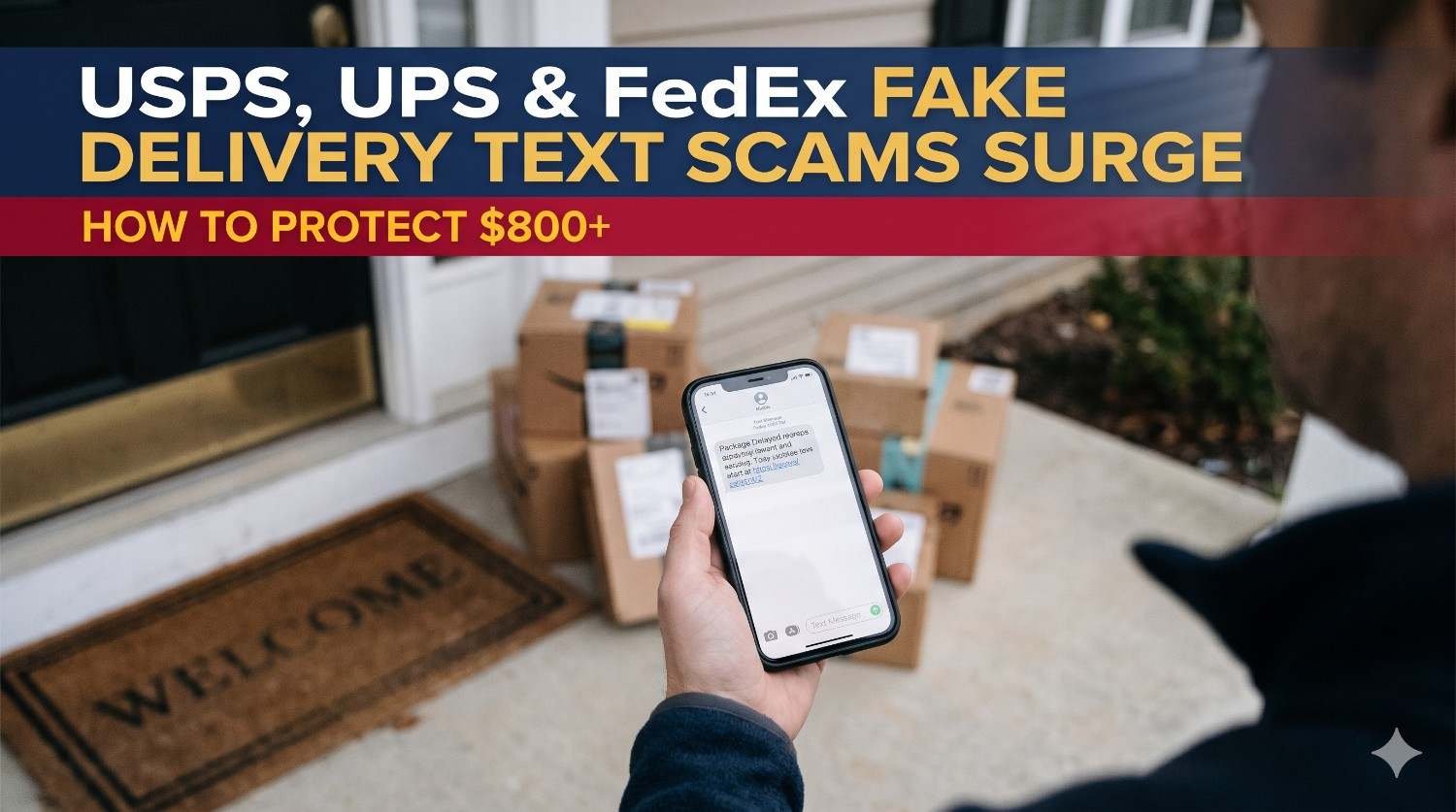
- Smishing & Delivery Fee Traps: Hours after real Black Friday orders leave warehouses, criminals blast spoofed texts pretending to be USPS, FedEx, UPS, or Amazon. Tapping the lookalike link opens a cloned tracking portal demanding a $1.99 or $3.00 “redelivery fee”—a credential harvester built to capture full card numbers, CVV codes, and billing addresses for immediate account takeover.
- Vishing & Fake Bank Callbacks: Ted E. Docks, Special Agent in Charge of the FBI Boston Division, warned that scammers follow up with spoofed caller ID phone calls—sometimes using AI voice cloning—posing as your bank’s fraud department. Once on the line, the caller pressures victims to read back a six-digit multi-factor authentication (MFA) code, install remote access tools like AnyDesk or TeamViewer, or “protect” funds by transferring them via Zelle or wire.
Official incident metrics compiled by the FBI Internet Crime Complaint Center (IC3) show total U.S. cybercrime losses climbed 26% year-over-year to $20.877 billion across more than one million complaints in 2025, with cyber-enabled fraud driving 85% of all financial damage. The Cybersecurity and Infrastructure Security Agency (CISA) reinforced these warnings through its #SecureTheSeason guidance, urging buyers to type retailer URLs manually and verify multi-factor security before checkout.
Caption: Federal cyber analysts warn that AI-cloned storefronts, paid search ads, and spoofed delivery SMS portals now operate as interconnected credential-harvesting networks across the United States.
Federal Liability Laws, Agency Rules, and Holiday Shopping Scam Alert Protections
Knowing how scammers operate is only half the defense. Every victim impacted by this holiday shopping scam alert needs to understand the exact federal statutes that decide whether your bank absorbs the loss or forces you to eat it.
U.S. consumer protection law draws sharp legal boundaries based entirely on how money leaves your account. Under the Fair Credit Billing Act (FCBA / Regulation Z), federal law caps consumer liability for unauthorized credit card charges at $50—and major U.S. issuers enforce $0 zero-liability policies—while also granting formal chargeback rights when counterfeit goods or non-delivered merchandise occur.
Debit cards, checking accounts, and automated clearing house (ACH) transfers fall under a far stricter statute: the Electronic Fund Transfer Act (EFTA / Regulation E). If your debit card or banking credentials are stolen, your liability is capped at $50 only if you notify the financial institution within 2 business days of discovering the compromise. Wait past 2 business days, and your statutory exposure jumps to $500; miss the 60-calendar-day window after your bank statement posts, and you can legally lose 100% of every unauthorized dollar drained afterward.
Identity-theft fallout is governed separately by the Fair Credit Reporting Act (FCRA), which guarantees free security freezes at Equifax, Experian, and TransUnion, plus mandatory Section 605B blocks requiring bureaus to suppress fraudulent accounts within four business days of receiving an official FTC Identity Theft Report. On the telecom front, FCC SIM-Swap and Port-Out Fraud Rules (47 CFR) compel wireless carriers to authenticate identity before transferring your phone number to a scammer’s SIM card—a favorite tactic used to intercept bank SMS passcodes.
One ironclad government rule cuts through every impersonation call: the FBI, U.S. Secret Service, IRS, Social Security Administration, and USPS will never demand payment via gift cards, Bitcoin kiosks, wire transfers, or peer-to-peer payment apps. Yet federal protections collapse inside one narrow banking loophole that costs unsuspecting shoppers thousands of dollars every December.
Payment Method & Fraud Recovery Matrix (What Banks Must Refund vs. Where Victims Lose)
Before clicking “Place Order” on any Cyber Monday deal, compare how U.S. law treats each payment rail when a transaction goes sideways.
| Payment Method | Governing Federal Law | Statutory Victim Liability Cap | Critical Reporting Window | Realistic Refund Odds | Required Dispute Action |
| Credit Card | Fair Credit Billing Act (FCBA / Reg Z) | $50 max ($0 via issuer policy) | 60 days from billing statement | High (Unauthorized & non-delivery) | File formal billing-error dispute / chargeback |
| Debit Card / ATM | Electronic Fund Transfer Act (EFTA / Reg E) | $50 (within 2 days); $500 (days 3–60); Unlimited (60+ days) | Within 2 business days of discovery | High if unauthorized & timely | Report stolen credentials; request provisional credit |
| Unauthorized ACH / Zelle | EFTA / Regulation E | $0 if reported within 60 days (no card lost) | Within 60 days of bank statement | Moderate–High (Requires breach proof) | Prove account takeover / unauthorized access |
| Scam-Induced Zelle / Venmo / Cash App | Voluntary Network Policy (Outside Reg E) | Unlimited (Often 100% victim loss) | Immediately (Minutes matter) | Very Low (Limited imposter exceptions) | Escalate via bank fraud desk & CFPB complaint |
| Bank Wire Transfer | UCC Article 4A (Not Reg E) | Unlimited once settled | Within 72 hours (Before clearing) | Low–Moderate (Depends on Kill Chain) | Trigger bank recall + FBI IC3 Kill Chain |
| Gift Cards / Crypto ATM | No Federal Chargeback Law | Unlimited (100% loss typical) | Immediate (Before card drained) | Near Zero once redeemed | Call issuer with receipt/PIN; file IC3 & FTC reports |
The deadliest trap hidden inside this holiday shopping scam alert is the legal wall between unauthorized transfers and fraudulently induced authorized transfers. If a cybercriminal steals your login from a spoofed FedEx link and drains $3,000 through Zelle while you sleep, Regulation E legally forces your bank to investigate and reimburse the unauthorized transfer.
However, if a scammer posing as a bank fraud agent convinces you to log into your own banking app and tap “Send” on a Zelle transfer to “reverse a fake charge,” most U.S. banks classify the transaction as authorized by the accountholder. Under current Federal Reserve interpretations of Regulation E, institutions frequently deny these claims outright unless the scam meets narrow network-level imposter reimbursement rules.
When a bank wrongly labels an account takeover as “authorized” or refuses to supply investigation documents, victims can escalate directly to the Consumer Financial Protection Bureau (CFPB). Timing also changes everything for wire fraud, where the difference between a 24-hour response and a 72-hour delay can separate full recovery from permanent financial ruin.
Real-World Loss & Recovery Math: Exact Financial Outcomes for US Victims
To see how federal statutes operate under real pressure, consider two realistic American shoppers hit by an identical $6,500 holiday cyber fraud during Black Friday weekend.
Victim A (Protected Under FCBA & Reg E Timing): Elena, a Chicago homeowner, enters her credit card on an AI-cloned electronics storefront promoted through a sponsored search ad. When a bogus “bank fraud specialist” calls 20 minutes later demanding a wire transfer, she hangs up and checks her accounts. She spots a $1,500 fraudulent charge on her credit card and a $5,000 unauthorized ACH debit pulled from her checking account via credentials harvested from a spoofed shipping text. Within 4 hours (before 5:00 PM CST), Elena calls both back-of-card fraud numbers, initiates a Regulation E unauthorized-transfer claim, files an FCBA billing dispute, and freezes all three credit bureaus. Her bank issues provisional credit within 10 business days, her card issuer reverses the $1,500 charge, and her total out-of-pocket loss is $0.
Victim B (Trapped by the Authorized-Transfer Loophole): David, a retiree in Tampa, clicks a fake USPS delivery text, exposes his banking credentials, and answers a spoofed bank call from a criminal using AI voice audio. Convinced his savings are under attack, David authorizes a $4,000 Zelle transfer to a “safe holding account” and buys $2,500 in Apple gift cards to “verify his identity,” reading the PINs aloud. He waits five days before reporting the incident after receiving no confirmation email. Because David initiated the Zelle payment himself and redeemed gift cards voluntarily, Regulation E does not mandate reimbursement, the 72-hour wire-recall window does not apply, and his bank denies the dispute. David faces a $6,500 permanent out-of-pocket loss, plus months of credit monitoring to block secondary identity theft.
Caption: Reporting speed and payment method govern U.S. fraud recovery, creating a $6,500 gap between timely Regulation E disputes and scam-induced instant transfers.
Overlooked Danger Zones: Secondary “Recovery Scams,” Tax Traps, and High-Risk Groups
Major retail coverage routinely ignores what happens two weeks after a holiday shopping scam alert fades from headlines. Cybercrime syndicates compile “sucker lists” of Black Friday victims and sell those phone numbers to secondary Recovery Room Scams.
Weeks later, victims receive emails or calls from fake “blockchain forensic investigators,” bogus consumer lawyers, or fraudulent “class-action settlement portals” promising to claw back stolen Zelle, crypto, or gift card losses for an upfront retainer fee. Real law enforcement agencies and legitimate U.S. government refund programs never charge upfront fees to return stolen money.
Federal tax rules add another painful surprise. Under post-2017 IRS personal casualty and theft loss rules (Tax Cuts and Jobs Act provisions), ordinary consumers generally cannot deduct personal shopping or imposter-scam losses on Form 1040 unless the loss stems from a federally declared disaster or qualifies under strict profit-motivated investment or business-theft criteria under Internal Revenue Code Section 165. Meanwhile, if a fake storefront captured your Social Security number, criminals often wait until January to file bogus tax returns—a threat best blocked by submitting IRS Form 14039 (Identity Theft Affidavit) and enrolling in a mandatory six-digit IRS Identity Protection PIN (IP PIN).
Three overlooked groups face heightened fallout during this holiday wave:
- Seniors on Medicare & Social Security: Criminals pair holiday gift scams with Medicare Open Enrollment calls (running through December 7) to steal Medicare Beneficiary Identifiers and hijack Social Security direct deposits, which must be reported immediately to the SSA Office of the Inspector General (OIG).
- Small-Business Owners: Holiday vendor invoices surge in late November, fueling Business Email Compromise (BEC) attacks—which generated over 24,700 IC3 complaints last year—where spoofed supplier emails swap ACH routing numbers ahead of year-end payroll.
- Seasonal Gig & Job Seekers: Fake “work-from-home package reshipping” and seasonal courier listings recruit holiday job hunters as unwitting money mules or harvest W-4 tax forms for synthetic identity fraud.
Even locking Equifax, Experian, and TransUnion leaves blind spots. Victims whose banking or personal data leaked must also place free security freezes at ChexSystems (which screens new checking accounts), Innovis, and the National Consumer Telecom & Utilities Exchange (NCTUE) so fraudsters cannot open unauthorized utility or cell lines. Readers tracking ongoing federal consumer alerts, breach disclosures, and regulatory scam trackers across the United States can monitor updated bulletins through SarkariResultine.com/us/. If you already clicked a bad link or sent money, the next 24 hours determine what you can still salvage.
Emergency 24-Hour Damage-Control Checklist: Exact Steps If You Clicked or Paid
Execute these six containment actions in strict order if you interacted with a suspicious storefront, delivery SMS, or spoofed call flagged in this holiday shopping scam alert:
- Disconnect, Revoke Access, and Reset Passwords: If you downloaded a “package tracker” app or remote-access tool (AnyDesk, TeamViewer, ScreenConnect), immediately turn off Wi-Fi and cellular data, uninstall the app, and run updated antivirus scans. From a clean device, change passwords on your email, banking, and retail accounts—starting anywhere you reused the compromised password—and enable app-based multi-factor authentication.
- Call Your Bank’s Back-of-Card Fraud Desk Immediately: Never dial a phone number inside a text message or Google ad. Call the number printed on your physical card to cancel compromised cards, log a formal Regulation E or FCBA dispute, and record your claim reference number and timestamp (EST/CST/PST). If you sent a domestic or international wire exceeding $50,000—or any large urgent wire—demand an immediate bank recall and file with FBI IC3 within 72 hours to activate the FBI Recovery Asset Team (RAT) Financial Fraud Kill Chain (FFKC).
- File Federal Law Enforcement & Identity Theft Reports: Submit complete transaction logs, fake URLs, crypto wallet IDs, and spoofed numbers to the FBI Internet Crime Complaint Center and the FTC at ReportFraud.ftc.gov. If your SSN, driver’s license, or bank credentials were exposed, build an official recovery plan at IdentityTheft.gov to generate the formal FTC Identity Theft Report required for FCRA Section 605B credit blocks.
- Freeze All Six Consumer Reporting Databases: Place free credit freezes at Equifax, Experian, and TransUnion, then lock ChexSystems, Innovis, and NCTUE to block fraudulent checking accounts and telecom lines. Pull free weekly credit reports through AnnualCreditReport.com to watch for unauthorized inquiries.
- Kill Smishing Trails & Lock Your Wireless Number: Forward every fake USPS, FedEx, UPS, or bank text directly to
7726(SPAM) so wireless carriers can sinkhole the domain, then block and delete the thread. Call your mobile carrier (Verizon, AT&T, T-Mobile) to enable a custom Port-Out Freeze / Number Lock PIN protected under FCC SIM-swap regulations. - Lock Your Tax Account & Gift Card Receipts: Enroll in an official IRS Identity Protection PIN before tax season opens to stop fraudulent filings. If you were coerced into buying gift cards, keep the physical card and purchase receipt, call the card issuer’s dedicated fraud line immediately to attempt a freeze on unspent balances, and file a local police report.
Containing today’s breach stops immediate bleeding, yet federal investigators warn that the tactics emerging this holiday weekend are a preview of a much sharper escalation across 2027.
2026–2027 Threat Escalation, Regulatory Crackdowns, and What Happens Next
Cybersecurity analysts and federal prosecutors see this week’s holiday shopping scam alert as the opening salvo of an AI-automated fraud cycle stretching well into 2027. Immediately following Cyber Monday (November 30, 2026) and Giving Tuesday (December 1, 2026), FBI and Secret Service threat trackers expect criminals to pivot seamlessly from fake Black Friday retail sites to bogus charity drives, year-end subscription renewal traps, and fake “holiday return refund” portals.
By mid-January 2027, the same credential databases harvested from November smishing campaigns will fuel tax-season IRS impersonation waves and synthetic W-2 filing fraud. Simultaneously, autonomous AI shopping agents will become a prime battleground, prompting state Attorneys General—led by New York’s November 2026 guidance—and federal regulators to push for mandatory human-approval spending guardrails and stricter liability standards on automated commerce.
On the banking policy front, the CFPB, FinCEN, and state enforcement divisions continue pressuring instant-payment networks including Zelle and FedNow participants to expand consumer reimbursement for bank-imposter fraud beyond narrow technical takeovers. Until Congress or federal regulators formally rewrite Regulation E to cover scam-induced transfers, consumer survival hinges on verifying every merchant manually and keeping official federal reporting portals bookmarked before disaster strikes.
Official Federal Reporting Portals & Primary Verification Links
Use only verified .gov and official statutory portals referenced in this holiday shopping scam alert to report fraud, freeze accounts, or confirm active warnings:
- FBI Internet Crime Complaint Center (IC3) — File cyber fraud complaints and trigger the 72-hour Financial Fraud Kill Chain for wire recalls.
- FTC ReportFraud Portal — Report fake online stores, social media shopping scams, gift card fraud, and impersonation schemes.
- FTC IdentityTheft.gov — Generate an official Identity Theft Report and step-by-step recovery plan for FCRA Section 605B credit blocks.
- Consumer Financial Protection Bureau (CFPB) — Escalate denied bank fraud disputes, Regulation E violations, and Zelle or wire complaints.
- Cybersecurity and Infrastructure Security Agency (CISA) — Access
#SecureTheSeasondevice-hardening advisories and active phishing threat alerts. - Federal Communications Commission (FCC) — Report spoofed caller ID vishing calls, robotexts, and unauthorized SIM-swap or port-out incidents.
- Internal Revenue Service (IRS) Identity Theft Central — Request a free IRS IP PIN or submit Form 14039 if your Social Security number was exposed.
- AnnualCreditReport.com — Access the sole federally authorized portal for free weekly Equifax, Experian, and TransUnion credit reports.
Frequently Asked Questions (People Also Ask)
Can I get my money back if I fell for a Zelle, wire, or crypto shopping scam?
Recovery odds depend strictly on whether the transfer was unauthorized or scam-induced. Unauthorized account takeovers are protected under federal Regulation E, whereas voluntary Zelle payments and crypto transfers rarely receive bank refunds unless your bank’s imposter policy applies or an FBI IC3 Kill Chain intercepts a wire within 72 hours.
What happens if I only clicked a fake delivery text link without entering information?
Merely tapping a smishing link without submitting payment details, passwords, or downloading files rarely compromises an updated iPhone or Android device. Close the browser tab immediately, clear site data, install pending OS updates, forward the message to 7726 (SPAM), and watch for follow-up phishing calls confirming your number is active.
How long do US banks take to resolve a Regulation E fraud dispute?
Under federal Regulation E rules, your bank must investigate an unauthorized electronic transfer within 10 business days (20 business days for new accounts). If the investigation requires up to 45 calendar days—or 90 days for point-of-sale debit or foreign transactions—the institution must issue temporary provisional credit while completing its review.
Does placing a credit freeze hurt my FICO credit score?
No, placing or lifting a security freeze at Equifax, Experian, or TransUnion has zero impact on your FICO or VantageScore credit ratings. Under the Fair Credit Reporting Act, freezes are completely free nationwide and prevent criminals targeted in this holiday shopping scam alert from opening new credit cards or loans using your Social Security number.
How can I verify if a call from my bank, the FBI, or the IRS is real?
Hang up immediately—never trust caller ID, which scammers spoof effortlessly alongside AI-cloned voices. Dial the verified phone number printed on the back of your bank card or listed on an official .gov website from a separate line, and remember no federal agency ever demands gift cards, crypto, or urgent wire transfers.
Editorial Safety & Legal Note: Federal consumer liability rules under EFTA, FCBA, and FCRA depend on individual transaction facts, account agreements, and exact reporting timestamps; this investigative report is provided for consumer education and cyber-risk awareness rather than formal legal or tax advice.
For a quick visual breakdown of how federal investigators are tracking these AI retail websites and spoofed messages in real time, watch this local broadcast report covering the FBI Boston warning on AI holiday shopping scams.



Leave a Reply