
HARTFORD, Conn. — When a customer-facing chatbot fabricates a binding refund policy or an automated pricing model triggers a state discrimination probe, most executives assume their AI liability insurance will cover the defense. That assumption is quietly collapsing ahead of 2027 renewals, as US commercial carriers strip generative artificial intelligence from standard policies while extreme weather losses force businesses to rethink catastrophe protection.
A nationwide review of state insurance filings confirmed 2,369 generative AI exclusion records already in force across 49 states by mid-2026, with zero admitted standalone products replacing that lost general liability coverage. Simultaneously, commercial property wind and hail deductibles reaching 5% of insured building value—equal to $250,000 out of pocket on a $5 million facility—have pushed the global parametric insurance market to $24 billion as CFOs seek rapid, data-triggered weather payouts.
Key Policy & Compliance Takeaways (At a Glance):
- Who Is Impacted: US LLCs, S-Corps, C-Corps, contractors, and mid-market firms deploying AI tools or holding coastal, Midwest, and Sun Belt commercial property.
- Official Rule/Rate Benchmark: ISO forms CG 40 47, CG 40 48, and CG 35 08; 2%–5% commercial wind/hail deductibles. Mayflower Specialty+ 1
- Effective Date/Deadline: ISO AI exclusions live since January 2026; Colorado SB 26-189 takes effect January 1, 2027 (12:00 a.m. MST). Vaquill AI
- Governing Regulator: State Departments of Insurance, NAIC, FTC, EEOC, and IRS.
- Estimated Dollar Impact: $100,000–$250,000+ in uncovered weather deductibles or $200,000+ in uncurable AI statutory fines.
- Immediate Action Required: Audit endorsement schedules 90 days before renewal and evaluate parametric weather triggers. Mayflower Specialty
AI Liability Insurance: Official Rules, Regulatory Shifts, and What Sparked Them
For decades, commercial insurance policies operated in what underwriters call “Silent AI”—contracts drafted long before large language models entered daily workflows, saying neither yes nor no to algorithmic losses. That ambiguity ended abruptly in January 2026 when the Insurance Services Office (ISO) released three standardized generative AI exclusions for Commercial General Liability (CGL) policies.
Major admitted carriers including Chubb, Travelers, AIG, W.R. Berkley, and Berkshire Hathaway moved rapidly, filing ISO forms or proprietary equivalents across state insurance departments by April 2026. Because AI liability insurance disputes often hinge on causation, insurers inserted sweeping “arising out of” lead-in wording that lets claims adjusters deny an entire loss if a generative model touched even one step of the workflow.
Underwriter Warning: Under ISO form CG 40 47, a structural or safety error reviewed and signed off by human staff can still face denial if an AI tool generated the initial draft or calculation.
At the same time, severe convective storms, hurricanes, and heatwaves forced underwriters to protect property loss ratios through percentage wind/hail deductibles, roof Actual Cash Value (ACV) schedules, and 72-hour Business Interruption (BI) waiting periods. While national commercial property premiums softened by 6.3% in Q2 2026 according to Council of Insurance Agents & Brokers (CIAB) data, carriers refused to surrender restrictive storm deductibles in high-hail corridors like Texas and coastal Florida.
State regulators have responded on both fronts through the National Association of Insurance Commissioners (NAIC), whose Model Bulletin on AI Systems reached adoption across 29 US jurisdictions—27 states, the District of Columbia, and Puerto Rico—by November 2026. Texas issued Commissioner’s Bulletin #B-0003-26 on June 12, 2026, followed by Mississippi (Bulletin 2026-9) and North Dakota (Bulletin 2026-2), signaling tighter scrutiny of insurer models and third-party vendor governance.
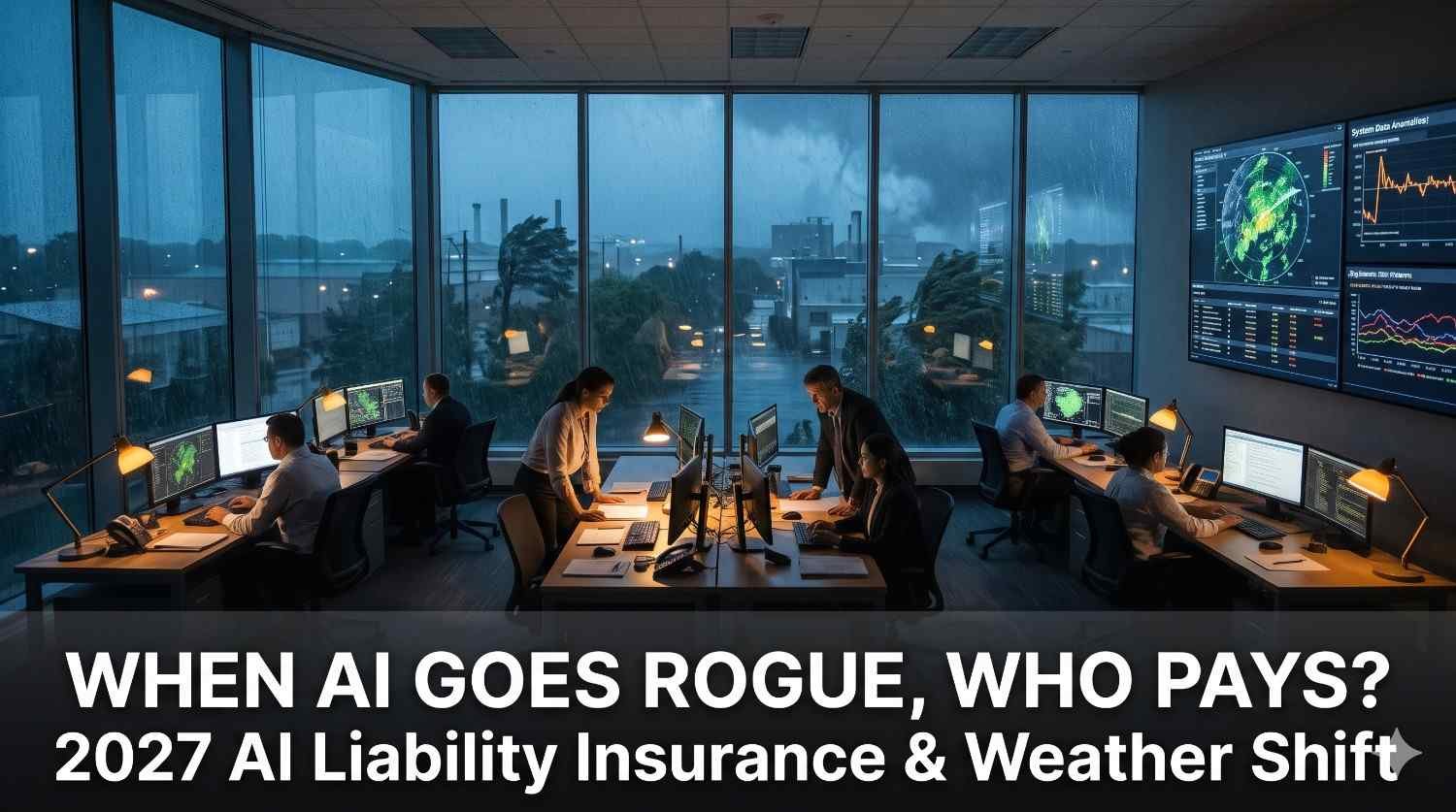
Caption: US commercial underwriters and risk officers now review ISO generative AI exclusions alongside catastrophe property deductibles ahead of 2027 policy renewals.
Federal Mandates, State Insurance Laws, and AI Liability Insurance Standards
Business owners face an expanding patchwork of statutory liabilities that standard CGL policies never intended to absorb. Under the McCarran-Ferguson Act, insurance policy wording remains state-regulated, meaning an endorsement approved by the Texas Department of Insurance (TDI) or Florida Office of Insurance Regulation (OIR) can differ materially from forms permitted by the California Department of Insurance (CDI) or New York Department of Financial Services (NYDFS).
Understanding how state statutes interact with your AI liability insurance stack prevents catastrophic blind spots:
- ISO CG 40 47, CG 40 48, and CG 35 08: CG 40 47 is the broadest exclusion, stripping both CGL Coverage A (bodily injury and property damage) and Coverage B (personal and advertising injury) tied to generative AI. CG 40 48 removes Coverage B alone, while CG 35 08 excludes products and completed operations claims. Mayflower Specialty
- Texas TRAIGA (HB 149): Effective January 1, 2026, Texas enforces an intent-based AI governance law with civil penalties ranging from $10,000 to $12,000 per curable violation, $80,000 to $200,000 per uncurable violation, and $2,000 to $40,000 per day for continuing offenses after a 60-day cure period. Substantial compliance with the NIST AI Risk Management Framework offers a statutory safe harbor. CASRAI
- Colorado Senate Bill 26-189: In May 2026, lawmakers repealed Colorado’s original SB 24-205 before it took effect and enacted SB 26-189, which takes effect January 1, 2027. Deployers making consequential decisions in hiring, lending, housing, healthcare, or insurance must issue consumer notices, explain adverse outcomes within 30 days, and provide human review. Vaquill AI
- Federal Enforcement & Parametric Oversight: The Federal Trade Commission (FTC) polices deceptive “AI-washing” marketing claims, while the Equal Employment Opportunity Commission (EEOC) pursues algorithmic hiring bias. Meanwhile, commercial parametric weather policies are predominantly placed through Excess and Surplus (E&S) lines under the federal Nonadmitted and Reinsurance Reform Act of 2010 (NRRA) and NAIC Model Act #870, while NYDFS Circular Letter No. 1 (2026) mandates formal insurer disaster preparedness filings. NY DFS – NY.Gov
Knowing the statutes is only half the equation; seeing how policy limits, waiting periods, and exclusions compare side by side reveals exactly where your balance sheet sits exposed.
2025 vs. 2026–2027 Cost, Coverage & Compliance Matrix (Side-by-Side Breakdown)
Commercial risk transfer has split into two tracks heading into 2027: explicit affirmative wording for algorithmic errors and objective, sensor-verified liquidity for extreme weather. The matrix below contrasts legacy 2025 coverage mechanics against the 2026–2027 reality.
| Risk Category & Policy Feature | Legacy 2025 Commercial Standard | 2026–2027 Market Reality | Hidden Exposure or Statutory Trap |
|---|---|---|---|
| CGL Generative AI Treatment | Silent AI (unaddressed in standard forms) | ISO CG 40 47 / CG 40 48 attached at renewal | Strips Coverage A & B even for vendor AI use |
| Tech E&O / Professional Liability | Covered software errors broadly | Insurers add absolute AI exclusions or sublimits | Claims-made wording retroactively hits prior acts |
| Cyber & D&O Policies | Standard breach and executive defense | AI-washing excluded under broad D&O endorsements | Separate cyber sublimits for AI-driven downtime |
| Traditional Property Wind/Hail | 1%–2% or flat $25,000 deductible | 2%–5% percentage deductibles + ACV roof schedules | 110% margin clauses cap payouts below rebuild cost |
| Business Interruption (BI) Trigger | Direct physical damage + 72-hour wait | Same physical-damage rule; slow adjuster audits | Grid outage or blocked roads yield $0 payout |
| Parametric Weather Insurance | Niche corporate treasury hedge | Mainstream $24B market; pays in 5–15 days | Basis risk; E&S policies lack State Guaranty backing |
Two structural shocks jump off this comparison. First, a company paying $15,000 annually for CGL and Umbrella policies can now watch an AI-linked bodily injury or defamation claim get rejected at both layers because follow-form Umbrella policies inherit primary CG 40 47 exclusions automatically.
Second, traditional commercial property insurance leaves mid-sized firms cash-starved during the exact 30 days after a hurricane, hailstorm, or freeze when payroll and vendor invoices come due. Pairing traditional Replacement Cost Value (RCV) property insurance with a parametric weather layer solves the liquidity gap—providing fast cash to cover a 5% deductible or non-damage revenue drop while adjusters audit physical repairs.
Yet percentage deductibles and policy exclusions look abstract until you run real claim math across an American small business P&L.
Real-World Dollar Math: Exact Claim, Premium, and Tax Scenarios for Americans
To illustrate how AI liability insurance endorsements and parametric weather structures perform under pressure, compare two realistic 2027 claim scenarios involving a Texas-based regional logistics and engineering firm operating as an S-Corporation ($4.5 million annual revenue, $2 million insured warehouse).
Scenario 1: Rogue AI Error ($185,000 Third-Party Financial & Advertising Claim) An AI-assisted bid estimator and automated client portal misquotes cold-chain freight specifications and publishes unverified competitor comparisons, triggering a $185,000 lawsuit (defense fees plus settlement).
- Business A (Unmodified 2027 Renewal with CG 40 47 & Generic E&O): The CGL carrier invokes ISO CG 40 47 to deny Coverage B advertising injury because generative AI produced the copy. The E&O insurer invokes a newly added absolute AI exclusion—effective at renewal on a claims-made basis—leaving the firm to pay $185,000 out of pocket. lamdabroking.com
- Business B (Negotiated CG 40 48 + Affirmative Tech E&O Endorsement): The broker paid $3,800 extra annually to swap CG 40 47 for CG 40 48 and add an affirmative AI endorsement to Tech E&O ($10,000 retention). The insurer covers $175,000 in defense and indemnity; net cost to Business B is $13,800—a $171,200 net savings. Mayflower Specialty
Scenario 2: Severe Hail & Grid-Outage Storm ($140,000 Physical Damage + $85,000 Lost Revenue) A spring supercell pounds the firm’s $2 million Dallas-area warehouse with 2.25-inch hail while knocking out regional power for 68 hours.
- Business A (Traditional Commercial Property Only, 5% Wind/Hail Deductible, 72-Hour BI Wait): On a $2 million building, the 5% wind/hail deductible absorbs the first $100,000 of physical repairs. Because power returned at hour 68—short of the 72-hour Business Interruption waiting period—BI pays $0, leaving $185,000 in total retained loss while the remaining $40,000 repair check takes 75 days to settle. The Agent’s Office
- Business B (Traditional Property + $150,000 Parametric Hail/Outage Policy, $11,500 Annual Premium): Independent NOAA radar and hail-size telemetry confirm 2.25-inch hail at the facility’s GPS polygon, automatically triggering a $150,000 payout within 10 business days. After the $11,500 premium and $40,000 traditional property payout, Business B cuts net out-of-pocket exposure to $46,500—preserving $138,500 in working capital.
Caption: Side-by-side underwriting math demonstrates how affirmative AI carve-backs and parametric weather triggers protect small-business cash flow during major losses.
Hidden Exclusions, State-by-State Traps, and Overlooked Edge Cases
Even experienced risk managers fall into five fine-print traps that major affiliate comparison websites rarely disclose:
- Claims-Made Retroactive Wipeouts: Under claims-made Tech E&O, D&O, and Employment Practices Liability (EPL) policies, the wording in force when a claim is reported controls—not when the error happened. An absolute AI exclusion attached at your January 2027 renewal can silently erase coverage for a model error committed back in 2024.
- Parametric Basis Risk: Parametric contracts pay strictly on index readings, not actual invoices. If a hurricane inflicts $300,000 in wind damage on your coastal Florida facility at 71 mph, but your policy requires 74 mph winds at a NOAA buoy 15 miles away, the contract pays exactly $0.
- No State Guaranty Association Safety Net: Because most US commercial parametric weather policies are written on non-admitted Surplus Lines paper, they are excluded from State Guaranty Associations. If a thinly capitalized insurtech carrier becomes insolvent after a major catastrophe, state guaranty funds will not pay your claim.
- IRS Section 162 & Accounting Classification Trap: Under GAAP rules (ASC 944 vs. ASC 815) and Internal Revenue Service (IRS) standards, a parametric payout must be tied to an insurable interest and require a sworn proof-of-loss attestation confirming actual economic loss to qualify as ordinary deductible business insurance. Pure “no-proof” weather triggers risk reclassification as derivatives or swaps, altering both balance-sheet reporting and tax treatment. Captive International
- Third-Party Vendor & 1099 Contractor Gaps: Broad AI liability insurance exclusions using the phrase “by any person or entity” reach subcontractors, outside marketing agencies, and independent 1099 developers. Small solo LLCs and seasonal businesses relying on third-party SaaS platforms should monitor shifting federal compliance notices and US regulatory updates through resources like SarkariResultine.com/us/ alongside primary agency bulletins so vendor agreements never outpace policy terms.
Once you see where these coverage landmines sit, closing them requires a disciplined pre-renewal audit rather than guesswork.
Step-by-Step Protection & Compliance Playbook: Exact Actions to Take Now
Execute these six underwriting and compliance steps at least 90 days before your next commercial policy renewal:
- Run a Full Policy-Tower Endorsement Audit: Pull your actual policy jackets—not just your broker’s summary proposal—for CGL, Business Owner’s Policy (BOP), Tech E&O, Cyber, D&O, EPL, and Umbrella layers. Search every endorsement schedule for ISO forms CG 40 47, CG 40 48, CG 35 08, or manuscript exclusions containing “arising out of” artificial intelligence. Sarvada+ 1
- Negotiate Narrower AI Language Before Signing: If an underwriter attaches CG 40 47, instruct your broker to request four remedies in descending order of strength: full deletion, a downgrade to CG 40 48 (preserving Coverage A bodily injury/property damage), causation tightening from “arising out of” to “solely caused by,” or a human-in-the-loop carve-back. For claims-made policies, demand a prior-acts carve-back so new exclusions apply only to acts after the 2027 renewal date. Sarvada
- Layer Affirmative AI Liability Insurance Where Core Operations Depend on Models: If your business sells AI-driven software, uses automated pricing, or deploys customer chatbots, purchase an affirmative AI endorsement or dedicated Difference-in-Conditions (DIC) excess layer backed by an A-rated carrier. Document your internal AI governance against the NIST AI Risk Management Framework to unlock safe harbors like Texas TRAIGA and earn better underwriting credits. Mayflower Specialty+ 1
- Stress-Test Your Property Wind/Hail Deductibles and BI Waiting Periods: Calculate your exact cash requirement under a 2%–5% wind/hail percentage deductible, check for roof ACV schedules or 110% margin clauses, and confirm whether your Business Interruption endorsement excludes off-premises utility failures. Review disaster financing and continuity checklists on the U.S. Small Business Administration (SBA) portal to benchmark your emergency liquidity reserve. The Agent’s Office
- Structure Parametric Weather Policies to Eliminate Basis Risk and Tax Friction: Choose high-resolution, site-specific polygon triggers (such as NOAA radar hail footprints, USGS ShakeMap intensity, or onsite IoT anemometers) rather than distant airport weather stations. Verify the Surplus Lines carrier holds an A.M. Best rating of A- or higher, and confirm the policy includes a proof-of-loss attestation clause to preserve IRS Section 162 deductibility and ASC 944 insurance accounting.
- Verify Insurer Standing and Escalate Unfair Denials Properly: Check your carrier’s complaint ratio through the NAIC Consumer Information Source and keep a 5-year loss-run file ready to challenge inaccurate loss histories. If an insurer wrongfully denies a claim under an overbroad exclusion, file a formal written complaint through your State Department of Insurance consumer portal and retain coverage counsel before signing a reservation-of-rights waiver.
Timing these negotiations matters almost as much as the wording itself, because several state statutes and carrier rate filings lock in over the next twelve months.
Critical 2026–2027 Renewal Windows, Filing Deadlines, and What Happens Next
Commercial insurance buyers face a tight cluster of statutory start dates and underwriting windows between late 2026 and late 2027:
- November–December 2026 (Q4 Renewal Lock-In): Following the NAIC Fall National Meeting in Dallas (November 14–17, 2026) and adoption of the NAIC AI Systems Evaluation Tool, state examiners are expanding reviews of insurer AI governance. Businesses with January 1, 2027 renewals (12:01 a.m. EST/CST/PST) must finalize CG 40 47 carve-backs and parametric quotes immediately to avoid last-minute binder traps.
- January 1, 2027 (Statutory Enforcement Wave): Colorado SB 26-189 takes effect at 12:00 a.m. MST for consequential AI decisions, requiring consumer notices, 30-day adverse-action explanations, and human review. Separately, Texas TRAIGA enforcement remains active following the Texas Attorney General’s September 1, 2026 public complaint portal launch, and IRS Section 162(m) expands covered-employee compensation caps for publicly traded corporations for tax years starting after December 31, 2026. Davis Polk
- March–May 2027 (Pre-Storm Parametric Window): Commercial buyers in hurricane and Midwest hail corridors should bind parametric wind, hail, and flood layers before May 1, 2027—well ahead of the June 1 Atlantic hurricane season start—when seasonal capacity tightens and pricing spikes.
- July 1, 2027 (Mid-Year AI Reporting): Annual chatbot operator reporting obligations under Colorado’s updated statutory framework begin July 1, 2027, prompting mid-year AI liability insurance underwriting audits across SaaS, healthcare, and e-commerce accounts.
With softening national commercial property rates giving buyers rare leverage, the smartest move is shopping your full commercial tower 90 to 120 days ahead of expiration—reclaiming lost deductible terms while locking in affirmative AI wording before a major courtroom verdict hardens the market again.
Official Government Regulators & Primary Verification Links
Verify carrier licenses, state AI bulletins, flood maps, and tax deductibility standards directly through primary US federal and state portals:
- National Association of Insurance Commissioners (NAIC) — State AI Model Bulletin adoption tracker, surplus lines standards, and insurer complaint lookups.
- New York Department of Financial Services (NYDFS) — Circular Letter No. 7 (AI fairness) and Circular Letter No. 1 (2026) P&C disaster preparedness guidance.
- Internal Revenue Service (IRS) — Business expense deductibility rules under IRC Section 162 and Form 1120-S / Schedule C compliance.
- U.S. Small Business Administration (SBA) — Commercial disaster preparedness loans, risk management guides, and federal business compliance alerts.
- Federal Emergency Management Agency (FEMA) FloodSmart — Official National Flood Insurance Program (NFIP) commercial flood limits and zone lookup tools.
- Federal Trade Commission (FTC) — Federal guidance on deceptive AI marketing claims and commercial consumer protection enforcement.
- National Oceanic and Atmospheric Administration (NOAA) — Authoritative US weather, hail, wind, and climate telemetry datasets commonly used as parametric policy triggers.
Frequently Asked Questions (People Also Ask)
Does standard Commercial General Liability cover errors made by an AI tool?
Increasingly, no. Since January 2026, insurers have filed over 2,369 generative AI exclusions across 49 states using ISO forms CG 40 47, CG 40 48, and CG 35 08. If CG 40 47 sits on your declarations schedule, your carrier can deny bodily injury, property damage, and advertising injury claims tied to generative AI.
Insurance Business
What type of AI liability insurance covers chatbot hallucinations or algorithmic mistakes?
Pure financial losses caused by faulty model outputs typically fall under Technology Errors & Omissions (Tech E&O) or specialized affirmative AI liability insurance endorsements rather than Cyber or CGL policies. Confirm your Tech E&O definition of professional services explicitly includes AI-enabled workflows and lacks an absolute AI exclusion.
lamdabroking.com
Can parametric weather insurance completely replace traditional commercial property insurance?
No—parametric insurance works best alongside, not instead of, traditional Replacement Cost Value (RCV) property coverage. Commercial mortgage lenders still require standard admitted property insurance, while parametric policies provide rapid 5-to-15-day liquidity to fund 2%–5% wind/hail deductibles, payroll, and non-damage outages.
The Agent’s Office
Are parametric weather insurance premiums tax-deductible for US businesses?
Generally yes under IRS Section 162 as an ordinary business expense, provided the contract qualifies as true insurance rather than a financial derivative. To maintain insurance tax and ASC 944 accounting status, your policy must require an insurable interest, a real economic loss, and a signed proof-of-loss attestation.
What happens if a Surplus Lines parametric insurer becomes insolvent after a major storm?
Non-admitted Surplus Lines insurers are not backed by State Guaranty Associations, leaving policyholders exposed if an undercapitalized carrier fails. Always require your surplus lines broker to document an A.M. Best rating of A- or higher, verify state eligibility under NRRA rules, and confirm backing from established global reinsurers.
Editorial Disclosure: Commercial insurance rates, ISO form approvals, state AI statutes, and federal tax interpretations vary significantly by state and business structure; this report is provided strictly for informational and educational purposes and does not constitute licensed insurance, legal, or CPA tax advice.





Leave a Reply