

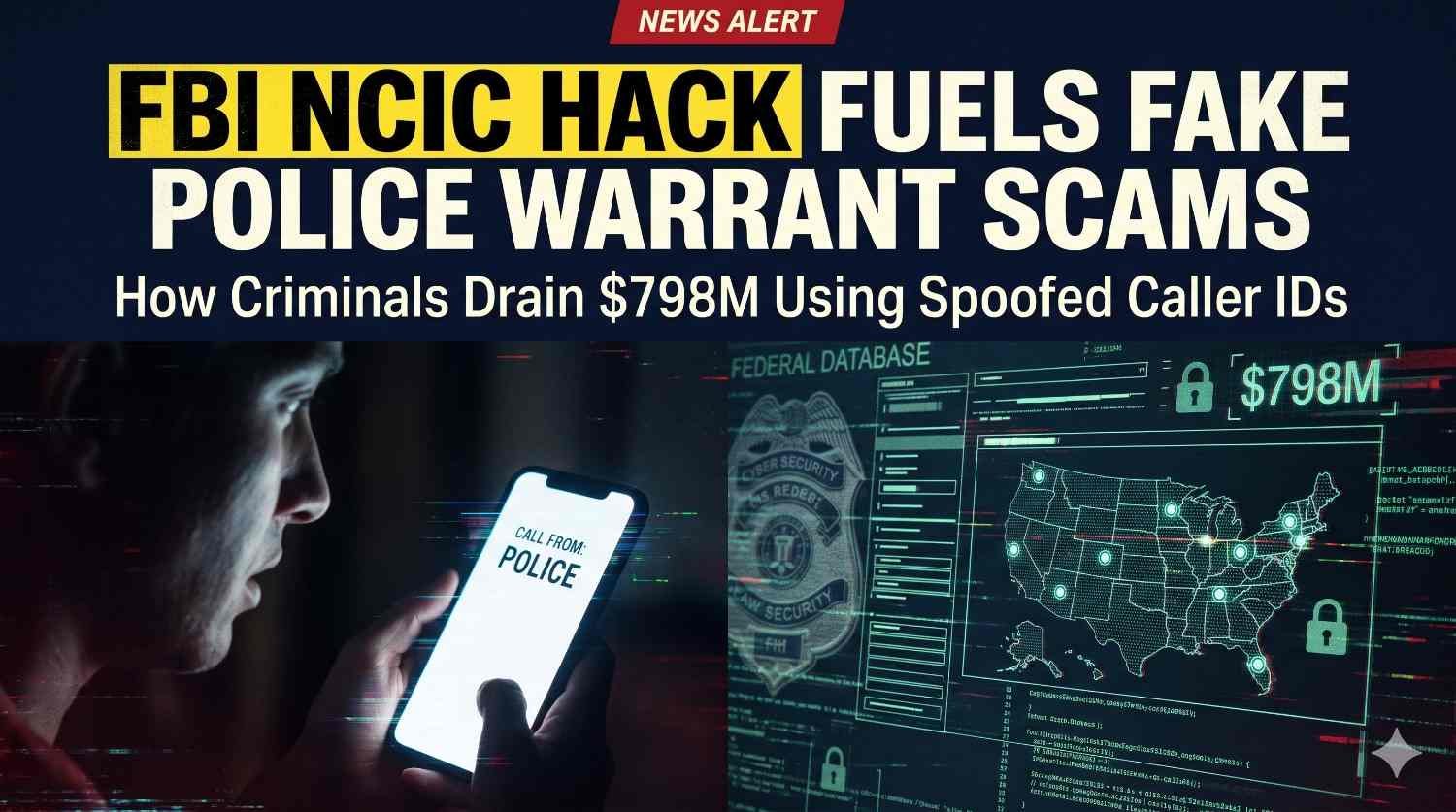
WASHINGTON — Cybersecurity analysts and consumer protection officials are issuing an urgent fake police warrant scam warning after reports revealed the FBI is investigating an apparent hack of its National Crime Information Center. The intrusion probe, first disclosed on November 20, 2026, and confirmed to The Associated Press on November 21 at 12:52 PM PST, involves a database housing more than 19.3 million records.
While federal investigators have not confirmed whether attackers exfiltrated active files, fraud monitors warn that criminal syndicates immediately exploit breaking law enforcement breach headlines. Scammers combine spoofed local precinct phone numbers with leaked personal data to threaten Americans with immediate arrest unless they wire funds or deposit cryptocurrency.
Key Takeaways (Fast Facts):
- Who: U.S. consumers, older adults, and individuals whose details appear in criminal justice or court filings.
- What: Heightened fake police warrant scam risks following a reported intrusion into the FBI NCIC database.
- When: Breach probe surfaced November 20–21, 2026.
- Where: Nationwide across all 50 states.
- Why: Attackers exploit stolen data and public panic to coerce wire, crypto, or gift-card payments.
- Key Metric: Over 19.3 million NCIC records tracked in FY 2025; $797.9 million lost to government impersonation.
Fake Police Warrant Scam: What Triggered the Official Shift
The latest federal security warning follows confirmation by the Associated Press that the FBI is examining a suspected breach of its National Crime Information Center. Local, state, and federal officers query NCIC daily during traffic stops, background checks, and active fugitive investigations.
According to the bureau’s Criminal Justice Information Services review, NCIC held more than 19.3 million records in fiscal year 2025, covering wanted-person warrants, missing persons, protection orders, and stolen property. Security researchers note that combining even partial warrant metadata with commercial data-broker files turns a generic fake police warrant scam into a chillingly specific extortion call.
This probe marks the third major FBI cyber incident surfaced in 2026, following a March investigation into suspicious activity on an internal surveillance network and a September breach exposing employee personal data. Although the bureau declined public comment over the November 21 weekend, threat monitors detected an immediate uptick in spoofed breach-notification texts and law enforcement phishing scripts.
Caption: Federal law enforcement and cybersecurity analysts review national criminal justice data protocols in Washington following reports of the November 2026 NCIC intrusion probe.
Federal Regulations and Fake Police Warrant Scam Precedents
Federal prosecutors and regulators rely on strict statutory tools to pursue impersonators operating across state lines. Under 18 U.S.C. § 912, falsely pretending to be a federal officer or employee to demand money or compel action is a felony carrying up to three years in prison.
On the civil enforcement front, the Federal Trade Commission enforces the Rule on Impersonation of Government and Businesses codified at 16 C.F.R. Part 461. Section 461.2 bars any party from materially misrepresenting affiliation with federal, state, local, or tribal agencies across phone calls, texts, emails, or mailers.
Violators face consumer redress orders and inflation-adjusted FTC civil penalties reaching $53,088 per knowing violation, alongside caller ID spoofing bans under the Telemarketing Sales Rule at 16 C.F.R. § 310.3(a)(2)(vii). On October 1, 2026, the FTC also published an Advance Notice of Proposed Rulemaking examining platform accountability for hosting impersonation schemes.
Data Breakdown & Comparative Matrix (2025 vs. 2026 Standards)
Federal reporting compiled by the FBI Internet Crime Complaint Center and the FTC reveals how rapidly government-impersonation losses expanded heading into late 2026. The matrix below compares verified 2025 baseline data against active 2026 enforcement realities.
| Metric / Enforcement Benchmark | 2025 Verified Baseline | Late 2026 Active Status / Standard | Primary Federal Source |
| Total Cybercrime Losses (IC3) | $20.877 billion (1,008,597 complaints) | Record base; up 26% over 2024 | FBI IC3 2025 Report |
| Government Impersonation Losses | $797.94 million (~32,000 complaints) | Elevated threat post-NCIC hack news | FBI IC3 Annual Review |
| All Imposter Scam Losses (FTC) | $3.5 billion (over 1M reports) | Nearly 3x 2020 loss volume | FTC Consumer Sentinel |
| Senior (60+) Reported IC3 Losses | $7.75 billion ($38,500 avg. loss) | Up 59% year-over-year | FBI IC3 2025 Report |
| AI-Enabled Fraud Complaints | 22,364 reports ($893 million lost) | Voice cloning & spoofed dispatch audio | FBI IC3 / Security Advisories |
| Federal Disruption Hub | Fragmented task force referrals | Threat Disruption Center (30+ fed, 440+ local) | HSTF Launch (Nov. 2026) |
Numbers inside the 2025 IC3 Annual Report underscore why every fake police warrant scam call carries severe household risk. Average losses per cybercrime report climbed to $20,699 overall, while Americans aged 60 and older lost an average of $38,500 per complaint.
More troubling, the FBI documented 22,364 complaints involving artificial intelligence in 2025, representing $893 million in adjusted losses. Call centers now pair synthetic police radio chatter with real badge numbers pulled from public municipal rosters to disarm skeptical targets within seconds.
Real-World Impact: What This Means for American Households
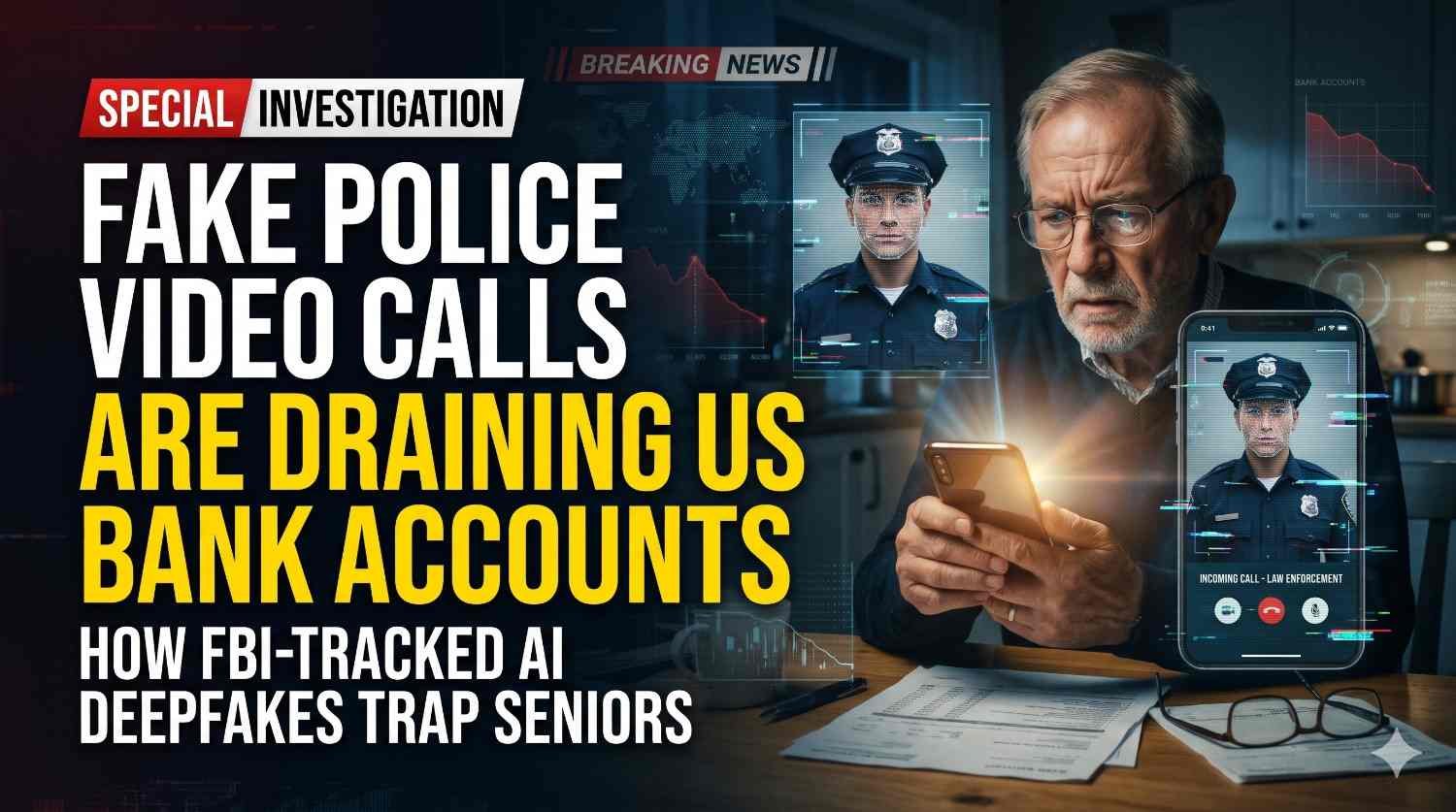
To understand how a modern fake police warrant scam dismantles a family’s balance sheet, consider a realistic household scenario based on verified FBI and FTC victim patterns. Suppose a 64-year-old retired teacher in Columbus, Ohio, receives a call displaying the spoofed main number of the Franklin County Sheriff’s Office.
The caller recites the retiree’s home address, claims she missed a federal grand jury subpoena, and cites a fabricated bench warrant linked to the recent national database alert. Demanding silence under a fake “gag order,” the impostor instructs her to withdraw $14,500 from her checking account and deposit cash into a nearby Bitcoin ATM to post a “refundable court bond”.
Once converted into cryptocurrency or wired across instant ACH rails, the $14,500 principal is virtually unrecoverable—and the financial fallout compounds quickly. If she liquidates an IRA distribution early to cover living costs or pays a 12% crypto kiosk fee ($1,740), her total household hit jumps to $16,240 plus potential federal tax reporting headaches on Form 1099-R.
Caption: An analysis of common cash-withdrawal, cryptocurrency kiosk, and wire-transfer pressure tactics targeting U.S. retirees and working households in 2026.
Regional and Demographic Breakdown Across the States
Federal data shows impersonation losses do not strike all demographics evenly. According to the FTC’s October 2026 report on protecting older consumers, reported aggregate fraud losses among older Americans surged from $600 million in 2020 to approximately $3 billion in 2025.
Within IC3 filings alone, 12,444 seniors aged 60 and over each lost more than $100,000 in a single year. Exposure to a fake police warrant scam spikes in suburban counties across Florida, Texas, California, and Ohio, where retirees hold higher liquid home equity and accessible retirement accounts.
Working-age adults and small-business owners also face growing risk from spoofed text notices alleging unpaid court citations or compromised background checks. Readers tracking ongoing federal consumer alerts, financial policy shifts, and public-sector guidance can monitor updated briefings at SarkariResultine.com alongside official agency portals.
Step-by-Step Actionable Checklist: How to Prepare Before the Deadline
Stopping a fake police warrant scam before money leaves your checking or retirement account requires immediate verification habits. Follow these five operational steps whenever an unsolicited caller claims you face arrest or breach exposure:
- Hang Up Immediately Without Sharing Data: Real police officers, U.S. Marshals, and FBI agents never demand gift cards, wire transfers, payment apps, or cryptocurrency kiosks to clear a warrant. Never confirm your Social Security number, date of birth, or banking routing digits on an inbound call.
- Verify Through Independent Official Directories: Do not trust caller ID displays or callback numbers given by the caller. Look up your county courthouse clerk or local police non-emergency line on a verified
.govdirectory and call directly to check for any legitimate notice. - Ignore Unsolicited “NCIC Breach” Texts and Links: Scammers frequently send phishing emails claiming you must click a link to confirm whether your record appeared in the FBI hack. Navigate directly to official federal websites instead of tapping text URLs.
- Lock Down Accounts and Credit Files: Enable passkeys or app-based multi-factor authentication on banking, brokerage, and email logins. Place free security freezes with Equifax, Experian, and TransUnion if you suspect your personal records were exposed.
- File Rapid Federal Reports Within 24 Hours: If you received a threat or sent funds, immediately alert your bank’s wire-recall team and file complaints with the FBI Internet Crime Complaint Center (IC3) and the FTC at ReportFraud.ftc.gov. Fast filings feed real-time disruption workflows at the new federal Threat Disruption Center.
Critical Timeline, Enforcement Dates & What Happens Next
Federal oversight of the NCIC intrusion probe and national anti-scam disruption efforts moves along several documented milestones across 2026:
- April 2026: The FBI published its 2025 IC3 Annual Report documenting $20.877 billion in cybercrime losses and $797.94 million in government impersonation losses.
- June 15, 2026: The FTC released data showing reported imposter scam losses hit $3.5 billion in 2025, nearly triple 2020 levels.
- October 1, 2026: The FTC published an Advance Notice of Proposed Rulemaking to potentially expand 16 C.F.R. Part 461 regarding online platforms that facilitate impersonation fraud.
- November 18, 2026: The Homeland Security Task Force launched the Threat Disruption Center, connecting more than 30 federal agencies and 440 state and local partners with private firms to pause victim transfers and shut down fake police warrant scam infrastructure faster.
- November 20–21, 2026: News organizations confirmed the FBI probe into an apparent NCIC hack covering a system with over 19.3 million FY 2025 records.
- December 2026 – Early 2027 (Expected): Federal investigators are expected to complete forensic scoping of the NCIC incident, issue formal notifications if citizen exfiltration is confirmed, and advance FTC platform-impersonation rulemaking comments.
Official Primary Sources & Verification Links
Verify active breach updates, statutory protections, and federal fraud-reporting channels directly through these authoritative primary resources:
- Associated Press: FBI Probing Apparent Hack of National Criminal Justice Database (Nov. 21, 2026)
- FBI Internet Crime Complaint Center (IC3): 2025 Annual Internet Crime Report (PDF)
- Homeland Security Task Force: Threat Disruption Center Official Announcement (Nov. 18, 2026)
- Electronic Code of Federal Regulations: 16 C.F.R. Part 461 — Rule on Impersonation of Government and Businesses
- Federal Trade Commission: $3.5 Billion Imposter Scam Loss Release (June 15, 2026)
- U.S. Department of Justice Manual: Federal Officer Impersonation Statute (18 U.S.C. § 912)
Frequently Asked Questions (People Also Ask)
How can I tell immediately if a call is a fake police warrant scam?
Recognizing a fake police warrant scam comes down to one ironclad rule: genuine U.S. law enforcement agencies never call to demand money to cancel an arrest warrant. Real officers serve warrants in person, and courts issue formal written notices rather than requesting gift cards, wire transfers, or crypto deposits.
Did hackers steal my personal warrant records in the November 2026 FBI NCIC hack?
Federal investigators have not confirmed whether attackers viewed, copied, or exfiltrated any of the 19.3 million records housed in NCIC during fiscal year 2025. Even without confirmed theft, scammers exploit public headlines about the probe to run convincing phishing campaigns.
Why does my caller ID show my real local police department number?
Fraudsters use inexpensive voice-over-IP software to spoof caller ID displays so an overseas call appears to originate from your local sheriff or courthouse. Always hang up and dial the agency’s verified number listed on its official government website.
What should I do if I already sent money in a fake police warrant scam?
Contact your bank, wire service, or card issuer’s fraud desk immediately to request an emergency recall or transaction freeze. Then file detailed reports with local police, ReportFraud.ftc.gov, and the FBI’s IC3 portal—and reject anyone who contacts you later charging upfront “recovery fees”.
Can the new federal Threat Disruption Center refund money lost to warrant scams?
No, the Homeland Security Task Force Threat Disruption Center is an intelligence-sharing hub designed to interrupt active payments and dismantle scam infrastructure, not a direct victim refund service. Victims must still report incidents promptly through IC3 and their financial institution to maximize any chance of freezing stolen funds.





Leave a Reply