

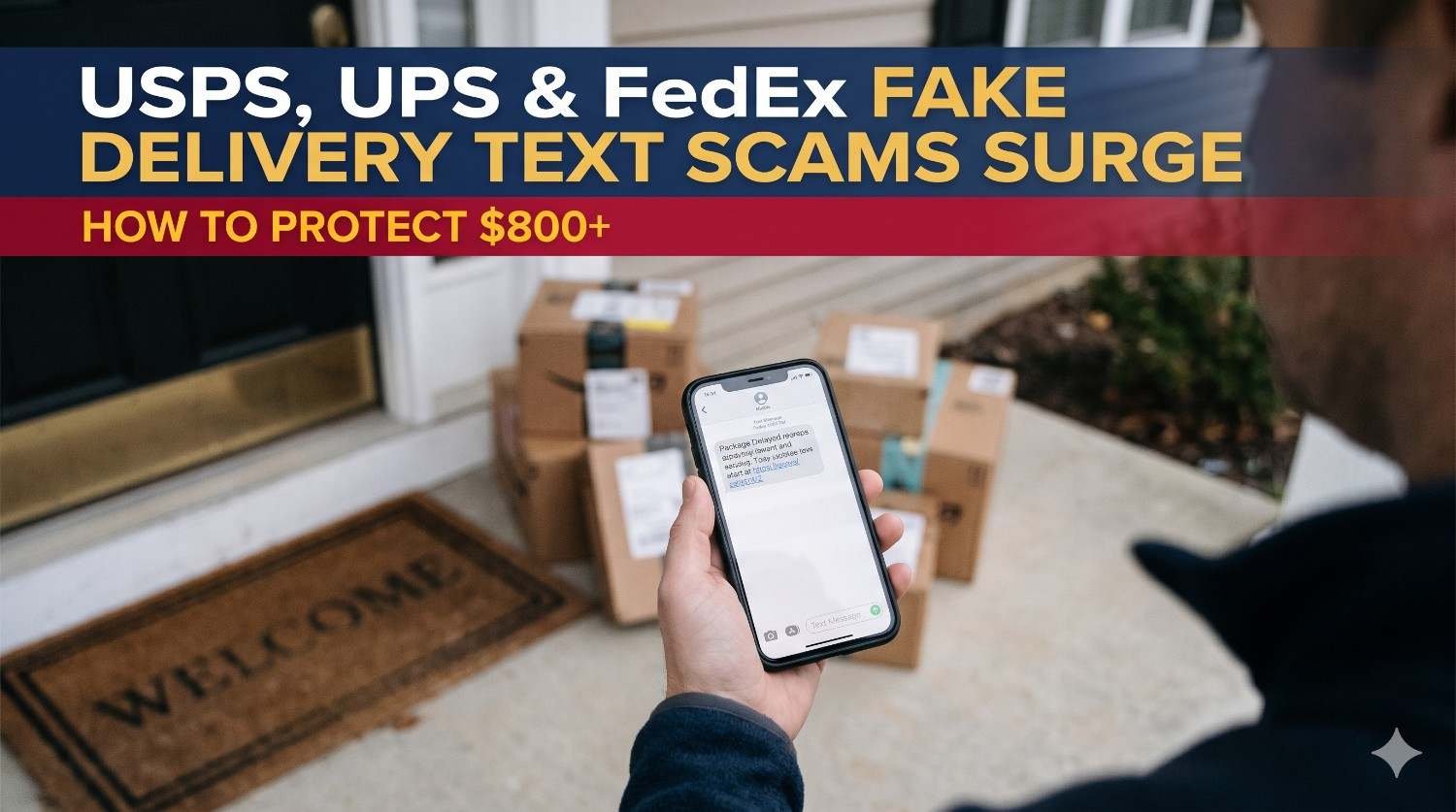
WASHINGTON — Every hour since Black Friday wrapped up, millions of American phones have buzzed with urgent alerts claiming a holiday parcel cannot be delivered without an immediate address confirmation. These fake delivery text scams impersonating the U.S. Postal Service, UPS, and FedEx are not after the $0.30 “redelivery fee” shown on the spoofed checkout screen.
They are engineered to harvest your card number, bank login, and one-time passcodes in real time, draining an average of $800 per victim before the weekend ends—and exposing households to thousands more in downstream credit damage. Whether you type in a credit card or a debit card determines if federal banking law caps your loss at $50 or leaves your entire checking balance exposed.
Key Financial Takeaways (At a Glance):
- Who Is Impacted: US holiday online shoppers expecting USPS, UPS, or FedEx parcels from Black Friday through Christmas.
- Official Loss Benchmark: Reported US fraud hit $16.1 billion at the FTC and $20.877 billion at the FBI IC3 in 2025, with phishing and spoofing ranking #1 by complaint count.
- Peak Window: November 28 through December 19, 2026 USPS domestic shipping cutoffs.
- Governing Laws: TILA/Regulation Z (credit), EFTA/Regulation E (debit), and FCRA (credit freezes).
- Smart First Move: Forward texts to 7726 and verify tracking only on official carrier apps.
Fake Delivery Text Scams: Official Rules, Federal Policies, and What Just Changed
Fraud networks no longer rely on broken-English SMS blasts that wireless carriers easily quarantine. Phishing-as-a-service platforms such as Darcula and Lucid now route attacks over end-to-end encrypted Apple iMessage and Google RCS channels, blinding carrier spam filters to the malicious links inside.
The financial toll across American households has reached historic territory. Consumer Sentinel Network data released by the Federal Trade Commission in 2026 confirmed roughly $16.1 billion in reported fraud losses for 2025—a 26% annual surge—led by $3.5 billion in imposter scams.
Meanwhile, the FBI Internet Crime Complaint Center logged 1,008,597 complaints and $20.877 billion in cybercrime losses in its 2025 annual report published in April 2026. Phishing and spoofing topped all complaint categories with 191,561 filings and $215.8 million in direct losses, alongside $893 million tied to AI-assisted fraud.
Insider Underwriter Reality Check: Modern smishing kits stream every keystroke you type—card digits, CVV codes, and bank SMS passcodes—live to an operator’s dashboard, allowing thieves to provision your card into an Apple Pay or Google Pay wallet in under three minutes.
Federal regulators are tightening the screws heading into winter. On November 23, 2026, FCC Chairman Brendan Carr proposed expanded mandatory scam-blocking rules requiring downstream telecom providers to intercept fraudulent traffic, with a formal Commission vote slated for December 17, 2026.
At the same time, the U.S. Postal Inspection Service maintains an ironclad policy consumers routinely overlook during holiday chaos. USPS will never initiate an unsolicited text message requesting a link click, personal identifying data, or payment unless you explicitly registered a specific tracking number for SMS alerts.
Both UPS and FedEx enforce identical guardrails against fake delivery text scams. Neither private carrier asks for account credentials, Social Security numbers, or redelivery fees over unsolicited texts, and legitimate UPS notices always include a verifiable tracking code you can check directly at ups.com.
Federal enforcement agencies including the FTC, FBI IC3, FCC, and U.S. Postal Inspection Service have escalated holiday smishing alerts as encrypted messaging fraud surges across the United States.
Federal Protections, Banking Laws, and Fake Delivery Text Scams Liability Rules
Once a victim enters financial credentials on a counterfeit shipping portal, federal law splits consumer protection sharply by payment rail. Understanding the exact statutory boundaries inside your bank’s compliance department prevents costly mistakes during the first 48 hours.
- Credit Cards (Truth in Lending Act / Regulation Z): Under 12 CFR § 1026.12(b), federal law caps your liability for unauthorized credit card charges at $50, and major US networks extend voluntary $0 zero-liability policies. You have 60 days from your billing statement date to submit a written billing-error dispute under § 1026.13, requiring issuers to acknowledge within 30 days and resolve within 90 days.
- Debit Cards & ACH (Electronic Fund Transfer Act / Regulation E): Under 12 CFR § 1005.6(b), debit liability escalates steeply based on speed. Report within two business days and your cap is $50; report after two business days and liability jumps to $500; wait past 60 days from your statement date and your exposure becomes legally unlimited.
- Credit Bureau & Underwriting Fallout (FCRA): Under the Fair Credit Reporting Act, you hold the federal right to place free security freezes and fraud alerts at Equifax, Experian, and TransUnion. If smishers steal your date of birth and Social Security number alongside your card, fraudulent hard inquiries and maxed-out revolving balances can crush your FICO Score 8, FICO Score 10T, and VantageScore 4.0 right before a 2027 mortgage or auto-loan application.
- FDIC & NCUA Deposit Misconception: Neither FDIC nor NCUA deposit insurance reimburses consumer smishing theft. Those federal funds protect depositors strictly against institutional bank or credit union insolvency, leaving fraud recovery entirely governed by Regulation Z, Regulation E, and CFPB oversight.
Even more alarming for bank customers, Regulation E does not automatically protect transfers you personally authorize under false pretenses—a legal distinction that separates full reimbursement from permanent loss in the side-by-side matrix below.
2025 vs. 2026 Smishing Threat, Liability & Recovery Matrix (Side-by-Side Breakdown)
Payment choice dictates your legal leverage when a spoofed tracking link compromises your wallet. Here is how US federal banking rules, 2026 threat vectors, and bank underwriting risks stack up across every common holiday payment method.
| Payment Method / Channel | Governing US Federal Law | Statutory Fraud Liability Cap | Official Dispute Window | Bank Provisional Credit / Resolution | Credit Score & Underwriting Risk |
|---|---|---|---|---|---|
| Credit Card (Consumer) | TILA / Reg Z (12 CFR 1026) | $50 ($0 network policy) | 60 days from statement (written) | Disputed charge withheld; 30-day ack / 90-day resolve | Low if disputed fast; no direct cash drain |
| Debit Card (Consumer) | EFTA / Reg E (12 CFR 1005) | $50 / $500 / Unlimited (tiered) | 2 business days / 60 days from statement | 10 business days provisional credit; 45-day resolve | High cash-flow risk; bounced rent/loan payments hurt FICO |
| Bank ACH / Zelle / FedNow | EFTA / Reg E (unauthorized only) | $0–$500 unauthorized; 100% loss if user-authorized | 60 days from statement | 10 business days if strictly unauthorized EFT | Severe liquidity shock; overdraft fees & DTI disruption |
| Digital Wallet (Apple/Google Pay) | Follows underlying card (Reg Z or E) | Matches linked credit or debit card | Matches linked card rail | Requires explicit token revocation at bank | High if thieves pass OTP and provision persistent token |
| Business Debit / 1099 Accounts | UCC Article 4A / Bank Agreement | No Reg E statutory cap (contractual) | Often 24–48 hours per treasury contract | Rarely offers consumer provisional credit | Threatens SBA/business credit lines and payroll |
Comparing 2025 to late 2026 exposes two brutal shifts inside bank fraud departments. First, consumer fraud losses across the FTC jumped from $12.5 billion in 2024 to $16.1 billion in 2025—a 26% climb mirroring the FBI IC3’s 26% jump to $20.877 billion—forcing banks to scrutinize “authorized” scam claims far more aggressively.
Second, fake delivery text scams now weaponize real-time one-time passcodes. When a holiday shopper types a bank’s six-digit verification code into a spoofed UPS page thinking it confirms a $0.30 charge, the bank’s fraud engine logs an authenticated Apple Pay enrollment—making debit chargebacks dramatically harder to win.
Using a credit card rather than a debit card during holiday shopping does not merely add convenience; as the worked borrower math below demonstrates, it can protect thousands of dollars in checking cash and future loan interest.
Real-World Dollar Math: Exact Cost & Savings Scenarios for American Borrowers
To see how a single holiday text cascades through household finances and loan underwriting, compare two realistic American shoppers who both fall for an identical spoofed USPS “$0.30 address-verification” text on Cyber Monday 2026. Both enter their card details and accidentally relay a six-digit bank verification code.
Borrower A — Debit Card + Delayed Discovery (645 FICO Score 8, Fair Tier):
- Immediate Fraud Theft: Thieves tokenize her debit card into a mobile wallet within three minutes and run $2,400 in electronics purchases.
- Regulation E Liability Penalty: Busy with holiday travel, she spots the drained checking balance 12 business days later—missing the 2-business-day $50 cap and triggering the $500 statutory liability tier under 12 CFR § 1005.6(b).
- Secondary Liquidity Damage: Before provisional credit arrives on business day 10, her scheduled auto-loan autopay bounces, triggering $70 in bank NSF and lender late fees plus a 30-day delinquency notice if unresolved.
- Downstream Underwriting Cost: A single 30-day late payment cuts her Fair 645 FICO Score 8 down to ~580. When she finances a $25,000 used car over 60 months in spring 2027, her APR jumps from 7.2% ($497/month) to 11.4% ($549/month)—adding $3,120 in extra loan interest.
- Total Net Financial Hit: $3,690 in direct liability, fees, and excess borrowing costs.
Borrower B — Credit Card + Instant Freeze (745 FICO Score 8, Very Good Tier):
- Immediate Fraud Theft: Thieves attempt $2,400 in charges on his consumer credit card.
- Regulation Z Protection: He spots the instant app push alert, locks the card, demands a digital wallet token purge, and submits a written TILA dispute under 12 CFR § 1026.13. Out-of-pocket liability: $0 (legally capped at $50).
- Checking & Credit Preservation: His checking account stays untouched, zero bills bounce, and a free FCRA freeze blocks new-account fraud. His 745 FICO Score 8 stays intact for 2027 borrowing.
- Total Net Financial Hit: $0—a $3,690 lifetime savings gap caused entirely by payment rail and response speed.
The financial gap between credit card Regulation Z protections and debit card Regulation E exposure can exceed thousands of dollars once bounced payments and FICO score damage are factored in.
Hidden Lender Traps, Tax Consequences, and Overlooked Edge Cases
Major personal finance roundups almost always stop at “call your bank,” glossing over four high-stakes traps buried in bank fine print and federal tax law.
- The Persistent Digital Wallet Token Trap: Asking your bank to cancel a compromised plastic card number does not automatically deactivate tokenized credentials provisioned to a scammer’s Apple Pay or Google Pay wallet. Many issuers auto-update digital wallets via Visa Account Updater or Mastercard Automatic Billing Updater—meaning thieves keep charging your brand-new replacement card unless you explicitly instruct the fraud agent to “revoke all digital wallet tokens.”
- The Cash-Advance APR Ambush: If criminals push a fraudulent peer-to-peer payment or wire equivalent through a compromised credit card, issuers classify it under 12 CFR § 1026.2(a)(15) as a cash advance carrying 24% to 30% APR with zero grace period—requiring an immediate written fraud dispute so interest stops accruing.
- 2026 Federal Tax Disallowance (No IRS Bailout): Many victims assume stolen funds can be written off on Form 4684. Under Internal Revenue Code § 165(h)(5)—expanded and made permanent starting in 2026 by the One Big Beautiful Bill Act (P.L. 119-21)—personal casualty and theft losses remain strictly disallowed unless tied to a federally declared or qualifying state-declared disaster. Guidance from the Internal Revenue Service (Chief Counsel Advice 202511015) further confirmed that non-investment consumer scams lack a profit motive under § 165(c)(2) and cannot be deducted on personal Form 1040 returns.
- Vulnerable Borrower Edge Cases: Self-employed 1099-NEC freelancers using business debit cards lose consumer Regulation E shields (though verified business theft losses may still be evaluated under IRC § 165(c)(1)). Meanwhile, Americans aged 60 and over remain prime holiday targets, having reported $7.75 billion in FBI IC3 losses in 2025—a 59% spike averaging $38,500 per complaint.
For ongoing consumer banking alerts, federal regulatory calendars, and updated borrower protection schedules as agencies roll out new rules, readers can track official developments via SarkariResultine.com/us. Understanding these hidden financial consequences of fake delivery text scams sets the stage for the exact defense sequence every household should execute today.
Step-by-Step Defense & Recovery Blueprint: Exact Moves to Make Right Now
Whether you just received a suspicious parcel alert or already typed your digits into a spoofed checkout screen, executing these six steps in exact order locks down your money and preserves your legal rights against fake delivery text scams.
- Verify Exclusively Inside Official Carrier Dashboards: Never tap a link or reply “STOP” to an unexpected parcel text, as replying confirms your phone number is active. Open your browser directly to
usps.com,ups.com, orfedex.com, and enroll in free monitoring—USPS Informed Delivery, UPS My Choice, and FedEx Delivery Manager—which preview genuine incoming shipments safely. - Report the Smishing Infrastructure Immediately: Copy the suspicious message without clicking the URL and forward it to 7726 (SPAM) so wireless carriers map and block the sender. Forward carrier-specific lures to
spam@uspis.gov(USPS),fraud@ups.com(UPS), orabuse@fedex.com(FedEx), then block and delete the thread. - Kill Cards AND Digital Wallet Tokens Simultaneously: If you entered payment info, call the number printed on the back of your card immediately. Demand two distinct actions: permanent card cancellation and full revocation of all linked Apple Pay, Google Pay, and recurring merchant updater tokens, followed by a written Reg Z or Reg E dispute confirmation number.
- Audit Free Credit Reports and Place FCRA Security Freezes: Pull your official weekly credit files at AnnualCreditReport.com to verify no unauthorized hard inquiries or trade lines appeared. Place free statutory security freezes at Equifax, Experian, and TransUnion—freezes do not lower your FICO score and can be lifted temporarily in minutes whenever you apply for a mortgage, auto loan, or credit card.
- Lock In Statutory Blocking Rights With Federal Reports: If you entered a driver’s license number, date of birth, or Social Security number, generate an official Identity Theft Report at IdentityTheft.gov and file a cybercrime report at IC3.gov. Under FCRA § 605B, an FTC Identity Theft Report forces credit bureaus to block fraudulent accounts within four business days—and protects you from wrongful Form 1099-C tax bills if a criminal opens and defaults on debt in your name.
- Escalate Stalled Bank Refunds and Lock Your IRS Profile: If a bank drags its feet past the 10-business-day Regulation E provisional credit deadline or wrongfully denies an unauthorized claim, submit a formal complaint with the Consumer Financial Protection Bureau. Finally, enroll in a free six-digit IRS Identity Protection PIN (IP PIN) online so criminals cannot file a fraudulent 2026 Form 1040 refund using your stolen holiday credentials.
Timing your defensive moves matters just as much as taking them, because the next four weeks bring a dense cluster of shipping cutoffs, Federal Reserve policy shifts, and federal enforcement deadlines.
2026–2027 Key Financial Deadlines, Fed Calendar & What Happens Next
Fraudsters synchronize fake delivery text scams directly with US retail and policy calendars, knowing distracted shoppers drop their guard when deadlines tighten. Mark these verified late-2026 and early-2027 milestones on your household financial calendar:
- November 28 – December 2, 2026 (Black Friday to Cyber Monday Surge): Peak e-commerce checkout volume triggers the highest wave of spoofed “address incomplete” iMessage and RCS lures targeting active shoppers.
- December 8–9, 2026 (Federal Reserve FOMC Decision — 2:00 PM EST): The FOMC announces its final 2026 benchmark rate decision (currently in a 3.75%–4.00% target range) followed by the Chair’s 2:30 PM EST press conference. Elevated benchmark rates keep variable credit card APRs near historic highs, making rapid TILA billing-error disputes essential so disputed fraud balances never accrue punitive interest.
- December 17, 2026 (USPS Domestic Cutoff & FCC Open Meeting): USPS Ground Advantage and First-Class Mail Christmas cutoffs fall on the exact same day the FCC votes on Chairman Brendan Carr’s mandatory carrier scam-blocking framework.
- December 18–19, 2026 (Priority Mail & Express Cutoffs): Final USPS Priority Mail (Dec. 18) and Priority Mail Express (Dec. 19) shipping deadlines spark last-minute “pay immediately or parcel returns to sender” panic texts.
- January 15 – February 28, 2027 (60-Day Reg Z / Reg E Statement Cutoff): Audit your December 2026 bank and credit card statements line by line before the 60-day federal statutory dispute clock expires.
- April 15, 2027 (IRS Form 1040 Filing Deadline): File early with an IRS IP PIN if your personal identity data was exposed during the 2026 holiday rush.
Official Government Resources & Primary Financial Verification Links
Bookmark these verified federal agencies and federally mandated verification portals—never trust phone numbers or URLs pasted inside unsolicited text messages:
- U.S. Postal Inspection Service (USPIS) — Official federal postal law enforcement portal for reporting USPS smishing and mail fraud (
spam@uspis.gov). - FTC ReportFraud Portal — Central federal reporting intake feeding the Consumer Sentinel Network.
- FTC IdentityTheft.gov — Official federal recovery plan generator and statutory FCRA identity-theft affidavit.
- FBI Internet Crime Complaint Center (IC3) — Federal cybercrime reporting portal for financial and spoofing losses.
- Consumer Financial Protection Bureau (CFPB) — Federal banking regulator for escalating Regulation E, Regulation Z, and credit-reporting disputes.
- AnnualCreditReport.com — The sole federally authorized source for free weekly Equifax, Experian, and TransUnion credit reports.
- Federal Reserve FOMC Calendar — Official schedule for US benchmark interest-rate announcements and policy statements.
- Internal Revenue Service (IRS) — Official portal for IRS Identity Protection PIN (IP PIN) enrollment and Form 4684 theft-loss rules.
- Federal Deposit Insurance Corporation (FDIC) — Bank charter verification and official consumer banking cybersecurity guidance.
Frequently Asked Questions (People Also Ask)
Will USPS, UPS, or FedEx ever text me to pay a redelivery fee?
No. Neither USPS, UPS, nor FedEx sends unsolicited text messages demanding a payment, credit card number, or personal credentials to fix a delivery address. USPS texts customers strictly when they explicitly opt into tracking alerts for a specific package, and official redelivery scheduling is always free through verified carrier portals.
Does clicking a fake delivery text link automatically infect my phone or hurt my credit score?
Simply tapping a spoofed tracking link on an updated iPhone or Android device rarely installs malware by itself and does not directly impact your credit score. The real financial danger happens when you type card numbers, bank logins, one-time passcodes, or Social Security digits into the counterfeit form, triggering immediate theft or fraudulent credit applications.
Will my bank refund money lost to fake delivery text scams if I used a debit card?
Recovery depends on speed and whether the bank classifies the transaction as unauthorized under Regulation E (12 CFR § 1005.6). Reporting unauthorized debit fraud from fake delivery text scams within two business days caps statutory liability at $50, but waiting longer raises exposure to $500 or unlimited loss—and voluntary user-authorized transfers often receive no federal refund protection.
Can I deduct money stolen in a holiday delivery scam on my 2026 federal tax return?
For personal household victims, no. Under IRC § 165(h)(5)—made permanent for 2026 and beyond by the One Big Beautiful Bill Act—and IRS Chief Counsel Advice 202511015, personal non-investment scam losses cannot be deducted on Form 4684 unless linked to a qualifying disaster. Only verified trade or business theft losses may qualify under IRC § 165(c)(1).
What should I do if I already entered my Social Security number or credit card on a spoofed tracking site?
Call your card issuer immediately to cancel the card and revoke all digital wallet tokens, then lock down your Equifax, Experian, and TransUnion credit files with free FCRA security freezes. Immediately file an FTC Identity Theft Report at IdentityTheft.gov and request an IRS Identity Protection PIN so fake delivery text scams cannot escalate into tax-refund fraud.
Editorial Financial Disclosure: Federal banking regulations, interest rates, tax statutes, and carrier policies referenced in this report are verified as of November 28, 2026, remain subject to legislative or regulatory change, and are provided strictly for informational purposes rather than personalized financial, legal, or tax advice.




Leave a Reply