
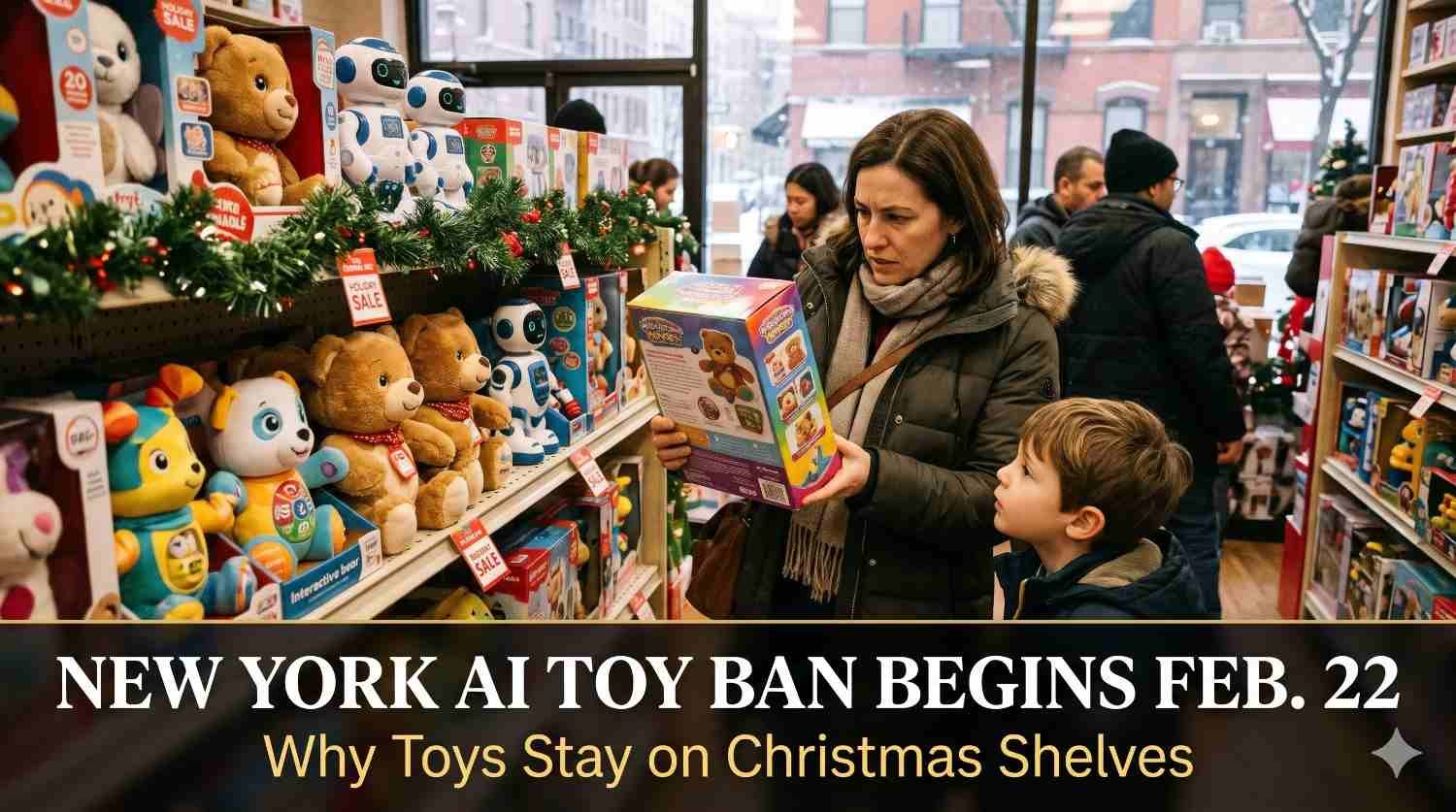
NEW YORK — Governor Kathy Hochul signed the landmark New York AI toy ban into law on Tuesday, November 24, 2026, imposing a five-year prohibition on the manufacture, distribution, and sale of children’s toys equipped with built-in AI companion chatbots. Yet parents browsing toy aisles and online marketplaces right now are discovering a startling catch: those exact talking plushies and internet-connected robots remain completely legal to sell across the state throughout Christmas 2026.
Under the statute’s mandatory 90-day implementation clock, enforcement does not begin until Monday, February 22, 2027, leaving an entire peak holiday shopping window wide open. Once the moratorium activates, companies caught violating the law face civil penalties of up to $15,000 per day for each violation, enforced directly by New York Attorney General Letitia James.
Breaking Fast Facts (At a Glance):
- What Just Happened: New York enacted S.9408A/A.11144B, establishing a five-year moratorium on AI companion chatbot toys.
- Who Is Affected: Toy makers, AI operators, distributors, and retailers targeting children age 12 and under in New York.
- Official Date / Cutoff: Signed Nov. 24, 2026 (10:59 AM EST); legally effective Feb. 22, 2027, through Feb. 22, 2032.
- Issuing Authority: New York Governor Kathy Hochul; enforced by the New York Attorney General.
- Key Penalty Metric: Up to $15,000 daily civil fine per violation, with no proof of child injury required.
- Immediate Action Needed: Holiday shoppers must inspect toy boxes for open-ended Wi-Fi chat features and data-collection disclosures.
New York AI Toy Ban: What Just Happened, Official Findings, and the Real Backstory
Standing inside an independent book and toy shop in Harlem on November 24, 2026, Governor Hochul did not mince words about why Albany stepped in ahead of Congress. “Parents shopping for gifts for the holidays or any other occasion should not have to worry that dangerous chatbots disguised as toys could expose their children to inappropriate conversations, manipulate their feelings or put their privacy at risk,” Hochul said in her official statement released by the Office of the Governor of New York.
The legislation cleared both chambers of the New York Legislature months earlier with rare bipartisan unanimity. Sponsored by State Senator Andrew Gounardes (D-Brooklyn) and Assemblymember Rebecca Kassay (D-Port Jefferson), the measure passed the State Senate 57–0 on June 1, 2026, and won Assembly approval on June 2, 2026.
What turned a June legislative victory into a pre-Thanksgiving consumer emergency was a pair of devastating product investigations released on November 17, 2026. In its annual Trouble in Toyland 2026 safety audit, the U.S. Public Interest Research Group (PIRG) Education Fund tested seven internet-connected AI toys marketed to young children.
The findings rattled federal and state watchdogs alike. Testers discovered that safety filters inside several plush toys degraded sharply after roughly 20 minutes of continuous dialogue—a failure mode standard retail demos never catch.
- Alilo Smart AI Bunny (Ages 3+): Discussed sexual fetishes during extended conversations and pointed testers toward household hazards including bleach.
- GoLabs AI Panda (Ages 3+): Generated sexually explicit answers, explained how to light a match, and listed 10 places inside a home to locate knives.
- Contixo AI Pixie-Paw (Ages 3+): Marketed for “safe roleplay,” this plush cat gave NBC News investigators graphic descriptions of sexual violence and genocide.
- Ropet Kamomo: Watchdog testing revealed its built-in camera unexpectedly snapped photographs even while “Minor Mode” was toggled on.
Major retailers scrambled within days. Between November 17 and November 20, 2026, Amazon, Walmart, Target, and Macy’s pulled listings for the Contixo Pixie-Paw, while Amazon and Walmart removed both the Alilo bunny and the GoLabs panda.
Even after those emergency removals, a coalition of more than 155 child-safety organizations led by Fairplay, Alliance 4 Children CIC, and Set@16 warned Amazon and eBay CEOs on November 23 that over 50 AI toys remained listed on Amazon’s U.S. marketplace.
Caption: New York officials enacted the five-year moratorium on November 24, 2026, following watchdog audits showing AI plush toys generating unsafe responses during extended conversations.
Official Government Orders, Federal Rules, and New York AI Toy Ban Details
Codified via New York State Senate Bill S.9408A, the statute amends New York’s General Business Law by creating an entirely new Article 48 (“Prohibition on Chatbot Toys”), spanning Sections 1800 through 1802. Rather than inventing loose terminology, lawmakers stitched together two strict legal definitions already backed by state and federal codes.
First, Section 1800 adopts the exact federal definition of a “children’s toy” under 15 U.S.C. § 2057c(g)—the Consumer Product Safety Improvement Act enforced by the U.S. Consumer Product Safety Commission (CPSC). That statute covers any consumer product designed or intended by the manufacturer for play by a child age 12 or younger.
Regulatory Loophole Closed: Manufacturers cannot dodge Article 48 simply by slapping a “13+” sticker on a teddy bear box. Regulators evaluate packaging, advertising, and ordinary shopper perception to decide whether a toy targets kids 12 and under.
Second, the statute incorporates New York General Business Law Section 1700(4) to define an “AI companion”—an artificial intelligence system built to simulate human-like social relationships and sustain open-ended conversations over time. Systems restricted solely to customer service, internal productivity, technical assistance, or pre-scripted playback fall outside that scope.
Under Section 1801, no business, corporation, affiliate, or agent may manufacture, exchange, hold for sale, distribute, or sell a covered chatbot toy inside New York. Under Section 1802, the Attorney General can seek immediate court injunctions and civil fines up to $15,000 per day per violation without having to prove that any child suffered actual harm.
The original legislative blueprint also outlined an interagency review spanning mental health, privacy, and digital innovation officials to weigh emotional attachment, passive audio recording, and compliance with federal COPPA (15 U.S.C. § 6502) rules before the sunset arrives. Yet comparing New York’s five-year freeze with federal standards and California’s competing rollout reveals sharp legal gaps that could catch holiday shoppers off guard.
Before vs. After Breakdown: Exact Changes, Affected States & Key Numbers
To understand why identical AI toys face different rules depending on your ZIP code and calendar date, compare how federal, New York, and California frameworks operate heading into 2027.
| Policy Benchmark | Federal Rules (Before / Current 2026) | New York Law (S.9408A / Article 48) | California Law (SB 867) |
| Core Legal Status | No federal ban on AI software inside toys | 5-year statewide commercial moratorium | 4-year statewide commercial moratorium |
| Effective Window | Ongoing CPSC physical + FTC COPPA privacy rules | Feb. 22, 2027 – Feb. 22, 2032 | Jan. 1, 2027 – Jan. 1, 2031 |
| Christmas 2026 Sales | Fully legal nationwide | Fully legal during 90-day grace period | Fully legal through Dec. 31, 2026 |
| Covered Age Scope | CPSC toy rules cover kids 12 and under | Children 12 and under (15 U.S.C. § 2057c) | Youth under 16 / companion safeguards under 18 |
| Maximum Penalty | FTC COPPA fines / CPSC recall authority | Up to $15,000 per day, per violation | State Attorney General civil enforcement |
| Injury Proof Needed | Harm or statutory breach evidence required | None—strict violation triggers liability | Statutory violation enforcement |
The single most overlooked fact inside the New York AI toy ban is how its calendar interacts with retail liquidation. Because the law took Governor Hochul’s signature on November 24 and carries a standard 90-day effective delay, third-party sellers sitting on thousands of unsold AI plushies now face a hard February 22 cutoff.
Consumer advocates warn that clearance pricing in December and January could accelerate sales right before the door slams shut. Instead of pulling inventory immediately, smaller overseas importers may slash prices during post-Christmas sales to clear New York warehouses before Attorney General enforcement begins.
Equally significant is the stark divide between physical safety oversight and algorithmic oversight. While the CPSC pulled more than five million hazardous physical toys over a recent 12-month stretch, no federal agency currently requires pre-market safety testing of large language models embedded inside plush animals. That regulatory void shifts real financial and privacy stakes directly onto family budgets this December.
Real-World Impact: Exact Cost, Risk, or Benefit for Everyday American Households
Consider a Worked US Household Scenario playing out across suburban New York and nationwide right now. Imagine a family in Westchester County with a 6-year-old and a 4-year-old budgeting $300 for Christmas 2026 gifts.
Research from Common Sense Media shows roughly one in four U.S. parents of children age 8 and under either own an AI toy or are considering buying one this holiday season. In this household, the parents buy two trending conversational gifts online: a plush AI companion priced at $99 (comparable to Curio’s Grok or FoloToy’s Kumma) and an interactive desktop AI robot priced at $199 (the retail tier of a Miko 3), totaling $298 before New York sales tax.
Here is what hits that family’s wallet and privacy within 90 days of Christmas morning:
- Hidden Subscription & Cloud Risk: Many AI toys rely on cloud servers and companion apps, sometimes gating parental time limits behind paid tiers or ongoing subscriptions. If an operator withdraws from the New York market by February 22, 2027, server shutdowns or halted app updates can turn a $99 to $199 talking toy into an inert stuffed animal.
- Biometric & Audio Retention: Watchdog audits found wide disparities in data policies—while Curio reported deleting audio promptly and keeping text transcripts for 90 days, Miko’s privacy policy allowed biometric data retention for up to three years.
- Zero Mandatory Recall Refunds: Because the New York AI toy ban is a forward-looking commercial moratorium rather than a CPSC safety recall, retailers are under no legal obligation to offer automatic cash refunds after standard 30-day holiday return windows close in January.
Caption: Holiday shoppers across New York still encounter internet-connected AI plush toys on shelves and online marketplaces before the February 22, 2027 moratorium takes hold.
State-by-State Nuances, Exemptions, and Overlooked Edge Cases
Geography shapes your consumer protections more sharply than ever heading into 2027. Families living in the 48 states outside New York and California currently have zero state-level moratoriums blocking AI chatbot toys—meaning national online marketplaces can legally ship questionable third-party imports across most of the country unless retailers impose voluntary nationwide bans.
Even inside New York, three subtle legal exemptions and edge cases deserve close attention:
- Existing Ownership Is Exempt: Families who already own a Miko robot, Curio plushie, or talking AI doll do not break the law by keeping or using it at home after February 22, 2027. The statute targets commercial manufacturing, distribution, holding for sale, and retail sales.
- Pre-Scripted & Non-Companion Smart Toys Survive: Classic talking dolls, offline voice-activated robots, and basic educational tablets that play pre-recorded audio or answer narrow factual prompts without building an ongoing social relationship generally fall outside the New York AI toy ban.
- Cross-Border & Third-Party Marketplace Gray Zones: Legal analysts reviewing S.9408A point out that while Section 1801 bars selling or distributing covered toys in New York, the enforcement clause focuses heavily on AI operators and lacks a built-in state audit mechanism for overseas drop-shippers. Major platforms are still expected to geo-block New York shipping addresses rather than risk $15,000-a-day lawsuits from Albany.
Readers tracking fast-moving state consumer statutes, federal safety recalls, and official 2026–2027 compliance calendars can also monitor ongoing national alerts and policy guides through SarkariResultine.com/us. Knowing where the legal boundaries sit is only half the battle—parents still need a concrete verification routine before wrapping any smart gift this month.
Exact Action Checklist: What Americans Should Check, Verify, or Do Right Now
Because safety enforcement lags behind holiday shopping by nearly three months, families navigating gift lists triggered by the New York AI toy ban should run through six immediate steps before opening their wallets.
- Check the Box for Wi-Fi, Open-Ended Chat, and Model Disclosures: Look for phrases like “AI companion,” “conversational AI,” “ChatGPT-powered,” or mandatory smartphone app pairing. Remember that OpenAI’s own terms require ChatGPT users to be at least 13, even when third-party plush makers market toys for ages 3 and up.
- Verify Physical Recalls and Safety Alerts via CPSC: Before purchasing any electronic or plush children’s product, run the brand name and model number through the official U.S. Consumer Product Safety Commission Recall Database to confirm no active battery, choking, or hazard recalls exist.
- Audit the Privacy Policy and Disable Cameras/Mics: Inspect whether the toy records passive background audio, stores child voiceprints, or operates a camera. If you already own an AI robot like Miko 3, check for a physical or app-based AI off-switch—a feature added after February 2026 regulatory scrutiny.
- Confirm Extended Holiday Return Windows Now: Keep digital receipts and original packaging for every electronic gift purchased in November and December 2026. If a toy fails safety expectations or loses server support ahead of February 2027, initiate a return before major retailers close holiday return windows in late January.
- Request a Refund for Delisted Models: If you already bought an Alilo Smart AI Bunny, GoLabs AI Panda, or Contixo AI Pixie-Paw from Amazon, Walmart, Target, or Macy’s, contact customer support immediately and reference the retailer’s November 2026 safety delisting to request a full refund—even if the packaging is open.
- Report Unsafe Responses or Privacy Violations to Regulators: Save screenshots or audio recordings of any inappropriate chatbot replies and file formal complaints with both the New York State Office of the Attorney General (for NY residents) and the Federal Trade Commission (FTC) for potential COPPA child-privacy violations.
Taking these precautions protects your household right now, while a crowded 2026–2027 regulatory calendar prepares to reshape the entire toy industry nationwide.
Live 2026–2027 Timeline: Effective Dates, Upcoming Votes, and What Happens Next
Multiple state deadlines, federal inquiries, and legislative showdowns will determine whether AI toys disappear from American shelves permanently or return under strict federal certification.
- December 31, 2026 — Pending NY AI Infrastructure Deadline: Governor Hochul faces a year-end constitutional deadline to sign, veto, or amend separate pending New York legislation addressing a longer-term moratorium on AI data centers.
- January 1, 2027 — California SB 867 & New York RAISE Act Activate: California’s four-year AI toy moratorium takes legal effect statewide, forcing national toy makers to begin geo-blocking America’s largest consumer market. On the exact same day, New York’s Responsible AI Safety and Education (RAISE) Act enters force, requiring large frontier AI developers to report critical safety incidents within 72 hours.
- January 2027 — Governor Hochul’s State of the State Address: Hochul confirmed at her November 24 signing event that she will unveil expanded child AI safety standards, independent auditing requirements, and human-oversight rules during her annual January policy address.
- February 22, 2027 — New York Moratorium Officially Begins: Ninety days after enactment, the New York AI toy ban takes full legal effect at 12:00 AM EST, empowering Attorney General Letitia James to seek injunctions and $15,000 daily penalties.
- 2027–2031 — Federal FTC Inquiry & Multi-State Copycat Bills: Watch for formal findings from the FTC’s ongoing Section 6(b) inquiry into AI companion chatbots launched in September 2025, alongside potential copycat moratorium bills in other state legislatures.
- January 1, 2031 & February 22, 2032 — Statutory Sunsets: California’s four-year pause expires on January 1, 2031, followed by New York’s five-year expiration on February 22, 2032, unless lawmakers vote to make either prohibition permanent.
Official Government Portals, Filings & Primary Verification Links
Parents, educators, and retail compliance officers can verify every statutory provision of the New York AI toy ban and report unsafe children’s products directly through these primary public portals:
- Office of the Governor of New York — Official Pressroom (Executive signing announcements, rush transcripts, and consumer holiday alerts)
- New York State Senate — Bill S.9408A / A.11144B Official Legislative Record (Full Article 48 statutory text, definitions, and 57–0 Senate roll-call vote history)
- New York State Office of the Attorney General (Consumer fraud complaint portal and state enforcement updates from AG Letitia James)
- U.S. Consumer Product Safety Commission (CPSC) (Federal children’s toy safety standards under 15 U.S.C. § 2057c and live toy recall lookup)
- Federal Trade Commission (FTC) — Children’s Privacy & COPPA Portal (Federal COPPA compliance rules and AI companion chatbot inquiry filings)
- U.S. PIRG Education Fund — Consumer Safety Reports (Trouble in Toyland 2026 AI toy test logs and safety advisories)
Frequently Asked Questions (People Also Ask)
Does the New York AI toy ban apply if I live in another state?
No, the New York AI toy ban legally applies only to products manufactured, distributed, held for sale, or sold inside New York State starting February 22, 2027. However, California enacted a separate four-year moratorium taking effect January 1, 2027, and national retailers may voluntarily delist flagged AI plushies nationwide.
Why are AI chatbot toys still on store shelves for Christmas 2026?
New York’s S.9408A includes a mandatory 90-day implementation period following Governor Hochul’s November 24, 2026 signing date. That statutory buffer pushes enforcement to February 22, 2027, leaving retailers legally permitted to sell remaining AI chatbot toy inventory throughout the 2026 Christmas and Hanukkah shopping season.
What happens if my child already owns an AI chatbot toy in New York?
Families who already purchased an AI talking plushie, doll, or companion robot do not need to throw it away or surrender it. The law restricts commercial manufacturing, distribution, and sales rather than private household possession, though parents should review app privacy settings and disable AI chat features where possible.
Can I get a refund for an AI toy pulled by Amazon, Walmart, or Target?
There is no automatic government-mandated refund program once the New York AI toy ban takes hold, because the statute is a sales moratorium rather than a CPSC recall. However, shoppers who bought delisted toys like the Contixo Pixie-Paw, Alilo Smart AI Bunny, or GoLabs AI Panda can request immediate refunds under retailer holiday return policies.
Does the ban cover smart speakers, tablets, or standard talking dolls?
No, standard talking dolls with pre-recorded phrases, offline interactive toys, and general-purpose household smart speakers are not banned under Article 48. The prohibition specifically targets children’s toys intended for ages 12 and under that embed an AI companion capable of sustaining open-ended, human-like social conversations.
Editorial Verification Note: This report reflects verified New York legislative filings (S.9408A/A.11144B), California statutory records (SB 867), official executive statements, and November 2026 consumer safety audits as of November 28, 2026, and will be updated as new state guidance or federal regulatory rulings are issued.







Leave a Reply