

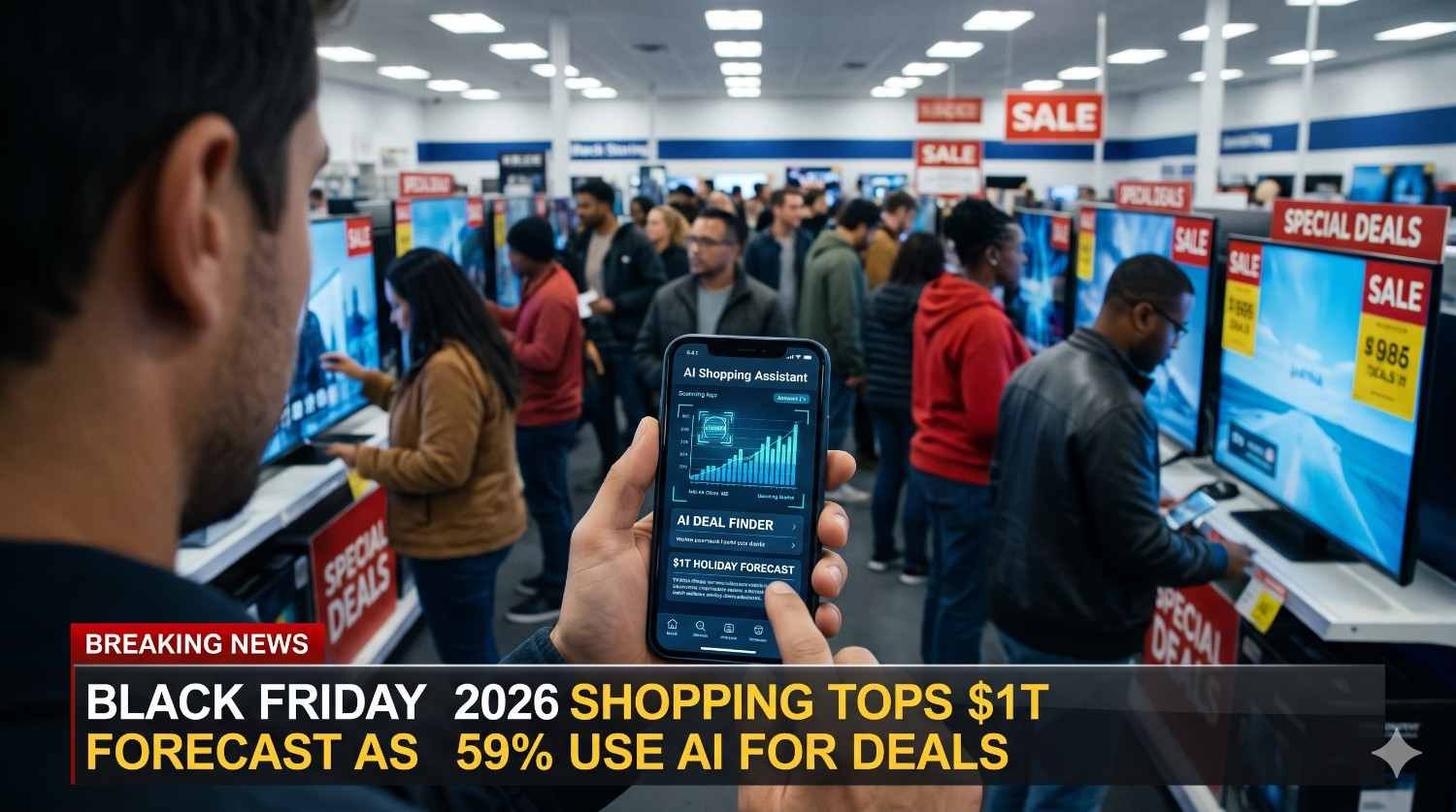
Black Friday 2026 shopping surged past historic thresholds Friday morning as an estimated 182.7 million Americans mobilized for the five-day Thanksgiving weekend, pushing the National Retail Federation’s November–December holiday sales forecast above $1 trillion for the first time in U.S. history. Behind the record $1.013 trillion projection lies a sharp consumer pivot: 59% of holiday buyers are deploying artificial intelligence tools to track discounts—including 23% peak markdowns on televisions—to outmaneuver persistent inflation.
Early digital checkout numbers already beat Wall Street projections after Americans spent $7.1 billion online on Thanksgiving Day, up 10.4% from 2025, ahead of an expected $12.9 billion online haul on Black Friday by 11:59 p.m. PST. Yet federal pricing watchdogs and payment-network audits warn that automated bargain hunting carries hidden traps, from undisclosed dynamic markups to chatbots recommending mismatched merchandise.
Breaking Fast Facts (At a Glance):
- What Just Happened: U.S. holiday retail spending is forecast to cross $1.013 trillion (+4.2% year-over-year) as 59% of Thanksgiving weekend shoppers turn to AI tools for deal discovery.
- Who Is Affected: Roughly 182.7 million U.S. weekend shoppers—including 126 million on Black Friday and 66.1 million on Cyber Monday.
- Official Date / Cutoff: Core Cyber Week runs November 26 through November 30, 2026 (11:59 p.m. EST/PST retail cutoffs).
- Issuing Authority & Trackers: National Retail Federation (NRF), Adobe Analytics, U.S. Bureau of Labor Statistics (BLS), and Federal Trade Commission (FTC).
- Key Scope Metric: Peak TV discounts hit 23% on Black Friday, while broader electronics peak at 30% on Cyber Monday.
- Immediate Action Needed: Verify reference prices, disable automated AI checkouts, and document Buy Now, Pay Later (BNPL) terms before buying.
Black Friday 2026 Shopping: What Just Happened, Official Findings, and the Real Backstory
The headline $1.013 trillion figure released by the National Retail Federation marks a milestone for the American economy, rising 4.2% from $972 billion in 2025. That benchmark tracks core November 1 through December 31 retail sales while excluding auto dealers, gasoline stations, and restaurants.
Look beneath the top-line dollar surge, and a far tighter household reality emerges. Roughly half of that 4.2% growth stems from higher retail prices rather than fuller shopping carts, following five years of cumulative inflation documented by the U.S. Bureau of Labor Statistics.
According to the agency’s November 19, 2026 report, the Consumer Price Index for All Urban Consumers (CPI-U) climbed 22.0% over the five years ending October 2026, led by a 24.0% jump in food costs and a 33.2% surge in energy prices. Monthly inflation also ticked up 0.4% in October after rising 0.6% in September, squeezing discretionary gift budgets right as holiday promotions opened.
Newsroom Takeaway: Shoppers are not splurging freely—82% of Americans told NRF researchers they are actively cutting holiday expenses, including buying cheaper gifts (25%) and waiting specifically for Thanksgiving weekend discounts (20%).
That financial squeeze triggered a fast behavioral shift toward generative AI shopping assistants. NRF and Prosper Insights & Analytics surveyed 7,956 U.S. adults between October 30 and November 9, finding that 59% of Thanksgiving weekend buyers plan to use AI tools—rising to 71% among parents with children under 18.
Shoppers are using chatbots primarily for product recommendations (32%), gift brainstorming (31%), recipient list tracking (25%), budget control (25%), and scanning retailer sites for lowest prices (25%). Adobe Analytics recorded a 127% jump in U.S. retail website visits referred by AI chatbots between November 1 and November 22, projecting a 95% traffic spike on Black Friday alone.
Caption: Shoppers across major U.S. retail corridors are pairing mobile AI price-tracking apps with early doorbuster alerts to stretch strained 2026 holiday budgets.
Still, consumer trust has clear boundaries. Only 6% of AI-assisted holiday shoppers let bots complete checkout transactions, and 45% say nothing would convince them to hand over payment authority.
An independent 2026 evaluation by Visa shows why that caution makes sense. Testing 22 AI models from 12 research labs across 15 retail scenarios, Visa found models failed to match shopper requirements in 42% to 43% of runs—and in 54% of those failed attempts, the AI pushed a buy recommendation anyway.
Official Government Orders, Federal Rules, and Black Friday 2026 Shopping Details
While consumers deploy algorithms to hunt markdowns, major retailers use competing algorithms to customize shelf prices—a clash now directly in federal and state crosshairs. Under 16 CFR Part 233, the Federal Trade Commission’s Guides Against Deceptive Pricing prohibit retailers from advertising fake “former prices” inflated temporarily just to manufacture a steep holiday percentage cut.
On August 19, 2026, the Federal Trade Commission escalated enforcement by issuing a Proposed Enforcement Policy Statement on Personalized Pricing. The agency warned that hiding data-driven price variations likely violates Section 5 of the FTC Act, the Restore Online Shoppers’ Confidence Act (15 U.S.C. §§ 8401–8405), and the FTC Rule Against Unfair or Deceptive Fees.
Federal regulators followed up with formal Section 6(b) inquiry orders examining how companies feed browsing history, device type, and loyalty profiles into real-time pricing engines. On Capitol Hill, lawmakers are also weighing federal legislation including the Stop AI Price Gouging and Wage Fixing Act and the One Fair Price Act.
One major federal safeguard, however, vanished quietly before this year’s Black Friday 2026 shopping rush. In May 2025, the Consumer Financial Protection Bureau withdrew its May 2024 Buy Now, Pay Later interpretive rule (89 Fed. Reg. 47,068) and later confirmed it would not issue a replacement—meaning shoppers financing $807 million in Black Friday BNPL purchases cannot assume automatic credit-card-style federal dispute rights under Regulation Z.
Those overlapping rule changes reshape exactly which items offer genuine value this weekend—and which popular deals actually shrank compared to last year.
Before vs. After Breakdown: Exact Changes, Affected States & Key Numbers (Comparison Matrix)
Retailers stretched Black Friday into a month-long campaign this year, yet price tracking from Adobe Analytics and NRF shows sharp disparities across categories, days, and payment protections.
| Key 2026 Holiday Metric | 2025 Baseline / Prior Rule | 2026 Confirmed Benchmark / Rule | Official Scope & Effective Window | Verification Source |
| Total U.S. Holiday Sales | $972 billion (+3.1% YoY) | $1.013 trillion (+4.2% YoY) | Core U.S. retail, Nov. 1–Dec. 31, 2026 | NRF Official Forecast |
| Thanksgiving Weekend Shoppers | 186.9 million U.S. consumers | 182.7 million U.S. consumers | 126M Black Friday; 66.1M Cyber Monday | NRF Nov. 19 Survey |
| Black Friday Online Spend | ~$11.8 billion | $12.9 billion (+9.2% YoY) | U.S. e-commerce, Nov. 27, 2026 | Adobe Analytics |
| Peak TV & Toy Discounts | TVs 24.2%; Toys 28% | TVs 23%; Toys 29% (Black Friday) | Peak markdowns hit Nov. 27; weaker in Dec. | Adobe Analytics |
| Peak Electronics Discounts | 30.1% peak off list | 30% peak (Cyber Monday, Nov. 30) | Early Nov. capped near 13% off | Adobe Analytics |
| BNPL Dispute Protection | CFPB 2024 Reg Z interpretation | Federal rule withdrawn (May 2025) | $807M Black Friday BNPL; state/contract rules apply | CFPB / Federal Register |
| Algorithmic Pricing Rules | No state disclosure statutes | NY mandate live; CT ban passed | NY: $1,000/violation fine; CT starts July 1, 2027 | NY AG / State Statutes |
Most quick news briefs focus strictly on the $1 trillion headline while missing two sharper shifts buried inside the data. First, electronics buyers who rush to check out on Friday risk overpaying: Adobe’s tracking dataset confirms toys (29%), televisions (23%), apparel (23%), appliances (18%), and furniture (18%) bottom out on Black Friday, whereas broader electronics (30%) and computers (23%) hit deepest lows on Cyber Monday, November 30.
Second, major chains quietly trimmed flagship hardware markdowns even as total promotions multiplied. Target cut its maximum Apple hardware discount from $200 down to $100 and eliminated PlayStation console markdowns, pushing deal hunters toward Best Buy and Amazon for deeper tech savings.
Meanwhile, carts during Black Friday 2026 shopping are filling with everyday necessities instead of pure luxuries. Adobe reported online personal hygiene orders surging 40% above October averages and household cleaning products jumping 33%, signaling that millions of families are using holiday promos to restock bathroom cabinets and pantries.
Seeing those macro shifts on paper is one thing—running the exact checkout math for an ordinary American household reveals how much money is actually at stake.
Real-World Impact: Exact Cost, Risk, or Benefit for Everyday American Households
Consider a worked budget scenario for a four-person suburban household in Columbus, Ohio, targeting $1,150 in holiday purchases across four core categories this weekend.
Without price-timing discipline—buying early in mid-November when Adobe tracked electronics markdowns averaging just 13% and paying full retail on household staples—that family’s basket totals roughly $1,040 before Ohio state and local sales tax. Splitting the cart across the verified discount calendar shifts the final bill sharply:
- 65-Inch 4K Television ($600 list price): Purchased on Black Friday at the 23% average category markdown saves $138 (final price: $462).
- Children’s Toys & LEGO Sets ($200 list price): Purchased on Black Friday at the 29% peak toy discount saves $58 (final price: $142).
- Work Laptop Upgrade ($250 budgeted mid-tier Chromebook/tablet): Held until Cyber Monday for the 23%–30% computer/electronics window saves $58 to $75 (final price: $175–$192).
- Personal Hygiene & Household Staples ($100 regular basket): Bundled into Cyber Week promo tiers saves roughly $18 to $20.
Total real household savings hit $272 to $291—a tangible cushion when five-year cumulative grocery and utility bills sit more than 22% higher than in 2021. Yet if that same shopper lets an unchecked AI chatbot steer them toward a marked-up third-party seller or finances the cart via a BNPL app without checking return terms, a single disputed return or restocking fee can wipe out half those savings.
Caption: Households balancing 2026 grocery and utility inflation are pairing AI comparison tools with split Black Friday and Cyber Monday purchase schedules.
State-by-State Nuances, Exemptions, and Overlooked Edge Cases
Where you live in the United States directly shapes your legal leverage during Black Friday 2026 shopping. New York shoppers hold the nation’s first active transparency shield under the Algorithmic Pricing Disclosure Act (N.Y. Gen. Bus. Law § 349-a), which took effect November 10, 2025.
Under New York’s statute, any retailer using personal consumer data to set dynamic prices must display a clear notice directly next to the price tag, with Attorney General Letitia James authorized to seek civil penalties up to $1,000 per violation after a cease-and-desist cure window. Insurance companies, regulated financial institutions, and discounted existing subscription offers remain exempt.
Connecticut went further on May 27, 2026, enacting a statute that bans retailers and third-party delivery services from using personalized pricing altogether when it takes effect July 1, 2027. California launched a statewide dynamic-pricing enforcement sweep earlier in 2026, while lawmakers across 26 states—including Colorado, Illinois, and Minnesota—have introduced over 50 competing surveillance-pricing bills.
Other overlooked household edge cases deserve close attention this weekend:
- No-Sales-Tax States: Residents shopping in Alaska, Delaware, Montana, New Hampshire, and Oregon bypass state sales taxes completely, widening effective savings on big-ticket TVs and appliances by 5% to 9% compared to high-tax metros.
- Fixed-Income & Debit-First Households: NRF data shows 40% of holiday buyers now pay primarily with debit cards versus 35% using credit cards and 14% using cash. Debit cards curb overspending for retirees and fixed-income households, yet credit cards provide stronger federal Fair Credit Billing Act chargeback protection if an online order never arrives.
- Receiptless Returns & Gift Card Shifts: Gift card purchases fell to a decade low of $26.8 billion (39% of shoppers) as families tighten budgets. For physical gifts returned without a paper receipt, major chains typically issue store credit at the lowest promotional price recorded over the prior 30 to 90 days—meaning a Black Friday doorbuster returned without a gift receipt in January may refund far less than expected.
Readers tracking how state consumer laws, federal agency enforcement, and seasonal household cost alerts evolve through winter can review ongoing U.S. policy updates and consumer guides on SarkariResultine.com.
Knowing your rights is half the battle; running six rapid checks before hitting “Place Order” protects both your wallet and your data.
Exact Action Checklist: What Americans Should Check, Verify, or Do Right Now
Follow these six newsroom-verified steps to capture legitimate discounts and sidestep algorithmic pricing traps during Black Friday 2026 shopping:
- Split Your Cart by Category Peak Day: Buy televisions (23% off), toys (29% off), clothing (23% off), appliances (18% off), and furniture (18% off) before Black Friday cutoffs close tonight; hold general electronics (30% off) and computers (23% off) until Cyber Monday, November 30.
- Audit AI Recommendations Manually: Use chatbots as a brainstorming filter, never a final checkout agent—remembering Visa’s finding that AI models missed shopper criteria in 42% to 43% of tests. Confirm exact model numbers (especially on budget Black Friday TVs with fewer HDMI ports) directly on the manufacturer’s specification sheet.
- Test for Hidden Personalized Pricing: Open a logged-out private browser window or compare prices on a second device before buying. If a logged-in loyalty account shows a higher price without clear disclosure, screenshot both screens and review federal deceptive pricing standards at the FTC Consumer Portal.
- Choose Credit Over BNPL for Big-Ticket Tech: Because the CFPB withdrew its 2024 Regulation Z BNPL interpretation in 2025, short-term installment apps do not guarantee federal credit-card dispute protections. If you use BNPL, save the checkout schedule and verify separately that both the retailer and lender close the balance after any return.
- Verify Holiday Return Windows & Restocking Fees: Confirm whether third-party marketplace sellers on Amazon, Walmart, or Best Buy follow the host retailer’s extended January 2027 holiday return window or impose 15% restocking fees and 14-day cutoffs.
- Report Fake Reference Prices or Undisclosed Dynamic Markups: File formal complaints with your State Attorney General’s consumer protection division—especially in New York, California, or Connecticut—and log deceptive online discount schemes directly with the FTC under 16 CFR Part 233.
Even after Cyber Monday closes, several federal data releases, retail cutoffs, and state compliance deadlines will shape how prices behave through next summer.
Live 2026–2027 Timeline: Effective Dates, Upcoming Votes, and What Happens Next
Retailers and regulators face a packed calendar stretching from this weekend through mid-2027 that will dictate post-holiday markdowns, inflation readings, and permanent AI pricing rules.
- November 27, 2026 (11:59 p.m. EST/PST) — Black Friday Cutoff: Peak pricing window closes for TVs, toys, apparel, appliances, and furniture as U.S. online sales approach Adobe’s $12.9 billion daily forecast.
- November 28, 2026 — Small Business Saturday: Independent U.S. merchants run localized in-store promotions as NRF reports 53% online participation—the lowest digital-only share since 2015—signaling steady foot traffic.
- November 30, 2026 — Cyber Monday Record Push: Projected $15.1 billion single-day U.S. online milestone (up from $14.25 billion in 2025), marking the year’s deepest discounts on electronics (30%) and computers (23%).
- December 1–24, 2026 — Post-Cyber Week Markdown Fade: Adobe projects average online discounts softening to 10%–15% throughout December as inventory tightens ahead of shipping deadlines.
- Mid-December 2026 — BLS November CPI Release: The Bureau of Labor Statistics publishes November inflation figures following October’s data gap caused by the 2025 federal lapse in appropriations, giving economists the clearest read yet on real holiday volume versus price inflation.
- January 2027 — Holiday Return Wave & FTC Enforcement Review: Post-holiday returns peak alongside expected FTC next steps following its August 2026 Proposed Enforcement Policy Statement and Section 6(b) personalized-pricing inquiries.
- July 1, 2027 — Connecticut Personalized Pricing Ban Takes Effect: Connecticut’s May 27, 2026 law officially prohibits retailers and delivery apps from personalized pricing, serving as a model for pending bills in 26 other states.
Every milestone on that calendar hinges on primary government filings and audited retail datasets—making direct verification essential as final Black Friday 2026 shopping tallies arrive next week.
Official Government Portals, Filings & Primary Verification Links
- Federal Trade Commission (FTC) — Section 5 & Personalized Pricing Enforcement
- Electronic Code of Federal Regulations — 16 CFR Part 233 (Guides Against Deceptive Pricing)
- U.S. Bureau of Labor Statistics (BLS) — October 2026 Consumer Price Index Summary
- U.S. Bureau of Labor Statistics — 5-Year Cumulative Consumer Price Report (Ending October 2026)
- Consumer Financial Protection Bureau (CFPB) — Consumer Credit & BNPL Guidance
- National Retail Federation (NRF) — 2026 Winter Holiday Data & Thanksgiving Weekend Survey
- Adobe Analytics — 2026 U.S. Holiday Online Shopping & Discount Forecast
Frequently Asked Questions (People Also Ask)
Is Black Friday or Cyber Monday better for buying TVs and laptops in 2026?
Black Friday (November 27) delivers the deepest discounts on televisions (averaging 23% off), toys (29% off), clothing (23% off), appliances, and furniture. Cyber Monday (November 30) beats Black Friday for general electronics (up to 30% off) and computers (up to 23% off), according to Adobe Analytics’ 2026 discount calendar.
Are AI shopping tools actually reliable for finding Black Friday 2026 deals?
AI tools help quickly brainstorm gifts and scan retailer listings, which explains why 59% of shoppers use them during Black Friday 2026 shopping. However, a 2026 Visa test of 22 AI models found they failed to match shopper needs in 42% to 43% of runs, so buyers should verify model numbers and prices manually.
Which states have laws against AI dynamic or personalized holiday pricing?
New York enforces the nation’s first active Algorithmic Pricing Disclosure Act (N.Y. Gen. Bus. Law § 349-a), requiring clear on-screen notices whenever personal data sets prices, with fines up to $1,000 per violation. Connecticut passed a full retail personalized-pricing ban taking effect July 1, 2027, while 26 states have pending bills.
Do Buy Now, Pay Later purchases still carry credit-card dispute protections in 2026?
No. The Consumer Financial Protection Bureau withdrew its May 2024 BNPL interpretive rule in May 2025 and confirmed it will not issue a replacement. Dispute rights now depend on your individual lender contract, state lending laws (such as New York’s BNPL statute), and Fair Credit Reporting Act error rules.
What happens if I miss Black Friday and Cyber Monday cutoffs?
Online deals do not vanish entirely, but discounts drop sharply after November 30 at 11:59 p.m. PST. Adobe Analytics forecasts average December markdowns retreating to 10%–15% off list price, while popular doorbuster TVs and toys frequently sell out or revert to standard retail pricing until post-Christmas clearance.
Editorial Verification Note: This report reflects verified National Retail Federation, Adobe Analytics, Bureau of Labor Statistics, Federal Trade Commission, Consumer Financial Protection Bureau, and state statutory filings current as of November 27–28, 2026, and will be updated as final Cyber Week checkout tallies and federal regulatory guidance are released









Leave a Reply