

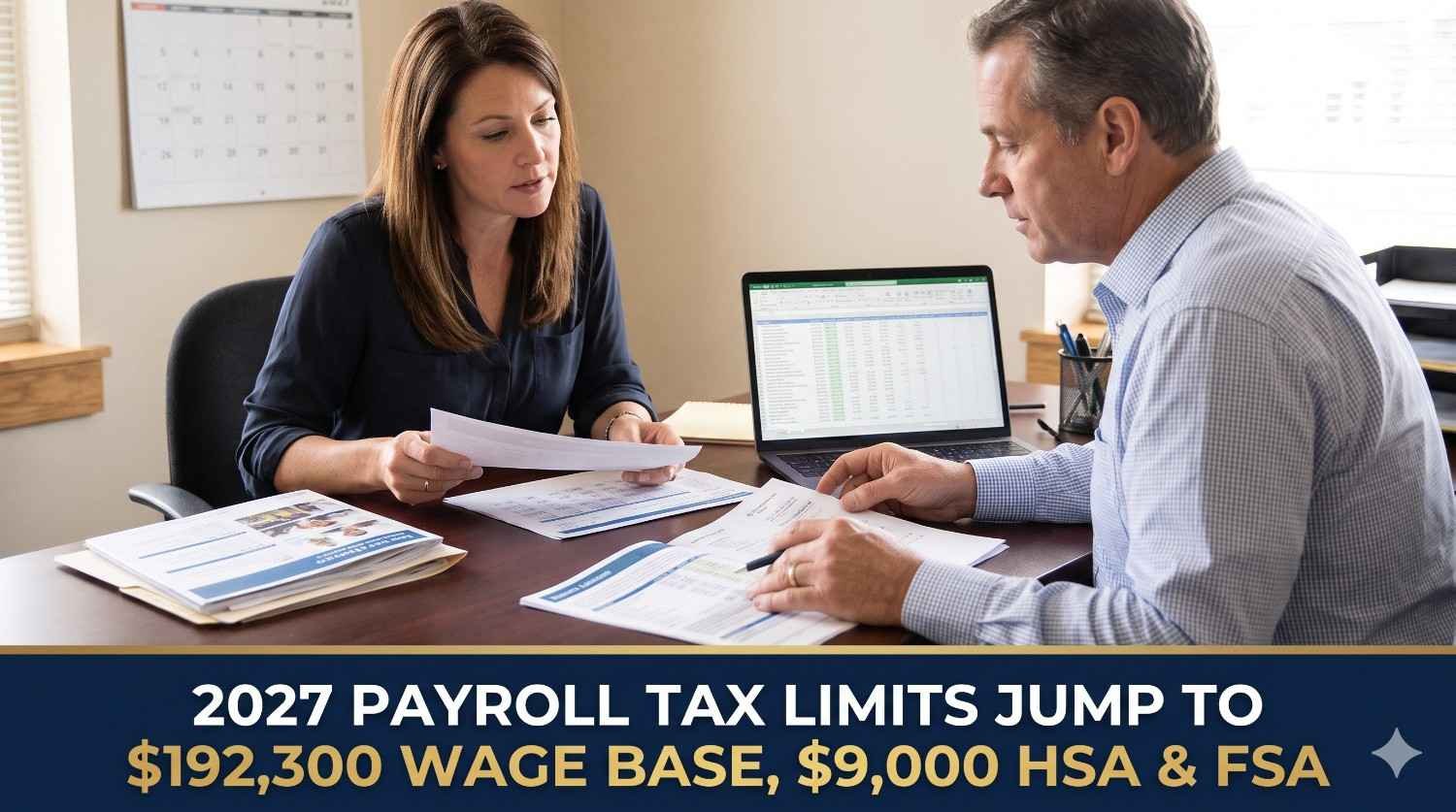
WASHINGTON — American small business owners and HR teams face an urgent December compliance crunch as newly finalized 2027 payroll tax limits take effect on January 1, 2027. Federal regulators have locked in a $7,800 surge in the Social Security taxable wage base to $192,300, alongside higher pre-tax ceilings for Health Savings Accounts (HSAs) and Flexible Spending Accounts (FSAs).
Failing to update payroll tables before your first January check run invites automatic IRS Failure-to-Deposit penalties, costly Form 941-X amendments, and angry high-earning employees. Meanwhile, businesses that coordinate these new Section 125 benefit caps right now can legally claw back nearly $1,000 per eligible worker in matching FICA taxes.
Key Policy & Compliance Takeaways (At a Glance):
- Who Is Impacted: US employers, HR/payroll teams, self-employed LLC/S-Corp owners, and W-2 earners above $184,500.
- Official Rule/Rate Benchmark: $192,300 OASDI wage base; $4,500/$9,000 HSA caps; $3,500 Health FSA cap; $25,500 401(k) deferral limit.
- Effective Date/Deadline: January 1, 2027 (Section 125 elections must lock by 11:59 PM EST on December 31, 2026).
- Governing Regulators: SSA, IRS, DOL, and state employment/insurance departments.
- Estimated Dollar Impact: +$483.60 max OASDI tax per party (+$967.20 self-employed).
- Immediate Action Required: Audit payroll software, W-2 Box 3 wages, and HDHP deductibles in December.
2027 Payroll Tax Limits: Official Rules, Regulatory Shifts, and What Sparked Them
Three rapid-fire federal announcements between October and November 2026 reshaped the 2027 payroll tax limits for every American employer. On October 14, 2026, the Social Security Administration (SSA) tied a 3.6% Cost-of-Living Adjustment (COLA) to a $7,800 jump in the Old-Age, Survivors, and Disability Insurance (OASDI) contribution base, lifting it from $184,500 in 2026 to $192,300 for 2027.
Driven by steady national average wage index growth, that statutory adjustment hits both sides of the payroll ledger. Employers and employees each pay 6.2% up to $192,300, pushing the maximum annual Social Security tax per party from $11,439.00 to $11,922.60. Self-employed founders paying both halves under SECA (12.4%) now face a $23,845.20 OASDI ceiling, up $967.20 year over year.
Weeks later, the IRS issued Revenue Procedure 2026-35 on November 5, 2026, followed by 2027 retirement plan updates on November 12, 2026. Together with earlier HSA indexing under IRS Revenue Procedure 2026-24, these directives raise pre-tax benefit ceilings across health, commuter, and retirement accounts.
A benefits director audits IRS Revenue Procedure tables and group High-Deductible Health Plan renewals ahead of the January 1, 2027 payroll rollover.
Underwriting & Tax Alert: Medicare Hospital Insurance (HI) tax remains uncapped at 1.45% per party (2.9% self-employed), and employers must still withhold the extra 0.9% Additional Medicare Tax on individual wages exceeding $200,000 without an employer match.
Federal Mandates, State Insurance Laws, and 2027 Payroll Tax Limits Standards
Running compliant US payroll requires synchronizing federal tax statutes with group health insurance underwriting rules and 2027 payroll tax limits simultaneously. Under Internal Revenue Code (IRC) Section 223, an employee can only fund a 2027 HSA ($4,500 self-only; $9,000 family; plus $1,000 catch-up at age 55+) if enrolled in a qualified High-Deductible Health Plan (HDHP).
For 2027, the IRS raised minimum HDHP annual deductibles to $1,750 for self-only coverage and $3,500 for family coverage, while capping HDHP out-of-pocket maximums at $8,700 and $17,400 respectively. If your insurance broker renews a group plan with a $1,700 deductible by mistake, every single employee HSA contribution instantly becomes disqualified and taxable.
Meanwhile, Applicable Large Employers (50 or more full-time equivalents) face steep Affordable Care Act (ACA) penalties enforced via Forms 1094-C and 1095-C. For 2027, IRC Section 4980H(a) penalties jump to $3,780 per full-time employee, Section 4980H(b) penalties hit $5,670, and the ACA affordability safe harbor rises to 10.22% of household income.
Add one massive retirement compliance change taking full regulatory effect on January 1, 2027: IRS Notice 2026-66 activates final SECURE 2.0 Roth catch-up rules. Any employee age 50 or older whose 2026 Form W-2 Box 3 FICA wages from your company exceeded $155,000 must route their $8,500 catch-up deferral into a Roth account—not pre-tax.
Seeing these federal numbers side-by-side exposes two surprising gaps where small businesses routinely overpay taxes or accidentally break plan rules.
2026 vs. 2027 Cost, Coverage & Compliance Matrix (Side-by-Side Breakdown)
Use this verified compliance matrix to audit your payroll software, group health plan declarations, and cafeteria plan documents before December 31, 2026.
| Payroll, Benefit, or Regulatory Provision | 2026 Official Limit | 2027 Official Limit | Year-Over-Year Shift | Governing IRS / SSA Rule |
| Social Security (OASDI) Wage Base | $184,500 | $192,300 | +$7,800 (+4.23%) | SSA Automatic Wage Index |
| Max OASDI Tax (Per Party @ 6.2%) | $11,439.00 | $11,922.60 | +$483.60 (+$967.20 SE) | IRC §3101 / Form 941 |
| HSA Limit (Self-Only / Family) | $4,400 / $8,750 | $4,500 / $9,000 | +$100 / +$250 | Rev. Proc. 2026-24 |
| HSA Catch-Up Contribution (Age 55+) | $1,000 | $1,000 | Unchanged | IRC §223(b)(3) |
| HDHP Minimum Deductible (Self / Fam) | $1,700 / $3,400 | $1,750 / $3,500 | +$50 / +$100 | Rev. Proc. 2026-24 |
| HDHP Out-of-Pocket Max (Self / Fam) | $8,500 / $17,000 | $8,700 / $17,400 | +$200 / +$400 | Rev. Proc. 2026-24 |
| Health FSA & Limited Purpose FSA | $3,400 | $3,500 | +$100 | Rev. Proc. 2026-35 |
| Health FSA Max Carryover (20%) | $680 | $700 | +$20 | Rev. Proc. 2026-35 |
| Dependent Care FSA (MFJ / MFS) | $7,500 / $3,750 | $7,500 / $3,750 | Unchanged | IRC §129 |
| 401(k) Elective Deferral / 50+ Catch-Up | $24,500 / $8,000 | $25,500 / $8,500 | +$1,000 / +$500 | IRS Notice 2026-66 |
| SECURE 2.0 Roth Catch-Up Wage Test | $150,000 (2025 FICA) | $155,000 (2026 FICA) | +$5,000 (Full Enforcement) | IRS Notice 2026-66 |
| QSEHRA Max (Self-Only / Family) | $6,450 / $13,150 | $6,700 / $13,550 | +$250 / +$400 | Rev. Proc. 2026-35 |
| Excepted Benefit HRA (EBHRA) | $2,200 | $2,250 | +$50 | Rev. Proc. 2026-24 |
| Commuter Transit & Parking (Monthly) | $340 / $340 | $350 / $350 | +$10 / +$10 | Rev. Proc. 2026-35 |
| ACA Non-Grandfathered OOPM | $10,600 / $21,200 | $12,000 / $24,000 | +$1,400 / +$2,800 | HHS / CMS 2027 Rule |
Look closely at the divergence inside these 2027 payroll tax limits and health insurance caps. While standard ACA out-of-pocket maximums ballooned by $2,800 for families to $24,000, IRS-qualified HDHP ceilings remain strictly pinned at $17,400.
That $6,600 spread is an underwriting trap for HR teams shopping group renewals. A broker can hand you a high-deductible PPO with a $9,500 individual out-of-pocket cap that passes ACA compliance but fails IRS HDHP rules—silently blowing up your entire company’s HSA tax exemption.
Equally misunderstood is the Health FSA cap: the $3,500 limit applies per employee, not per household. A married couple working for separate employers offering Health FSAs can shelter $7,000 combined in 2027, whereas family HSA contributions remain strictly capped at $9,000 total across both spouses combined.
Next, let us put exact dollars on the table to see how a single payroll configuration decision shifts nearly $2,000 in annual FICA taxes on just one employee.
Real-World Dollar Math: Exact Claim, Premium, or Tax Scenarios for Americans
Most small business owners treat 2027 payroll tax limits as an unavoidable fixed cost hike. In reality, routing health benefits through a properly drafted Section 125 cafeteria plan flips the FICA math in your favor immediately.
Consider two identical US engineering firms employing a full-time Project Manager earning $185,000 in 2027 with family HDHP coverage. Both managers sit just below the new $192,300 Social Security ceiling, meaning every taxable dollar carries the full 7.65% FICA load (6.2% OASDI + 1.45% Medicare) for both employer and worker.
- Firm A (Direct Post-Tax HSA & No Cafeteria Plan Optimization): The company skips Section 125 pre-tax payroll integration. The manager contributes $9,000 directly to a personal HSA after tax and claims a Form 1040 deduction—saving federal income tax, but forfeiting all payroll tax relief.
- Firm B (Section 125 Pre-Tax HSA + Limited Purpose FSA): The firm runs the $9,000 family HSA contribution and a $3,500 Limited Purpose FSA (dental and vision only) through pre-tax Section 125 payroll deductions ($12,500 total). Taxable Box 3 FICA wages drop from $185,000 to $172,500.
| 2027 Line-Item Payroll Math ($185,000 Manager) | Firm A (Unoptimized Setup) | Firm B (Section 125 Optimized) | Net Dollar Difference |
| Gross Annual W-2 Salary | $185,000.00 | $185,000.00 | $0.00 |
| Section 125 Pre-Tax HSA + LPFSA | $0.00 (Funded Post-Tax) | -$12,500.00 | -$12,500.00 FICA Base |
| Box 3 Social Security & Box 5 Medicare Wages | $185,000.00 | $172,500.00 | -$12,500.00 |
| Employer OASDI Tax (6.2%) | $11,470.00 | $10,695.00 | -$775.00 Saved |
| Employer Medicare Tax (1.45%) | $2,682.50 | $2,501.25 | -$181.25 Saved |
| Employee FICA Tax (7.65%) | $14,152.50 | $13,196.25 | -$956.25 Saved |
| Combined Annual Payroll Tax Savings | $0.00 | $1,912.50 | +$1,912.50 Net Gain |
Firm B cuts its employer payroll tax bill by $956.25 on that single employee—nearly double the $483.60 maximum OASDI hit triggered by the $192,300 wage base increase. Across a 12-person firm with half the staff maximizing Section 125 deductions, that setup puts $4,500 to $7,500 back into operating cash flow every year.
Payroll administrators verify Box 3 Social Security wages and Section 125 deductions to prevent FICA overpayments and Form 941-X refilings.
Hidden Exclusions, State-by-State Traps, and Overlooked Edge Cases
Even experienced accountants get burned by fine-print traps buried underneath federal 2027 payroll tax limits—especially when multi-state rules and commercial insurance audits collide.
- The Late-December Pay Date Trap: Social Security tax follows the constructive receipt rule (the date checks clear), not when hours were worked. A biweekly period covering December 14–27, 2026 that pays on January 2, 2027 falls entirely under the $192,300 cap and 2027 benefit limits.
- The Spousal FSA Disqualification Trap: Enrolling in a general-purpose Health FSA bars you from funding an HSA—even if the general-purpose FSA belongs to your spouse at a different company. To pair both accounts legally in 2027, restrict the FSA to a Limited Purpose FSA covering only dental and vision care.
- The Uncapped California & New York State Payroll Squeeze: Starting January 1, 2027, California’s State Disability Insurance (SDI) rate rises from 1.3% to 1.4% with no wage ceiling, taking $2,800 out of a $200,000 paycheck. In New York, New York State Paid Family Leave requires a 0.452% employee deduction capped at $451.81 for 2027.
- The More Than 2% S-Corp Shareholder Exclusion: Owners holding more than 2% of an S-Corporation cannot participate in a Section 125 cafeteria plan for pre-tax Health FSAs or payroll-deducted HSA contributions. Company-funded HSA contributions for those owners must be reported as Box 1 W-2 income (exempt from FICA if made under a nondiscriminatory plan) and deducted on Form 8889.
- The Workers’ Compensation & 1099 Audit Shock: While Section 125 HSA/FSA deductions trim federal FICA taxes, NCCI Workers’ Compensation auditors in states like Texas, Florida, and New York generally include employee-elected cafeteria plan salary reductions inside gross audited remuneration. Meanwhile, misclassifying W-2 staff as 1099-NEC contractors exposes small firms to retroactive IRS FICA assessments, DOL FLSA overtime backpay, and uninsured Workers’ Comp claims.
- The Missing 401(k) Roth Feature Crisis: Under the IRS final regulations effective January 1, 2027, if your company’s 401(k) lacks a Roth deferral option, employees who earned over $155,000 in 2026 FICA wages are legally barred from making any $8,500 catch-up contributions in 2027.
Small business owners tracking these overlapping federal wage caps, state insurance mandates, and ongoing regulatory alerts can monitor live compliance schedules through SarkariResultine.com/us alongside official agency bulletins.
Knowing the traps is half the battle; executing six specific operational checks before your final December pay run guarantees a clean start to 2027.
Step-by-Step Protection & Compliance Playbook: Exact Actions to Take Now
Complete these six concrete procedures in order before locking your first January 2027 payroll cycle:
- Confirm Written Payroll Table Updates for $192,300: Contact your payroll vendor (ADP, Gusto, Paychex, or Paylocity) and verify in writing that the $192,300 OASDI wage base, $3,500 Health FSA cap, $4,500/$9,000 HSA caps, and $25,500 401(k) limit are active for any pay date on or after January 1, 2027. Confirm whether employer HSA seed money is automatically subtracted from each worker’s annual HSA cap.
- Pull a 2026 Form W-2 Box 3 Report for SECURE 2.0: Run a payroll query listing every employee turning age 50 or older in 2027 whose 2026 Social Security wages (Box 3, not Box 1) exceeded $155,000. Flag those profiles so payroll automatically redirects deferrals above $25,500 into Roth catch-up buckets, and verify your 401(k) plan document includes a Roth feature.
- Audit Group Health Plan Deductibles Against HDHP Floors: Request the 2027 Summary of Benefits and Coverage (SBC) from your commercial benefits broker before signing renewal binders. Verify that every HSA-paired plan carries a minimum deductible of at least $1,750 (self-only) or $3,500 (family) and an out-of-pocket cap not exceeding $8,700 or $17,400.
- Amend Section 125 Plan Documents & Carryover Rules: Confirm whether your written Section 125 plan uses the $700 Health FSA carryover option or the 2.5-month grace period—IRS rules strictly forbid offering both simultaneously. Update employee open enrollment notices so staff do not forfeit unused 2026 balances.
- Reconcile Workers’ Comp Payroll Projections & Contractor Files: Review your NCCI Workers’ Compensation class codes and estimated 2027 payroll with your commercial insurance agent so year-end wage inflation does not trigger a surprise five-figure audit invoice. Collect updated Form W-9s and Certificates of Insurance (COIs) from every 1099 vendor to confirm compliance with U.S. Department of Labor (DOL) worker classification rules.
- Verify State SUTA, SDI, and Paid Leave Rates: Log into every state workforce portal where remote or hybrid employees physically work. Load 2027 State Unemployment Tax Act (SUTA) rate notices, California’s 1.4% uncapped SDI withholding, and New York’s 0.452% PFL rate before processing January paychecks.
Claims & Compliance Reality Check: Never backdate a Section 125 plan amendment. Under ERISA and IRS cafeteria plan regulations, pre-tax salary reduction elections must be signed prospectively before the plan year starts, or the IRS can retroactively tax every participant’s benefit deductions.
Missing even one calendar cutoff in the next four months can lock in avoidable penalties—here is your exact 2026–2027 compliance timeline.
Critical 2026–2027 Renewal Windows, Filing Deadlines, and What Happens Next
Every employer adapting to the 2027 payroll tax limits must hit seven non-negotiable dates between December 2026 and April 2027:
- December 14, 2026 (11:59 PM EST): FSAFEDS open enrollment closes for eligible federal employees selecting 2027 Health FSA and Dependent Care FSA elections. Most private-sector open enrollment windows also close between December 1 and December 15.
- December 31, 2026 (11:59 PM EST): Hard statutory deadline to execute prospective 2027 Section 125 cafeteria plan elections, adopt 2027 QSEHRA/EBHRA notices, and confirm Roth 401(k) plan amendments for calendar-year plans.
- January 1, 2027: Legal effective date for the $192,300 Social Security wage base, $4,500/$9,000 HSA caps, $3,500 Health FSA limit, $25,500 401(k) cap, SECURE 2.0 final Roth catch-up rules, California’s 1.4% SDI rate, and New York’s 2027 PFL deductions.
- February 1, 2027 (Adjusted from January 31 Sunday): Deadline to furnish 2026 Forms W-2 to employees, file Forms W-2/W-3 with the SSA, and file Form 1099-NEC with the IRS for non-employee compensation.
- March 2, 2027: Deadline for Applicable Large Employers to furnish 2026 Form 1095-C health coverage statements to full-time employees (electronic IRS filing follows on March 31, 2027).
- April 15, 2027: Final deadline for individuals to make prior-year 2026 HSA contributions ($4,400 self-only / $8,750 family) and remove any 2026 excess HSA deferrals without triggering the recurring 6% IRS excise tax.
Looking ahead into mid-2027, watch for rising commercial health insurance renewals—industry projections point to 8% to 10% employer medical cost inflation in 2027—which will push more mid-sized firms toward HDHP/HSA and QSEHRA models. Reviewing your benefit tier mix in Q3 2027, rather than scrambling in late November, preserves negotiating leverage with carriers.
Official Government Regulators & Primary Verification Links
Verify all 2027 federal wage caps, benefit thresholds, and state insurance compliance rules directly through these primary government and regulatory portals covering 2027 payroll tax limits:
- Social Security Administration — Contribution and Benefit Base (1937–2027)
- Internal Revenue Service — Revenue Procedure 2026-24 (2027 HSA, HDHP & EBHRA Limits)
- Internal Revenue Service — 2027 Tax Inflation Adjustments & Rev. Proc. 2026-35 (Health FSA & QSEHRA)
- Internal Revenue Service — 2027 401(k) & Retirement Contribution Limits
- U.S. Small Business Administration (SBA) — Employer Tax & Business Compliance Portal
- U.S. Department of Labor (DOL) — ERISA, FLSA & Employee Benefits Security Administration
- National Association of Insurance Commissioners (NAIC) — State Insurance Regulator Directory
- New York State Paid Family Leave — Official 2027 Rate & Benefit Schedule
Frequently Asked Questions (People Also Ask)
What happens if an employer misses the $192,300 Social Security wage base in January 2027?
Under-withholding Social Security taxes under the 2027 payroll tax limits forces employers to file quarterly corrections on Form 941-X and issue amended Form W-2c statements. The IRS also assesses Failure-to-Deposit penalties ranging from 2% to 15% of unpaid payroll taxes plus daily compounding interest until the shortfall is corrected.
Do employer HSA contributions count toward the $4,500 or $9,000 limit in 2027?
Yes. Combined employer and employee contributions cannot exceed $4,500 for self-only coverage or $9,000 for family coverage in 2027. For example, if your company seeds $1,000 into an employee’s self-only HSA, the employee may only contribute $3,500 through payroll to avoid the 6% annual IRS excess-contribution excise tax.
Can an employee contribute to both an HSA and a $3,500 Health FSA in 2027?
An employee cannot pair an HSA with a general-purpose Health FSA, as that immediately disqualifies HSA eligibility under IRC Section 223. However, employees can legally contribute up to $4,500/$9,000 to an HSA and up to $3,500 to a Limited Purpose FSA restricted strictly to dental and vision expenses.
How does the $192,300 wage base apply if an employee works two jobs in 2027?
Each employer must independently withhold 6.2% Social Security tax up to $192,300 without crediting taxes withheld by another company. Neither employer receives a refund on its matching 6.2% share, though the employee recovers any personal over-withholding above $11,922.60 as a refundable tax credit on Form 1040.
Are 2027 Health FSA employer contributions subject to the $3,500 IRS cap?
Generally, no. Non-elective employer Health FSA contributions or flex credits that employees cannot take as taxable cash do not count against the $3,500 employee salary-reduction cap. However, if workers can opt to receive those employer dollars as cash instead, the IRS treats them as employee deferrals subject to the $3,500 limit.
Editorial Disclosure: Payroll tax statutes, state disability/unemployment insurance rates, ACA employer mandate rules, and commercial insurance underwriting guidelines vary by state and entity structure; this report is published strictly for informational purposes and does not constitute licensed legal, CPA tax, or insurance advice.











Leave a Reply