
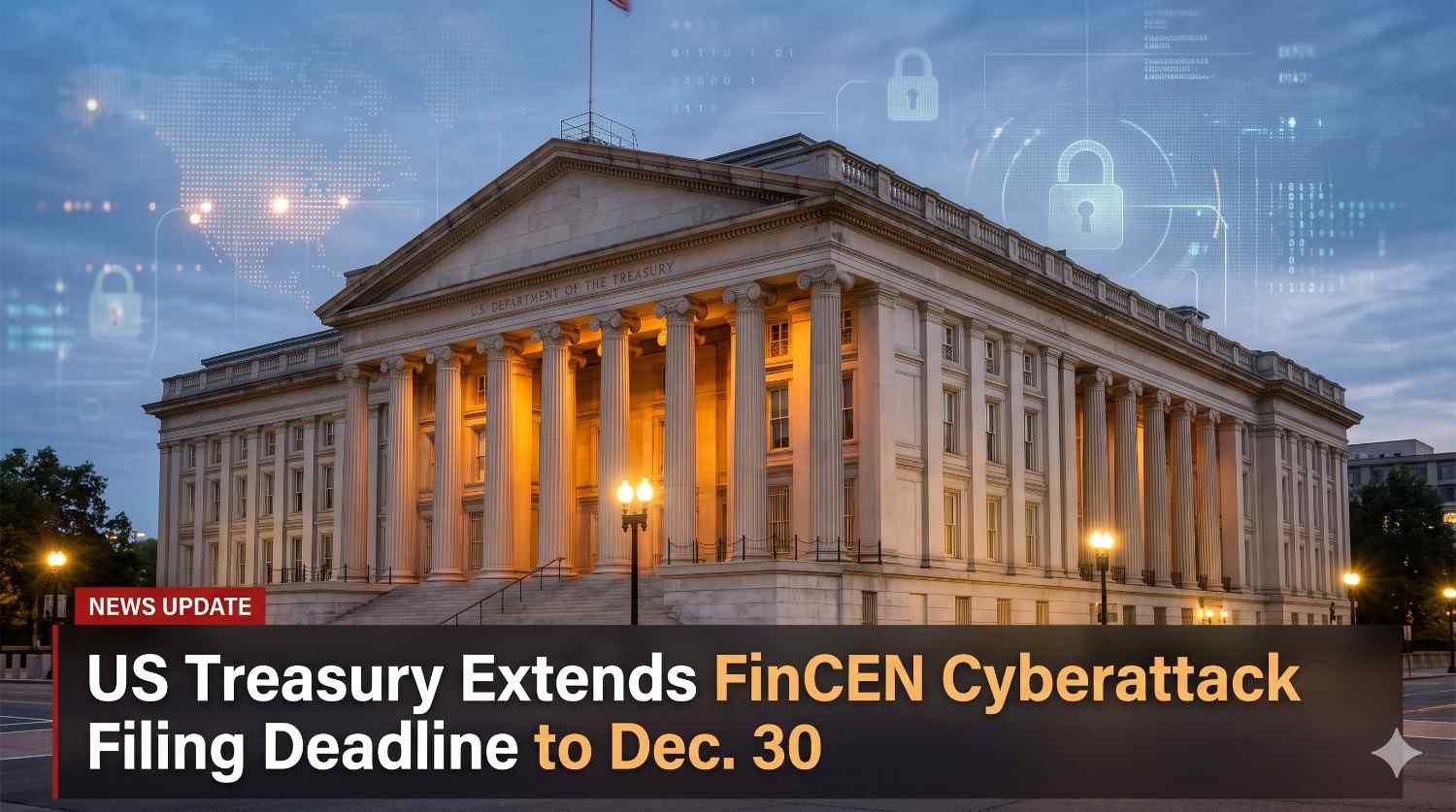
WASHINGTON — The U.S. Treasury Department’s anti-money laundering bureau has pulled key reporting systems offline after intruders gained unauthorized access, triggering an emergency FinCEN cyberattack filing deadline extension through December 30, 2026.
The sudden shutdown inside the Financial Crimes Enforcement Network (FinCEN) disrupts automated compliance pipelines used by American banks, credit unions, and foreign-owned companies registered across all 50 states. Ahead are the exact filers excluded from the federal grace period, a hidden software glitch falsely marking rejected bank reports as sent, and the surge of fake Treasury emails targeting small business owners right now.
VERIFIED BREAKING BRIEFING: FINCEN SYSTEM SHUTDOWN & RELIEF ORDER
- Issuing Authority: U.S. Department of the Treasury — Financial Crimes Enforcement Network (FinCEN), backed by a joint supervisory policy from the Federal Reserve, FDIC, NCUA, and OCC.
- Official Identifier: FinCEN Order FIN-2026-R002 (issued Nov. 24, 2026, under 31 U.S.C. § 5318(a)(7) and 31 C.F.R. § 1010.970).
- Covered Filing Window: Eligible submissions originally due between November 18, 2026, and December 29, 2026.
- Extended Deadline: December 30, 2026 (Order FIN-2026-R002 sets a calendar-date cutoff without specifying an exact ET/PT minute timestamp;
[VERIFY FROM OFFICIAL RELEASE]for intraday portal maintenance windows).- Data Exposure Status: Ongoing forensic investigation; no official confirmation that Suspicious Activity Reports (SARs) or Beneficial Ownership databases were exfiltrated.
- Emergency Law Enforcement Hotline: 1-866-556-3974 (fully operational for urgent suspicious activity).
How the Treasury Breach Unfolded Across Seven Days
FinCEN’s public disclosure on November 25, 2026, followed a full week of silent batch-submission failures that stalled bank compliance desks nationwide. While the bureau confirmed unauthorized access to a “limited subset” of its systems, federal officials have not publicly confirmed whether the intrusion caused the earlier filing outage.
Automated Bank Secrecy Act (BSA) batch transmissions first began breaking down on November 18, 2026, according to compliance software vendors. Two days later, FinCEN posted an alert flagging service disruptions on its Secure Data Transfer Mode (SDTM) pipeline without mentioning a security incident.
By November 24, FinCEN issued Order FIN-2026-R002, citing an unspecified “service disruption” that prevented institutions from meeting federal reporting deadlines. Within 24 hours, a banner appeared directly on the BSA E-Filing portal confirming an active cybersecurity investigation and proactive system shutdowns.
On November 25, FinCEN separately alerted users of its Section 314(a) law-enforcement information-sharing portal that their deadlines were also pushed to December 30. Federal banking watchdogs followed with a coordinated supervisory shield ensuring regulated lenders would not face enforcement actions for delayed filings tied to the outage.
That weeklong timeline raises a sharper question for banks and business owners alike: why does a single bureau inside the Treasury hold so much leverage over the American financial system?
What FinCEN Actually Does Inside the U.S. Financial System
Operating under the Bank Secrecy Act of 1970, FinCEN serves as America’s primary financial intelligence unit, collecting mandatory transaction reports from banks, credit unions, casinos, and money transmitters to track money laundering, sanctions evasion, and terrorist financing. The bureau analyzes those records and shares leads with federal, state, and local law enforcement.
Every time a customer deposits more than $10,000 in cash or triggers fraud alerts inside a U.S. bank, compliance officers transmit Currency Transaction Reports (CTRs) or Suspicious Activity Reports (SARs) to FinCEN under Chapter X of Title 31 of the Code of Federal Regulations. These filings form the backbone of federal prosecutions against drug cartels, cybercriminals, and corporate fraud rings.
FinCEN also administers the Corporate Transparency Act (CTA) registry under 31 C.F.R. § 1010.380, which collects Beneficial Ownership Information (BOI) from covered foreign entities registered to do business in any U.S. state. Because those databases contain sensitive Social Security numbers, passport scans, and investigative leads, even a partial perimeter breach triggers immediate national-security alarm.
Yet the relief order Treasury issued to manage the fallout does not protect everyone equally—and thousands of filers could face steep statutory penalties if they misread who actually qualifies.
Who Qualifies for the FinCEN Cyberattack Filing Deadline Relief
Under Order FIN-2026-R002, the FinCEN cyberattack filing deadline extension applies strictly to three categories of filers plus affected Section 314(a) portal users whose submissions fell due between November 18 and December 29, 2026. Manual web-portal filers who did not use automated SDTM servers remain bound by standard statutory deadlines.
| Filer Category | Statutory / CFR Rule | Covered by Dec. 30 Extension? | Mandatory Conditions & Compliance Trap |
| SDTM Batch Financial Institutions | 31 CFR Chapter X (BSA Reports) | Yes | Must have actively used SDTM batch filing as of Nov. 18, 2026; ongoing AML monitoring stays mandatory. |
| Section 314(a) Portal Filers | USA PATRIOT Act § 314(a) | Yes | Applies to institutions alerted via the 314 portal affected by the outage. |
| Foreign Reporting Companies (BOI) | 31 CFR § 1010.380 (CTA) | Yes | Covers ~20,000 foreign firms registered in U.S. states with BOI reports due Nov. 18–Dec. 29. |
| Non-U.S. FinCEN ID Holders | 31 CFR § 1010.380 | Yes | Covers individuals required to update a FinCEN Identifier between Nov. 18 and Dec. 29. |
| Manual BSA E-Filing Web Users | 31 CFR Chapter X (SAR/CTR) | No | Individual BSA E-Filing web portal remained online; standard deadlines and penalties still apply. |
| U.S. Domestic Companies & Citizens (BOI) | RIN 1506-AB67 (Aug. 11, 2026) | Already Exempt | Permanently exempt from federal BOI filing and FinCEN ID updates; no Dec. 30 filing required. |
Under 31 C.F.R. § 1010.970(a), FinCEN exceptive relief extends only to the exact populations named in the written order. Non-covered institutions that miss ordinary deadlines remain exposed to inflation-adjusted civil monetary penalties codified under 31 C.F.R. § 1010.821.
Those statutory fines are steep: willful Bank Secrecy Act violations carry penalties of $71,545 to $286,184 per violation under 31 U.S.C. § 5321(a)(1), while negligent violations draw $1,430 and patterns of negligence reach $111,308. Covered foreign firms that willfully skip BOI deadlines after December 30 face civil fines of $606 per day under 31 U.S.C. § 5336(h)(3)(A)(i).
Caption: A financial compliance analyst reviews federal Bank Secrecy Act filing logs after the U.S. Treasury Department extended select reporting deadlines to December 30, 2026.
Why Small Businesses Need to Watch the FinCEN Cyberattack Filing Deadline Fine Print
Millions of American small business owners still remember the 2024 Corporate Transparency Act rush, when roughly 32 million LLCs and corporations faced federal BOI mandates. Many owners seeing headlines about the FinCEN cyberattack filing deadline assume they must scramble to file a BOI update before December 30.
In reality, FinCEN permanently exempted all domestic U.S. companies and U.S. citizens from BOI reporting in its August 11, 2026, Final Rule (RIN 1506-AB67), following Treasury’s March 2025 enforcement suspension. Only roughly 20,000 foreign entities formed outside the United States and registered to do business in U.S. states remain subject to the rule.
Edge Case Note for Title & Real Estate Firms: Federal residential real estate reporting requirements remain paused while the judicial vacatur in Flowers Title Companies, LLC v. Bessent stays in force, meaning title agencies do not need to file under that rule during the outage.
Similarly, small domestic businesses that occasionally file Form 8300 for cash payments exceeding $10,000 do not use SDTM bank servers and should verify standard manual filing rules on the live web portal. State-chartered banks and money transmitters must also check with their state banking departments, because a federal FinCEN order does not automatically override separate state-level reporting mandates.
Even for large credit unions that do qualify for federal relief, a hidden technical snag inside third-party banking software is already causing compliance headaches.
Banking Regulator Safe Harbor, Vendor Glitches, and Leadership Scrutiny
Federal banking agencies moved quickly to shield supervised lenders from examination penalties while industry groups praised the deadline relief, even as reports about Treasury’s top technology official sparked fresh criticism in Washington.
In a Joint Statement of Supervisory Policy, staff from the Federal Reserve, FDIC, NCUA, and Office of the Comptroller of the Currency (OCC) confirmed they will not pursue supervisory or enforcement actions tied to BSA reporting delays caused by the disruption. The joint guidance cites parallel SAR regulations across all four regulators, including 12 C.F.R. § 208.62 (Federal Reserve), 12 C.F.R. Part 353 (FDIC), 12 C.F.R. § 748.1(d) (NCUA), and 12 C.F.R. §§ 21.11 and 163.180 (OCC).
“ABA appreciates FinCEN’s decision to extend the filing deadline for qualified filers after taking some of its systems offline,” an American Bankers Association spokesperson said in a statement. “We will continue to work closely with FinCEN as it restores those services.”
Behind the scenes, however, credit union technology vendor CUSOUTH revealed a dangerous reconciliation trap on November 20. FinCEN had rejected batches of Currency Transaction Reports sent through CUSOUTH’s CBX platform, yet those failed submissions still displayed as “transmitted” inside local credit union software. By November 25, the vendor was instructing affected credit unions to submit urgent CTRs directly through FinCEN’s web portal while confirming rejected batches were stripped from automatic retry queues.
Meanwhile, Treasury’s cybersecurity leadership drew public scrutiny after 404 Media reported that Chief Information Officer Sam Corcos—who oversees departmental cybersecurity—was pushing code updates to Legatum, an open-source AI-built strategy game on GitHub, during the same window FinCEN scrambled to contain the breach.
That scrutiny landed during one of the most intense weeks of federal cyber intrusions in years, raising urgent questions about how attackers are penetrating government networks so rapidly.
The CIA Breach, AI Hacking Tools, and Treasury’s 2024 Precedent
FinCEN’s shutdown arrived hours after news broke that hackers breached an unclassified open-source intelligence system shared by the Central Intelligence Agency (CIA) and the Office of the Director of National Intelligence (ODNI). While investigators have not linked the FinCEN incident to the intelligence-community hack, both sit inside an alarming November 2026 wave hitting federal agencies.
Within the same two-week stretch, hackers accessed an FBI crime database, and the U.S. Department of Agriculture took applications offline following a separate security incident. Officials investigating the CIA/ODNI unclassified breach suspect intruders leveraged ARTEX, an autonomous penetration-testing framework powered by large language models.
Just days earlier on November 13, 2026, the FBI issued FLASH-20261113-001, warning that threat actors have weaponized ARTEX to automate reconnaissance, credential harvesting, and data exfiltration at machine speed—compressing full cloud intrusion lifecycles to under three hours. Although the original developer pulled ARTEX from GitHub in October 2026, community forks and a commercial “ARTEX PRO” edition continue circulating across global networks.
For the Treasury Department itself, the November 2026 intrusion echoes a painful recent precedent. In December 2024, hackers compromised Treasury departmental offices using a stolen software key from remote-support vendor BeyondTrust—an attack Treasury attributed to a Chinese state-sponsored group.
Until FinCEN completes its forensic review, financial institutions and business owners face an equally immediate danger closer to home: criminals weaponizing the FinCEN cyberattack filing deadline chaos to launch targeted phishing campaigns.
How to Spot Fake Treasury Emails and Audit Your Filings Today
Every major federal outage triggers an immediate spike in impersonation scams, and fraudsters are actively exploiting confusion over the FinCEN cyberattack filing deadline to steal bank logins, corporate tax IDs, and wire transfers. Financial institutions and small businesses should lock down two fronts right now: verifying queued filings and blocking Treasury imposter messages.
Caption: Small business owners face heightened phishing risks during federal system outages as scammers send spoofed Treasury compliance notices demanding immediate fees or credential resets.
5 Red Flags of a Fake FinCEN or Treasury Phishing Scam
Federal officials publish strict verification rules on the official FinCEN Imposter Scams portal. Treat any email, text, letter, or phone call as an active fraud attempt if it matches any of these tactics:
- Demands for Filing Fees or Immediate Fines: FinCEN charges $0 to file BSA or BOI reports and never sends initial penalty notices by email, text, or phone.
- Fake Government Forms or Agencies: Any notice referencing “Form 4022,” “Form 5102,” or a “US Business Regulations Dept.” is a confirmed scam—none of those exist.
- QR Codes or Non-
.govLinks: Official FinCEN portals end strictly in.gov(never.com,.org, or.net). Never scan QR codes on mailed “urgent compliance” postcards. - Threats to Freeze Bank Accounts: FinCEN has zero legal authority to freeze personal bank accounts, block wire transfers, or demand you move funds to a “safe government account”.
- BOI Warnings Sent to U.S.-Owned LLCs: Because domestic U.S. companies are permanently exempt under the August 2026 Final Rule, any message claiming your U.S. LLC faces $606-per-day fines on December 30 is fraudulent.
5-Step Outage Verification Playbook for Banks, Credit Unions, and Covered Filers
- Audit Every Queued Batch From Nov. 18 Onward: Compliance officers at SDTM institutions should log original due dates and stop trusting “transmitted” labels inside third-party software. Match every accepted report to its official FinCEN status file and separate BSA ID acknowledgment.
- Prevent Duplicate Submissions: Before manually uploading a rejected CTR or SAR through the live web portal, confirm your core banking vendor has cleared that file from its automatic retry queue.
- Escalate Urgent Crimes by Phone: Do not wait until December 30 for active terror financing, elder fraud, or ongoing heist alerts. Call FinCEN’s unaffected Financial Institutions Hotline directly at 1-866-556-3974.
- Document Supervisory Good Faith: Retain timestamps of outage banners, vendor rejection alerts, and internal incident logs to qualify cleanly under the Federal Reserve, FDIC, NCUA joint supervisory statement, and OCC safe harbor.
- Report Spoofed Treasury Outreach Immediately: Forward fake FinCEN emails and phone numbers to the Treasury Office of Inspector General (OIG) and the Federal Trade Commission, and monitor latest US federal cybersecurity and compliance alerts for restoration notices.
Knowing which official portals remain live—and where to submit help tickets if a federal webpage stalls—saves compliance teams hours of guesswork before the December 30 cutoff.
Official Government Verification Directory and Direct Portals
Use only verified .gov channels to check filing rules, open technical support tickets, or confirm whether FinCEN modifies Order FIN-2026-R002 ahead of December 30, 2026. Bookmark these primary federal endpoints directly rather than clicking links inside unsolicited emails:
- Full Relief Order PDF: Read FinCEN Order FIN-2026-R002 directly from Treasury servers for exact statutory language.
- Technical Filing & Portal Outage Support: Submit a ticket via the FinCEN BSA E-Filing Help Desk if batch acknowledgments are missing or the portal times out.
- Regulatory & Scope Questions: Contact FinCEN’s Regulatory Support Section through FinCEN.gov/contact.
- BOI Exemption Verification: Confirm domestic U.S. company exemptions and foreign reporting company rules at the FinCEN Beneficial Ownership Information Hub.
- Urgent Law Enforcement Escalation: Call the 24/7 FinCEN Financial Institutions Hotline at 1-866-556-3974.
Frequently Asked Questions
Did hackers steal my banking data or Suspicious Activity Reports from FinCEN?
FinCEN confirmed unauthorized access to a “limited subset” of its systems, but federal officials have not confirmed whether any confidential banking records, SARs, or beneficial ownership files were stolen. A source familiar with the probe told Reuters that early forensic checks showed no evidence BSA or BOI databases were breached.
Do U.S. small businesses have to file a BOI report by December 30, 2026?
No. Under FinCEN’s August 11, 2026, Final Rule, all domestic U.S. companies and U.S. citizens are permanently exempt from filing Beneficial Ownership Information reports or updating FinCEN Identifiers. Only roughly 20,000 foreign-formed companies registered to do business in U.S. states remain covered by the December 30 extension.
Does the FinCEN cyberattack filing deadline extension pause bank anti-money laundering monitoring?
No. Both Order FIN-2026-R002 and the joint Federal Reserve, FDIC, NCUA, and OCC statement explicitly confirm that the FinCEN cyberattack filing deadline relief pauses only covered filing transmissions. Banks and credit unions must maintain full ongoing transaction monitoring and report urgent cases immediately via 1-866-556-3974.
What if my bank files SARs manually on the FinCEN web portal instead of SDTM?
Manual web-portal filers who did not use Secure Data Transfer Mode (SDTM) as of November 18, 2026, are not covered by Order FIN-2026-R002. Because the individual BSA E-Filing website stayed online, those institutions must meet standard statutory filing deadlines or risk BSA civil penalties up to $286,184 per willful violation.
How can I tell if a FinCEN cyberattack email asking for verification is a scam?
FinCEN never sends unsolicited emails, texts, or phone calls demanding payments, penalty settlements, QR code scans, or account verification. Legitimate updates appear only on official .gov portals; any message citing “Form 4022,” “Form 5102,” or a “US Business Regulations Dept.” is confirmed fraud.





Leave a Reply