

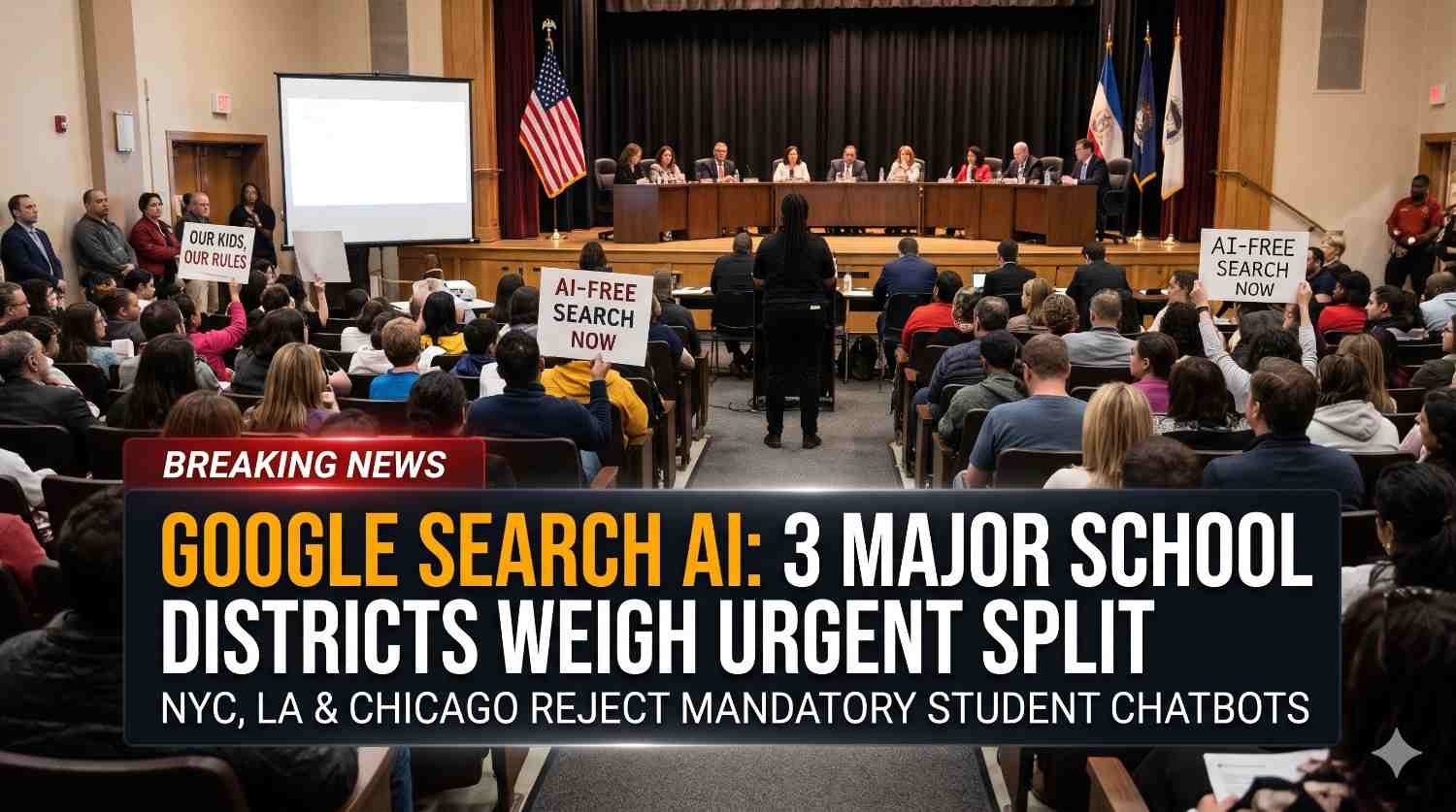
NEW YORK — America’s largest public school systems are preparing to drop Google’s flagship search engine after Alphabet refused to strip Google Search AI chatbots from student accounts. Education leaders in New York City, Los Angeles, and Chicago confirmed this month they are evaluating rival search providers ahead of a sweeping 2027 policy shift.
Starting next year, Google will automatically disable Search and its Gemini app for school-managed accounts unless district administrators opt in to the full artificial intelligence suite. Because no chatbot-free version will remain available, districts refusing generative tools face losing a core classroom research utility overnight.
Key Takeaways (Fast Facts):
- Who: New York City, Los Angeles, Chicago, and rural U.S. school districts.
- What: Evaluating DuckDuckGo and Microsoft Bing after Google refused to unbundle AI from Search.
- When: November 2026 announcement; default cutoffs begin in 2027.
- Where: Nationwide K-12 public classrooms and home Chromebook networks.
- Why: Student safety lawsuits, cheating concerns, and loss of local policy control.
- Key Metric: 3 of the 4 largest U.S. districts are weighing alternatives.
Google Search AI: What Triggered the Official Shift
The standoff escalated on November 18, 2026, after months of behind-the-scenes friction between K-12 technology directors and Silicon Valley executives. School IT leaders across four states had repeatedly urged Google to allow grade-by-grade toggles for generative tools rather than imposing a single district-wide mandate.
Google rejected that compromise, stating that Google Search AI tools are too deeply embedded in its architecture to separate. During a monthly Google Meet briefing with school administrators, program manager Jenn Brown stated the company now views Search fundamentally as an artificial intelligence product.
District officials responded swiftly across every U.S. time zone. Speaking from New York City on EST, Schools Chancellor Kamar H. Samuels warned the nation’s largest district refuses to accept Google’s “false binary” and will pursue competing search engines if Alphabet holds firm.
Hours later during a Los Angeles Unified School District AI committee session on PST, Chief Information Officer Jack Kelanic drew applause by noting districts retain software leverage. Kelanic told board members the system can swap its default browser search engine “literally overnight.”
Chicago Public Schools, the fourth-largest U.S. district, issued a similar email warning on CST after rallying parents demonstrated outside Google offices in Chicago, Boston, Boulder, New York, Portland, and Venice, California. “We don’t want corporations determining what is happening in our kids’ classrooms,” said Cassie Creswell, executive director of Illinois Families for Public Schools.
Caption: Public school administrators and parent coalitions nationwide are reviewing software procurement contracts following Google’s November 2026 decision to bundle generative tools with student search access.
Federal Regulations and Google Search AI Precedents
Beneath the local protests sits a tightening web of federal student-safety laws and active courtroom scrutiny. Earlier in November 2026, two North Carolina parents filed a lawsuit alleging their daughter developed a suicide plan after prolonged conversations with Google Search AI on a school-issued Chromebook.
Google stated it built crisis-intervention safeguards into its search tools and is reviewing the North Carolina complaint. Still, medical groups continue warning that open-ended chatbot interactions can harm adolescent mental health, forcing superintendents to reassess legal liability.
Public school systems accepting federal E-Rate connectivity subsidies must enforce strict content filtering under the Federal Communications Commission’s Children’s Internet Protection Act (CIPA), codified at 47 U.S.C. § 254(h). Districts must also verify that third-party classroom vendors comply with the Federal Trade Commission’s Children’s Online Privacy Protection Rule (COPPA) for students under age 13.
Data Breakdown & Comparative Matrix (2025 vs. 2026 Standards)
Google’s policy overhaul flips the administrative baseline for millions of K-12 Workspace accounts nationwide. The table below contrasts how school systems managed search access prior to late 2026 against the new bundled framework taking effect next year.
| Policy Dimension | 2025 – Early 2026 Standard | Late 2026 – 2027 Google Framework |
| Default Search Status | Standard Google Search enabled for K-12 accounts | Search and Gemini turned off by default until admin opt-in |
| AI Unbundling Option | Select districts (like LAUSD) received help disabling AI Mode | No chatbot-free version of Google Search offered |
| Bundled Search Tools | Traditional blue-link results plus optional trials | AI Overview, AI Mode chatbot, and Guided Learning pilot |
| Opt-Out Consequence | Students kept traditional web search access | Opting out of AI removes Google Search entirely |
| Major Rival Engines | Rarely deployed on school Chromebooks | DuckDuckGo and Microsoft Bing (both allow AI-off modes) |
| Workaround Filtering | Basic URL blacklists via Google Admin Console | Paid third-party filters (e.g., Lightspeed Systems) |
The operational catch sits in the third and fourth rows of the matrix. By tying traditional web indexing directly to Google Search AI tools, Alphabet forces districts with active AI moratoriums—such as New York City and Los Angeles—to either abandon their September 2026 pauses or replace their search engine.
Even proponents of classroom technology say the hardball tactic backfired. Los Angeles school board member Nick Melvoin noted the backlash has complicated structured AI literacy lessons, while New York City declined Google’s Guided Learning pilot to evaluate five competing high-school AI tools independently.
Real-World Impact: What This Means for American Households
For American families, this policy clash lands directly on the kitchen table whenever students log into school-issued Chromebooks for homework. Even in districts attempting to filter Google Search AI through network controls, New York City parents discovered children can still reach AI Mode at home on student accounts.
Consider a worked household and local taxpayer scenario in a typical 2,000-student district like Missouri’s Central R-3 School District in Park Hills. To independently block AI Overview and AI Mode without dropping Google Search, the district subscribed to Lightspeed Systems monitoring software.
At typical K-12 ed-tech licensing rates of roughly $5 per student annually, third-party filtering adds an estimated $10,000 per year to a small district’s tight IT budget. Scaled to a 100,000-student metro system, similar specialized filtering contracts can easily exceed $500,000 annually in local property-tax dollars.
Families unwilling to wait for district software patches face direct out-of-pocket costs at home. Parents purchasing a standalone router-level DNS filter spend roughly $60 to $120 per year, while buying a non-Chromebook Windows study laptop for offline Word and research tasks runs $350 to $450 upfront.
Caption: Parents across urban and rural districts face new home-monitoring decisions as school-issued Chromebooks remain tightly bound to Google Workspace accounts.
Regional and Demographic Breakdown Across the States
The burden does not fall evenly across American ZIP codes. Title I public schools serving lower-income neighborhoods rely most heavily on low-cost Chromebooks that lack local software storage, locking students deeper into Google Search AI ecosystems than peers at wealthier schools using MacBooks or iPads.
Rural districts face a parallel squeeze because small IT departments lack custom engineering staff. “We need to be able to control our own pace, not have Google tell us what the pace of A.I. adoption is going to be,” said Chris Warden, technology director for Central R-3 in Missouri.
Meanwhile, coastal and Midwestern hubs—specifically New York, California, and Illinois—carry the collective procurement clout to test Microsoft Bing and DuckDuckGo at scale. Parents and educators tracking public-sector policy shifts, digital workforce readiness, and school administration developments can follow ongoing updates at SarkariResultine.com.
Step-by-Step Actionable Checklist: How to Prepare Before the Deadline
Families and local school board advocates should take concrete steps before districts finalize their 2027 Workspace configurations:
- Test Your Child’s School Account at Home: Sign into your student’s school-issued Chromebook on your home Wi-Fi and run a standard query. Check whether AI Overview summaries or the conversational AI Mode tab load outside the school building’s firewall.
- Request Your District’s Written AI Policy: Email your principal or district technology director to ask how they plan to handle Google Search AI once default shutoffs begin in 2027. Confirm whether the district is switching to DuckDuckGo, Microsoft Bing, or paid filtering.
- Verify Student Data Privacy Protections: Review your district’s annual privacy notices under the U.S. Department of Education’s Family Educational Rights and Privacy Act (FERPA) portal. Parents hold the right to inspect educational records and question unvetted third-party AI pilots.
- Configure Home Router Safeguards: If your district’s filter fails off-campus, set up home DNS controls or supervised browser profiles during homework hours. Keep study laptops in shared family rooms rather than bedrooms to monitor chatbot interactions directly.
- Attend Upcoming School Board Committee Meetings: Public comment windows ahead of spring 2027 software renewals give parents direct leverage over procurement votes. Ask board members to mandate grade-level age gates before approving any generative tool.
Critical Timeline, Enforcement Dates & What Happens Next
School technology contracts typically lock in months ahead of each academic calendar, compressing the timeline for Google and district negotiators. Watch these key milestones through 2027:
- September 2026: New York City Department of Education and Los Angeles Unified School District enact formal moratoriums on student generative AI use; LAUSD initially receives Google help disabling AI Mode.
- Early November 2026: Two North Carolina parents file suit against Google over a student’s Chromebook chatbot conversations; parent rallies erupt outside Google offices in six U.S. cities.
- November 18, 2026: New York City, Los Angeles, and Chicago confirm they are exploring alternative search engines after Google refuses to build an AI-free Search tier.
- Winter – Spring 2027: School boards finalize FY 2027–2028 software budgets, evaluate DuckDuckGo and Bing deployments, and review NYC’s five-tool high-school AI study.
- 2027 Academic Rollout: Google automatically turns off Google Search AI and the Gemini app for school accounts nationwide, forcing administrators to either opt in to bundled AI or leave Google Search off.
Official Primary Sources & Verification Links
Readers seeking primary federal statutes and regulatory guidance governing student privacy, school internet filtering, and youth digital safety can consult these official portals:
- Federal Trade Commission (FTC) – Children’s Online Privacy Protection Rule (COPPA): Federal privacy enforcement rules covering commercial online services directed at children under 13.
- Federal Communications Commission (FCC) – Children’s Internet Protection Act (CIPA): Mandatory filtering and internet safety standards for schools receiving federal E-Rate discounts.
- U.S. Department of Education – Family Educational Rights and Privacy Act (FERPA): Federal guidelines detailing parental rights over student records and educational technology data.
- U.S. Department of Education – Office of Educational Technology AI Guidance: Federal policy recommendations for safe, transparent artificial intelligence adoption in K-12 classrooms.
Frequently Asked Questions (People Also Ask)
Are U.S. schools dropping Chromebooks and Google Docs too?
No, New York City, Los Angeles, and Chicago have not announced plans to abandon Chromebooks, Gmail, or Google Docs. Officials are currently weighing alternative search engines that can run inside existing Chrome browsers alongside Google’s core hardware and productivity suite.
Why won’t Google offer an AI-free search engine for schools?
Google executives told school tech directors that generative features are now too deeply integrated into its search infrastructure to separate cleanly. Company officials maintain that Google Search AI represents the core architecture of modern search rather than an optional add-on.
Which search engines are schools considering instead of Google?
District technology officers have highlighted DuckDuckGo and Microsoft Bing as leading classroom replacements. Unlike Google’s 2027 framework, both competing platforms currently provide administrative controls that allow schools to turn off AI-generated answers completely.
Can schools block AI Overview and AI Mode on their own?
Some districts are deploying third-party student monitoring platforms, such as Lightspeed Systems, to suppress AI Overview and AI Mode inside Google Search. However, parents in major cities have reported that students can still bypass certain school filters when signing into student accounts at home.
What is Google’s Guided Learning tool for students?
Guided Learning is a pilot chatbot widget Google is testing to walk students through academic concepts step-by-step instead of handing out direct homework answers. Major districts like New York City have declined to join the pilot while conducting independent reviews of rival educational AI tools.





Leave a Reply