

Right now, total US credit card debt is hovering near a record-breaking $1.25 trillion as of early 2026. With average new card APRs aggressively pushing past 23%, millions of hardworking Americans are getting suffocated by minimum payments designed to keep them trapped forever.
This isn’t an accident. Wall Street actively banks on you staying uneducated about your right to execute a credit card debt settlement negotiation. As a former bank executive and Certified Financial Planner, I have sat on the other side of the desk and watched underwriters systematically deny relief to consumers who simply didn’t know the right legal leverage to pull.
Today, we are changing the power dynamic. I am going to walk you through exactly how to force your creditors to the table, strip away unamortized interest, and settle your revolving debt for a fraction of what they claim you owe.
Quick Financial Specs (At a Glance)
Here is the real-world matrix banks use to categorize your financial distress and assign potential exit strategies. Knowing where your FICO score and current liquidity place you is your first tactical advantage.
| Lender/Strategy Option | Benchmark APR Range | Minimum FICO Required | Hidden Fees/Origination Costs | Best For |
| 0% Intro Balance Transfer | 0% (for 15-21 mos), then 19%-29.99% | 670+ (Good/Excellent) | 3% to 5% transfer fee upfront | High-credit borrowers needing an interest-free runway. |
| Debt Consolidation Loan | 7.99% to 35.99% | 600+ (Varies widely by lender) | 1% to 8% origination fee | Shifting variable debt to a fixed 36–60 month term. |
| Direct Debt Settlement | N/A (Lump sum or structured payout) | Accounts usually must be 90-180 days past due | Potential tax liabilities on forgiven amounts over $600 | Severe hardship cases looking to pay 40%-60% of total balance. |
| Credit Counseling (DMP) | Reduced to 8% to 10% typically | No strict minimum FICO | $25 to $50 monthly maintenance fee | Structured 3-5 year payoff without tanking credit to settlement levels. |
| Chapter 7 Bankruptcy | N/A (Total liquidation discharge) | No minimum | Attorney fees, $338 filing fee | Absolute last resort for unmanageable, permanent insolvency. |
The Debt Trap vs. Strategic Consolidation
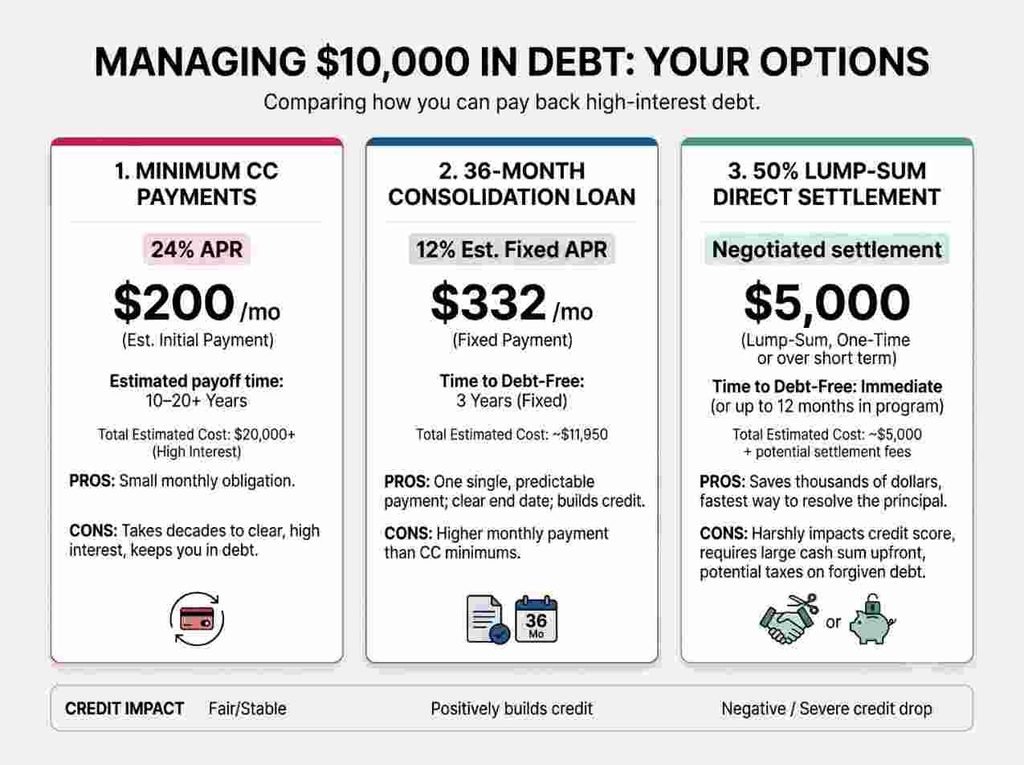
Let’s strip away the marketing jargon and look at the brutal mathematics of the revolving debt trap. The national average credit card balance is roughly $6,500, but let’s assume you are holding a very common $10,000 balance spread across two cards at a standard 24% APR.
If you fall into the trap of only paying the 3% minimum monthly payment (around $300 initially, decreasing as the balance drops), you will be trapped in repayment for well over a decade. You will end up paying an agonizing $12,000+ in pure interest, meaning that $10,000 shopping spree actually cost you over $22,000.
Now, let’s contrast that with a structured debt consolidation loan or a direct settlement. If you secure a 36-month fixed consolidation loan at a 9% APR, your monthly payment becomes a fixed $318. You pay exactly $1,447 in interest over three years, definitively breaking the debt cycle and saving yourself over $10,000 in Wall Street profits.
If your financial distress is severe enough to warrant a lump-sum settlement, the math changes again. By strategically withholding payments and negotiating with the recovery department, you might settle that $10,000 balance for $5,000 in cash. While your FICO score will temporarily tank, your cash flow is instantly liberated from the suffocating grasp of compound interest.
Federal Consumer Protections & Fine-Print Pitfalls
When you enter into a credit card debt settlement negotiation, you are stepping into a heavily regulated battlefield. Your primary shield is the Fair Debt Collection Practices Act (FDCPA), which explicitly prohibits collection agencies from using abusive, deceptive, or unfair practices to squeeze money out of you.
They cannot call you before 8 AM or after 9 PM, they cannot threaten you with jail time, and they must cease communication if you formally request it in writing. Furthermore, the Truth in Lending Act (TILA) mandates that lenders accurately disclose all costs, APRs, and terms associated with any consolidation or structured repayment offer.
However, you must be hyper-vigilant about the fine-print pitfalls banks use to claw back their losses. Beware of “prepayment penalties” on consolidation loans, which punish you for paying off your debt faster than the schedule dictates. Additionally, if a bank forgives more than $600 of your principal balance during a settlement, they will issue a 1099-C form to the IRS. You will owe federal income taxes on that forgiven amount unless you can prove you were legally “insolvent” at the time of the settlement.
Required Verification & Documentation Checklist
To negotiate effectively, you must build an undeniable paper trail that proves your financial hardship is real, not just a tactical play. Underwriters and loss mitigation officers look for hard data; they do not care about your emotional story unless it is backed by numbers.
Gather these exact documents before you ever pick up the phone or send a settlement letter:
- Most Recent Pay Stubs: Provide the last 30 to 60 days of income verification to establish your current cash flow baseline.
- W-2 Forms and 1099s: Have your last two years of tax returns ready to show your historical earning capacity and any recent income drop-offs.
- Complete Debt Schedules: Print the latest statements for every credit card, auto loan, and personal loan you hold, clearly highlighting the Total Balance, APR, and Minimum Payment.
- Hardship Proof Documentation: This is the silver bullet. Gather medical bills, unemployment award letters, divorce decrees, or military deployment orders that directly explain why you defaulted.
- Bank Statements: Provide two months of checking and savings account statements to prove you do not have hidden cash reserves capable of paying the full balance.
Copy-Paste Legal Financial Draft (Dispute / Hardship / Negotiation Letter)
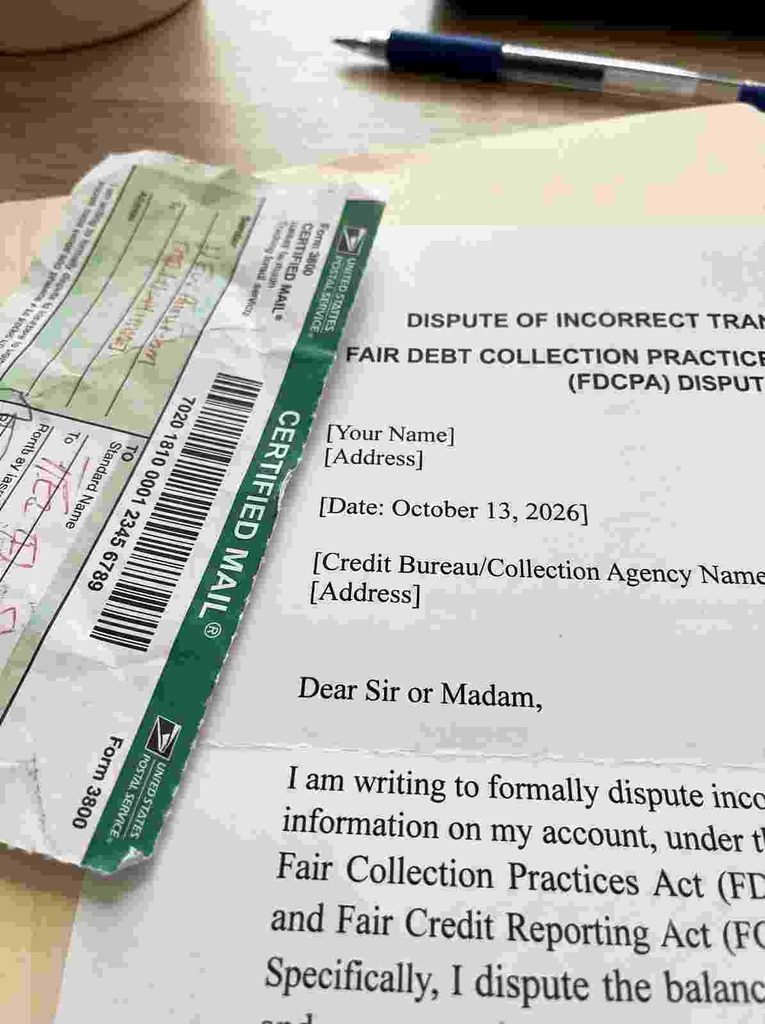
When you initiate a credit card debt settlement negotiation, you must communicate in writing via certified mail to trigger your federal rights. Do not rely on customer service phone calls, which are recorded to benefit the bank, not you.
Use this battle-tested Hardship Forbearance and Settlement Proposal template to bypass low-level representatives and reach the executive escalation team.
[Your Name]
[Your Street Address]
[Your City, State, ZIP Code]
[Your Phone Number]
[Your Email Address]

[Date]

[Lender / Bank Name]
[Recovery or Loss Mitigation Department]
[Lender Street Address]
[Lender City, State, ZIP Code]

RE: Hardship Settlement Proposal for Account Number: [Account Number]
Certified Mail Tracking Number: [Insert Tracking Number]

Dear Loss Mitigation Manager,

I am writing to formally notify you of a severe and enduring financial hardship that has severely compromised my ability to maintain the minimum payments on the aforementioned account. Due to [Insert specific hardship: e.g., unexpected medical emergency / permanent job loss / drastic reduction in household income], my current monthly debt obligations vastly exceed my incoming cash flow.

I am heavily insolvent and teetering on the edge of filing for Chapter 7 bankruptcy protection. However, before pursuing court-mandated liquidation—which would result in a total discharge of this unsecured debt—I prefer to resolve this matter amicably with your institution.

I currently have access to a one-time, borrowed lump sum of $[Insert amount, typically 40% to 50% of current balance]. I am offering this sum as a complete and final settlement for the outstanding balance of $[Insert total balance owed].

If accepted, this settlement must be considered payment in full. I require a written agreement from your office stipulating that upon receipt of this lump sum, the remaining balance will be fully forgiven, and the account will be reported to Equifax, Experian, and TransUnion as "Settled in Full" or "Paid in Full."

I cannot authorize electronic access to my checking account for this settlement. Upon your written acceptance of these terms, I will immediately forward a certified cashier’s check for the agreed-upon amount.

Please respond to this offer in writing within 14 days of receipt. Under the Fair Debt Collection Practices Act (FDCPA) § 805(c), I am also formally requesting that all future communications regarding this account be conducted exclusively in writing to my home address listed above. Please cease all telephone communications immediately.

Thank you for your prompt attention to this urgent matter.

Sincerely,

[Your Signature]
[Your Printed Name]
Step-by-Step Application & Underwriting Blueprint
Executing a successful settlement or consolidation is a precise, chronological operation. If you skip a step, you give the bank leverage to deny your request or hit you with hidden fees.
- Halt the Automated Bleeding: If you are pursuing a direct settlement, you must stop making minimum payments. Banks will not negotiate a reduced principal if your account is current; you generally must be 90 to 180 days delinquent for the charge-off department to take you seriously.
- Liquidate and Isolate Cash: While your account is aging into delinquency, aggressively stockpile cash in a separate banking institution. If you owe Chase, do not keep your settlement funds in a Chase checking account, as they can execute a “right of offset” and seize your cash without warning.
- Execute the Soft Credit Pull: If you are opting for a consolidation loan rather than a settlement, utilize pre-qualification tools that only perform a “soft pull” on your credit. This protects your score from unnecessary hard inquiries while you shop for a rate well below the prevailing 20.97% market average.
- Launch the Hardship Letter: Send the legal draft provided above via certified mail with a return receipt requested. This creates a federally recognized timestamp of your negotiation attempt and legally forces them to stop harassing you by phone.
- Hold the Line on the Counteroffer: The bank will reject your initial 40% offer and counter with an 80% demand. Stand firm, reiterate your bankruptcy threat, and slowly negotiate toward a mutually painful but acceptable 40% to 60% settlement figure.
- Demand the Settlement Agreement in Writing: Never, ever send a dime based on a verbal promise over the phone. You must receive a formal letter explicitly stating that the agreed-upon payment satisfies the debt in its entirety.
- Fund via Certified Check: Do not give the creditor your routing and account numbers. Send a cashier’s check so they cannot electronically dip into your accounts for more than the agreed amount.
Predatory Loan Traps: Red Flags to Identify
The debt relief industry is infested with bad actors looking to exploit your desperation. You must learn to spot the predatory traps that will push you further into insolvency.
First, entirely avoid “tribal payday lenders” and title loan companies. Because they claim sovereign immunity, these entities bypass federal usury laws and routinely charge annualized APRs exceeding 400%, explicitly designing their products to trap you in an endless cycle of refinancing.
Second, be deeply skeptical of third-party debt settlement companies that demand massive upfront fees before they have settled a single account. The FTC explicitly forbids these companies from charging you before they deliver results, yet many use complex retainer loopholes to bleed you dry while your credit goes down in flames.
Finally, watch out for “bait-and-switch APRs” on consolidation loans. A lender might aggressively market a 7.99% rate, but after executing a hard pull on your credit, they quietly approve you at 29.99% while adding a mandatory 5% origination fee disguised as an administrative cost. Always review the final Truth in Lending disclosure box before signing.
An Insider CFP’s Strategic Wealth Accelerators
Once you have stopped the bleeding, it is time to pivot from defense to offense. For more insider strategies on managing your wealth and protecting your legal rights, explore the complete guides at SarkariResultine.com.
My favorite wealth accelerator is the Debt Avalanche Switch. While popular advice pushes the emotional “Debt Snowball” (paying small balances first), the math demands the Avalanche. Rank your debts strictly by APR, ignoring the balance size, and attack the highest interest rate with every spare dollar while paying minimums on the rest.
Another highly guarded tactic is Strategic Authorized User Tradeline Utilization. If your credit is destroyed from a recent settlement, find a deeply trusted family member with a pristine credit card. Ask them to add you as an authorized user; that account’s flawless history will import onto your credit report within 30 days, artificially inflating your FICO score so you can qualify for premium refinancing rates.
Finally, master the art of Balance Transfer Fee Neutralization. If you secure a 0% introductory APR card, call the underwriting department before executing the transfer. Inform them you are considering a competitor’s offer and ask them to waive the standard 3% to 5% balance transfer fee to win your business; roughly 30% of the time, the frontline manager has the authority to zero out that fee on the spot.
Essential US Regulatory & Financial Portals
Do not rely on forums or unverified blogs for your legal protection. Bookmark these exact federal and regulatory portals to arm yourself with accurate, enforceable data.
- Consumer Financial Protection Bureau (CFPB): consumerfinance.gov – Use this portal to file direct complaints against banks or collection agencies that violate your FDCPA rights; lenders are legally compelled to respond to CFPB inquiries within 15 days.
- Federal Trade Commission (FTC): ftc.gov – The ultimate authority on consumer fraud, offering extensive resources on spotting predatory debt relief scams and reporting illegal business practices.
- Annual Credit Report: annualcreditreport.com – The only federally mandated website where you can pull your official Equifax, Experian, and TransUnion credit reports for free every week to verify that a settled debt is reporting correctly.
- Internal Revenue Service (IRS): irs.gov – Essential for downloading IRS Form 982, which you will need to file alongside your taxes to claim the insolvency exemption if a bank issues a 1099-C for forgiven debt.
Top 5 Frequently Asked Questions
1. Will settling my credit card debt completely ruin my FICO score?
Yes, a direct settlement will inflict severe damage, typically dropping a good score by 100 to 150 points immediately. Because you must go delinquent to force the bank to negotiate, the late payments and the final “Settled for less than full balance” remark will remain on your credit report for seven years.
2. Can I negotiate a settlement while my account is still current and in good standing?
It is extremely rare. Banks operate on algorithms and statistical risk models; if you are making your minimum payments on time, their system categorizes you as “profitable” and will flatly refuse to reduce your principal balance.
3. What happens if a collection agency sues me for the unpaid debt?
If you ignore the debt entirely, the creditor can file a lawsuit, obtain a default judgment, and legally garnish your wages or place a lien on your property. This is why you must engage proactively with the hardship letter before the account is sold to a vicious third-party litigation firm.
4. Do I have to pay taxes on the money the bank forgives in a settlement?
Typically, yes. If the bank forgives $600 or more of your principal balance, they are legally required to report it to the IRS as taxable income. You can only avoid paying taxes on this “phantom income” if you can mathematically prove to the IRS that your total liabilities exceeded your total assets at the exact moment the debt was settled. For more financial updates and educational resources, visit sarkariresultine.com.
5. Should I use a home equity loan to pay off my credit cards instead?
As a CFP, I strongly advise against this unless you possess absolute, unbreakable financial discipline. Shifting unsecured credit card debt onto your home converts a financial headache into a direct threat against your shelter; if you default on the home equity loan, the bank can foreclose on your house.
This video breaks down current 0% interest balance transfer options that can serve as an alternative strategy to prevent debt from snowballing before a settlement becomes your only option.