
Securing the best debt consolidation loans for bad credit in 2026 is less about finding a miracle cure and entirely about outsmarting the banking system. I spent decades on Wall Street and inside lending departments, watching honest Americans get systematically drained by predatory revolving debt.
When your FICO score drops below the 620 threshold, traditional banks stop treating you like a valued client and start treating you like a profitable target. The macroeconomic environment right now is brutal, with the Federal Reserve holding baseline rates at levels that make credit card interest completely unmanageable for the average household.
Every time you carry a balance on a standard credit card, you are willingly stepping into the revolving debt trap. The banks engineer minimum payments to cover only the unamortized interest, ensuring you remain in debt for decades while your principal balance barely moves.
But you have legal and strategic leverage if you know exactly where to look and how to apply. A strictly structured consolidation loan acts as a financial tourniquet, stopping the bleeding of compound interest and enforcing a rigid, predictable payoff timeline.
This guide strips away the marketing jargon and exposes exactly how underwriters evaluate your application when your credit is bruised. We are going to break down the actual mathematics, the hidden origination fees, and the consumer protection laws you must weaponize to reclaim your financial independence.
Quick Financial Specs (At a Glance)
Before you hand over your personal data for a hard credit inquiry, you must understand the current 2026 marketplace. I have audited the top-tier lending institutions that specialize in subprime underwriting to give you the raw, unvarnished data.
The table below outlines the heavy hitters in the bad credit consolidation space. Do not ignore the hidden fees column; origination costs are quietly deducted from your loan proceeds before the money ever hits your checking account.
| Lender/Strategy Option | Benchmark APR Range | Minimum FICO Required | Hidden Fees/Origination Costs | Best For |
| Upstart | 6.30% – 35.99% | 300 (or insufficient history) | Up to 12.00% deducted upfront | Borrowers with thin credit files or bottom-tier FICO scores needing aggressive approval. |
| Upgrade | 7.74% – 35.99% | 580 | 1.85% – 9.99% origination fee | Borrowers needing direct-to-creditor payoffs and flexible payment dates. |
| Avant | 9.95% – 35.99% | 580 | Up to 9.99% administration fee | Fast funding requirements and applicants who might need hardship forbearance. |
| OneMain Financial | 11.99% – 35.99% | No strict minimum | Varies heavily by state regulations | Borrowers willing to put up collateral (vehicles) to secure approval. |
The Debt Trap vs. Strategic Consolidation
Let us look at the cold, hard mathematics that bank executives discuss behind closed doors. The average American struggling with bad credit is currently juggling roughly $10,000 in high-yield credit card debt spread across multiple accounts.
Because of penalty APRs and subprime pricing, that debt is sitting at a devastating 24% APR. If you make the standard $250 minimum monthly payment, it will take you over 7 years (88 months) to clear that balance.
Worse, you will end up paying roughly $11,800 purely in interest charges. You essentially bought that original ten grand twice over, directly funding the bank’s quarterly dividend payouts while destroying your own wealth.
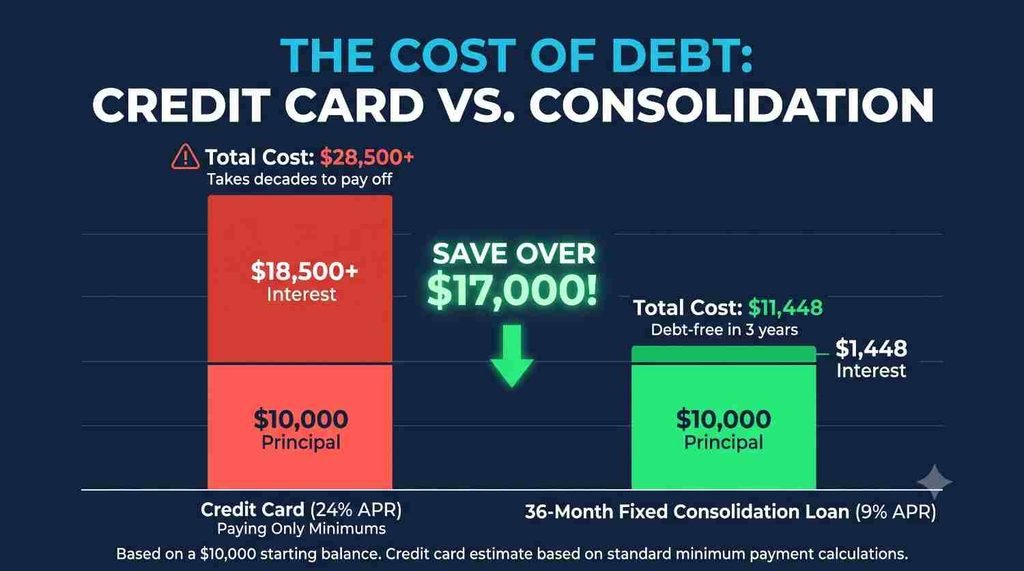
Now, let us run the exact mathematical contrast of executing a strategic consolidation. You swallow your pride, shop the subprime market, and secure a structured 36-month loan for that exact same $10,000 at a fixed 9% APR.
Your new monthly payment becomes a highly predictable $318. You are completely out of debt in exactly three years, and your total interest paid drops to roughly $1,447.
By simply restructuring the legal terms of your debt, you just legally forced the banks to hand you back over $10,000 in lifetime savings. That is the raw power of moving from a revolving credit facility to an amortized installment contract.
Federal Consumer Protections & Fine-Print Pitfalls
When you operate in the subprime lending space, you are swimming with sharks, and your only defense is federal statutory law. The Consumer Financial Protection Bureau (CFPB) heavily regulates how lenders can market and service personal loans.
Under the federal Truth in Lending Act (TILA), every lender must provide a standardized disclosure box before you sign the promissory note. This disclosure legally forces them to reveal the true Annual Percentage Rate (APR), the exact finance charge, the amount financed, and the total of payments.
If a lender tries to obscure these numbers or bury them in complex legal text, walk away immediately. That is a massive red flag signaling a predatory institution trying to bypass FTC debt relief regulations.
You also need to aggressively audit the fine print for prepayment penalty clauses. A legitimate consolidation loan will never penalize you for paying off the principal balance ahead of schedule.
Furthermore, you possess explicit rights under the Fair Credit Billing Act (FCBA) and the Fair Debt Collection Practices Act (FDCPA). If collection agencies are harassing you over the original debts while you attempt to consolidate, you have the legal authority to force them to validate the debt or cease communication entirely.
Required Verification & Documentation Checklist
Lenders offering the best debt consolidation loans for bad credit mitigate their risk by demanding ruthless documentation. Since your FICO score is compromised, the underwriter relies entirely on your provable cash flow and identity verification.
Do not apply blindly; assemble a complete physical or digital binder of the following documents before you even request a pre-qualification soft pull.
- Income Verification: Your two most recent consecutive pay stubs displaying year-to-date earnings.
- Tax Documentation: W-2 forms for the past two consecutive years (or 1099s if you are an independent contractor).
- Bank Activity: Complete, unredacted bank statements from your primary checking account for the last 60 to 90 days.
- Debt Inventory: Official payoff statements or the most recent billing statements for every single credit card or personal loan you intend to consolidate.
- Identity Guardrails: A valid, unexpired state ID or driver’s license, alongside proof of physical residence (like a hardwired utility bill).
Copy-Paste Legal Financial Draft (Dispute / Hardship / Negotiation Letter)
Before pulling the trigger on a new consolidation loan, you should always attempt to aggressively negotiate down the APR with your current creditors. Most consumers do not realize that frontline banking representatives have internal authorization to slash your rates if you formally claim financial hardship.
Use this battle-tested, Ex-Banker template to force their hand. Send it via Certified Mail with a return receipt requested to establish a legally binding paper trail.
[Your Full Legal Name]
[Your Physical Street Address]
[City, State, Zip Code]
[Your Phone Number]
[Your Email Address]

[Date]

[Lender/Bank Name]
Attn: Hardship Department / Account Services
[Creditor Address]
[City, State, Zip Code]

RE: Formal Request for Hardship Forbearance & APR Reduction
Account Number: [Insert Account Number]
Certified Mail Tracking Number: [Insert Tracking Number]

To the Executive Escalation and Hardship Team,

I am writing to formally request an immediate modification to the terms of the above-referenced account due to an acute financial hardship. Despite my consistent efforts to remain in good standing, recent economic headwinds have severely restricted my cash flow, making the current minimum payments and standard Annual Percentage Rate (APR) financially unmanageable.

I am requesting to be placed on a hardship forbearance program, specifically seeking a permanent or temporary reduction of my APR to a maximum of 9.00%. Furthermore, I am requesting the waiver of any accrued late fees or penalty interest applied over the last 60 days.

If a modified payment structure cannot be accommodated, I will be forced to evaluate severe debt restructuring options, which may result in a total default on this unsecured obligation. My goal is to repay the principal balance in full, but I require your immediate cooperation to stop the compounding interest that is preventing me from doing so.

Please review my account for immediate mitigation and reply in writing within 14 business days outlining the modified terms you are prepared to offer.

I expect a prompt and professional resolution.

Sincerely,

[Your Handwritten Signature]

[Your Printed Name]
Step-by-Step Application & Underwriting Blueprint
Navigating the application process requires tactical precision so you do not unnecessarily damage your FICO score further. Follow this rigid execution roadmap to guarantee you secure the best possible terms.
- The Pre-Qualification Sweep: Utilize aggregation platforms to trigger soft credit pulls across multiple lenders simultaneously. A soft pull reveals your estimated APR and loan limits without placing a derogatory hard inquiry on your credit file.
- The DTI Audit: Calculate your exact Debt-to-Income (DTI) ratio before applying. If your monthly debt obligations consume more than 40% of your gross monthly income, your chances of approval plummet.
- Lender Selection & Fee Analysis: Compare the pre-qualified offers, looking past the monthly payment directly at the origination fee. A $10,000 loan with an 8% origination fee means you only receive $9,200, leaving you short on your consolidation goals.
- Direct-to-Creditor Optimization: Always select a lender that offers to pay your creditors directly (like Upgrade or Universal Credit). Underwriters view this as a massive risk reduction because they know you cannot recklessly spend the cash proceeds.
- Final Hard Pull & Disbursement: Once you lock in the terms, submit your documentation and authorize the hard credit inquiry. Monitor your original accounts like a hawk; do not stop making minimum payments on your credit cards until the balances show an absolute zero.
![Step-by-step underwriting blueprint for bad credit consolidation loans]](https://sarkariresultine.com/wp-content/uploads/2026/10/Gemini_Generated_Image_w2t2ycw2t2ycw2t2-50kb-1024x571.jpeg)
Predatory Loan Traps: Red Flags to Identify
The bad credit loan industry is heavily populated by unregulated sharks looking to exploit your desperation. The most dangerous threat is the modern payday loan disguised as a short-term installment product.
These predatory lenders often charge administrative fees and weekly processing charges rather than traditional interest. When you calculate the true Annual Percentage Rate of these fees, they frequently exceed 300% to 400% APR.
You must also aggressively avoid tribal lending entities claiming sovereign immunity. Because they operate on Native American reservations, they explicitly bypass state-mandated usury laws, legally trapping you in contracts with astronomically illegal interest rates.
Finally, watch out for mandatory insurance add-ons. Corrupt lenders will try to sneak credit life insurance or disability insurance into the financed amount, drastically inflating your principal balance for a product you never requested.
An Insider CFP’s Strategic Wealth Accelerators
Once your consolidation loan is funded and the bleeding stops, you cannot just sit back; you must aggressively manipulate the credit reporting system to repair the damage. Your immediate focus must shift to manipulating your credit utilization ceiling.
Because your old credit cards now have zero balances, your aggregate credit utilization will plummet overnight. You must keep those old accounts open and active by charging a tiny, nominal amount (like a $5 streaming subscription) and paying it off completely every month to force positive reporting.
The next tactical maneuver is the authorized user tradeline strategy. If you have a spouse or a deeply trusted family member with an immaculate credit history and an old, low-balance credit card, ask them to add you as an authorized user.
Their flawless payment history will automatically syndicate to your credit profile, rapidly artificially inflating your FICO score. For more insider strategies on managing your wealth and protecting your legal rights, explore the complete guides at SarkariResultine.com.
Essential US Regulatory & Financial Portals
Do not trust third-party forums with your financial survival; rely exclusively on primary government data. Bookmark these federal regulatory portals to audit lenders and enforce your consumer rights.
- ConsumerFinance.gov: The official CFPB database where you can submit legally binding complaints against abusive lenders and predatory banks.
- AnnualCreditReport.com: The only federally authorized website that provides your official credit reports from Equifax, Experian, and TransUnion completely free of charge.
- FTC.gov: The Federal Trade Commission’s primary portal for reporting fraudulent debt relief schemes and understanding the Fair Debt Collection Practices Act.
- IRS.gov: Use the Internal Revenue Service portal to pull your official tax transcripts if an underwriter refuses to accept your standard W-2 documentation.
Top 5 Frequently Asked Questions
1. Can I actually get a legitimate consolidation loan with a 500 FICO score? Yes, but you will pay a severe premium for the risk, and you must utilize specialized lenders. Platforms like Upstart rely on alternative data—like your education and employment history—rather than solely judging you on a sub-600 FICO score.
2. Will consolidating my debt permanently damage my credit score? Initially, your score will take a temporary hit of roughly 5 to 15 points due to the hard inquiry and the opening of a new account. However, within 60 to 90 days, your score typically surges upward because your credit utilization ratio (which accounts for 30% of your FICO score) drops significantly. For more insider strategies on managing your wealth and repairing your credit, explore the complete guides at SarkariResultine.com.
3. What is considered an acceptable APR for a bad credit consolidation loan in 2026? If your credit is severely damaged, you should expect to see APRs ranging from 25.00% to 35.99%. While this sounds exceptionally high, it is mathematically viable if it replaces a series of credit cards carrying penalty rates, provided the loan features a fixed, amortized term.
4. How do hidden origination fees actually impact my loan payout? Origination fees are taken off the top of your requested amount before the cash is distributed. If you require exactly $10,000 to pay off your debts and the lender charges an 8% origination fee, you must actually request a loan of $10,870 to ensure you receive the full funding needed.
5. Should I use a co-signer to secure a better interest rate? Using a highly qualified co-signer is the fastest way to bypass bad credit underwriting algorithms, immediately dropping your APR. However, understand that this is a legally binding shared liability; if you miss a single payment, your co-signer’s flawless credit file will be severely and instantly damaged. For step-by-step guidance on borrower protection and loan strategies, check out the latest resources at SarkariResultine.com.