
Deciding between a 0% APR balance transfer vs debt consolidation loan is the single most critical financial choice you will make when fighting high-interest revolving debt. Federal Reserve policy shifts have pushed the average retail credit card interest rate past 22.15%, creating a mathematically impossible environment for everyday borrowers.
Wall Street banks generate record-breaking profits off the backs of consumers trapped in the revolving debt cycle. You are likely feeling the crushing weight of minimum payments that barely cover the monthly unamortized interest charges.
I spent decades as a Wall Street executive and veteran loan officer watching good people get buried by predatory lending math. I know exactly how underwriting algorithms classify your credit profile and how lenders maximize their yield from your financial stress.
The path to absolute debt clearance requires stripping away slick marketing jargon and executing a ruthless mathematical strategy. We are going to bypass the typical financial fluff and dissect exactly how these two consolidation vehicles actually work behind the scenes.
By the time you finish this blueprint, you will possess the institutional-grade knowledge to force lenders to play by your rules. Your goal is to aggressively protect your wealth and permanently lock your credit card accounts at a zero balance.
Quick Financial Specs (At a Glance)
| Lender/Strategy Option | Benchmark APR Range | Minimum FICO Required | Hidden Fees/Origination Costs | Best For |
| 0% APR Balance Transfer Card | 0% for 12-21 months, then 19.99%-29.99% | 670+ (Good to Excellent) | 3% to 5% upfront transfer fee | Borrowers who can pay off the exact balance within the promotional window. |
| Prime Debt Consolidation Loan | 7.99% – 14.99% Fixed | 740+ (Excellent) | 0% to 2% origination fee | Disciplined high-earners seeking a structured 3-year or 5-year payoff schedule. |
| Standard Personal Loan | 15.00% – 24.99% Fixed | 620 – 739 (Fair to Good) | 3% to 8% origination fee deducted from payout | Consumers needing to drastically lower their credit utilization ceiling quickly. |
| Subprime Installment Loan | 25.00% – 35.99% Fixed | 580 – 619 (Poor) | 8% to 10% origination fee + admin fees | Borrowers rebuilding credit who must avoid tribal or payday loan death traps. |
The Debt Trap vs. Strategic Consolidation
Lenders rely on your inability to calculate compound interest over time. Let us run the exact mathematical contrast on a typical $10,000 revolving credit card balance to expose the true cost of minimum payments.
If you carry that $10,000 balance at a standard 24% APR and only make a typical $300 monthly minimum payment, you are funding a banker’s vacation. It will take you a staggering 57 months to reach a zero balance, and you will bleed out $6,835 in pure interest charges.
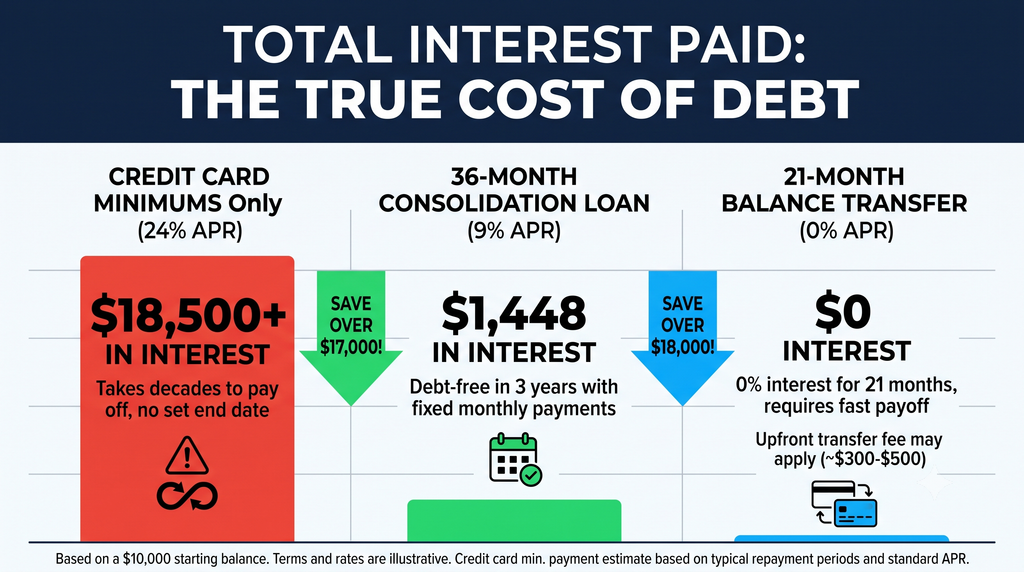
Now, contrast that disaster with a structured 36-month personal loan secured at a 9% APR through a prime credit union. Your monthly payment increases slightly to $318, but you will be completely debt-free in exactly three years while paying only $1,448 in total interest.
The third option is leveraging a 0% APR balance transfer credit card offering a 21-month promotional window. You will immediately get hit with a 5% transfer fee, turning your balance into $10,500 overnight.
If you aggressively divide that new balance by 21 months, your mandatory payment becomes $500 flat per month. You pay absolutely zero additional interest, saving you over $6,300 compared to the minimum payment trap.
The mathematical danger of the balance transfer lies entirely in human psychology. If you fail to pay off that $10,500 before month 22, the remaining balance gets crushed by a massive 29.99% penalty APR.
Federal Consumer Protections & Fine-Print Pitfalls
You cannot navigate the American credit system without understanding the regulatory guardrails built to protect your wallet. The Truth in Lending Act (TILA) mandates that every lender explicitly disclose the exact Annual Percentage Rate and total finance charges before you sign.
Unscrupulous lenders intentionally bury these mandatory TILA disclosures in massive blocks of digital fine print. Before accepting any consolidation offer, you must demand a clear breakdown of all unamortized interest and upfront origination costs.
Another massive legislative shield is the Credit CARD Act of 2009, which strictly governs how balance transfer promotions operate. This federal law requires issuers to apply any payment exceeding the minimum directly to the balance with the highest APR first.
However, the CARD Act contains a notorious loophole regarding “deferred interest” promotional financing. If a retail store card offers “no interest if paid in full by 24 months,” they are legally tracking retroactive interest in the background.
If you leave a single dollar on that balance by month 25, the bank will charge you the entire two years’ worth of backdated interest. A true 0% APR balance transfer from a major bank avoids this trap, but you must verify the contract language directly with the Consumer Financial Protection Bureau.
You also need to watch out for prepayment penalty clauses hidden inside personal loan agreements. A legitimate debt consolidation loan will explicitly allow you to make early principal-only payments without facing financial retaliation.
Required Verification & Documentation Checklist
Underwriting is a cold, mechanical process based entirely on document verification and risk algorithms. If your paperwork is disorganized, you will trigger manual reviews and face immediate loan application denial.
Prepare your financial dossier exactly like you are applying for a federal mortgage. You need to prove pristine liquidity, stable employment, and a documented history of taxable income.
- Proof of Income: Your two most recent pay stubs showing year-to-date gross earnings and employer contact information.
- Federal Tax Records: Your most recent W-2 forms or complete 1099 statements if you are an independent contractor. (You can request official tax transcripts directly from the Internal Revenue Service if you lost your physical copies).
- Debt Statements: The latest billing statements for every credit card you intend to consolidate, displaying exact payoff balances and account numbers.
- Bank Statements: Two months of pristine checking account statements showing consistent direct deposits and zero overdraft fees.
- Credit Bureau Files: A frozen or fully verified credit profile. (Pull your official statutory files for free at AnnualCreditReport.com before applying).
- Government Identification: A valid, unexpired state driver’s license or US Passport to clear stringent anti-money laundering (AML) compliance checks.
Copy-Paste Legal Financial Draft (Dispute / Hardship / Negotiation Letter)
Sometimes, you do not need a new loan; you just need your current bank to stop bleeding you dry. If you are drowning in a 29.99% penalty APR, you can legally request an internal hardship modification.
Do not call the frontline customer service representatives who read from rigid corporate scripts. Mail this targeted negotiation letter via Certified Mail to the executive review department to force a permanent APR reduction.
[Your Full Legal Name]
[Your Mailing Address]
[City, State, ZIP Code]
[Your Phone Number]
[Your Email Address]

[Date]

[Name of Credit Card Issuer / Bank]
Attn: Executive Office / Hardship Mitigation Department
[Bank’s Corporate Mailing Address]
[City, State, ZIP Code]

RE: Request for APR Reduction and Hardship Forbearance
Account Number: [Insert 16-Digit Account Number]
Certified Mail Tracking Number: [Insert Tracking Number Here]

To the Executive Review Department:

I am writing to formally request a permanent reduction of the Annual Percentage Rate (APR) on the above-referenced account. I have been a loyal customer with your institution since [Year Account Opened], but the current APR of [Insert Current APR]% has made it mathematically impossible to reduce my principal balance.

Due to unexpected macroeconomic pressures and inflation, I am currently facing a temporary financial hardship. I am committed to honoring my financial obligations and avoiding default, but the current interest charges are consuming my entire monthly payment.

Under the guidelines set forth by the Consumer Financial Protection Bureau (CFPB) regarding proactive loss mitigation, I am requesting that my account be placed on a hardship forbearance plan. Specifically, I am asking for my APR to be reduced to a fixed 9.99% or lower, and for all late fees to be waived, allowing my payments to directly amortize the principal balance.

If we cannot reach a mutually beneficial modification, I will be forced to execute a balance transfer to a competitor or explore insolvency restructuring, which will result in a total loss of yield for your institution. I have enclosed my recent financial statements proving my limited cash flow.

I expect a written response to this request within 15 business days. Please contact me directly at [Your Phone Number] to finalize a sustainable payment architecture.

Sincerely,

[Your Signature]

[Your Printed Name]
Step-by-Step Application & Underwriting Blueprint
Securing top-tier financing requires tactical execution to protect your FICO score from unnecessary damage. Do not blindly apply for multiple loans online, as this will trigger a cascade of hard inquiries that devastate your credit profile.
Follow this exact sequential blueprint to navigate the Wall Street underwriting gauntlet safely.
1. Calculate Your Exact Payoff Target
Log into every credit card portal and document the exact current balance, including pending interest charges. Add these figures together to generate your precise target funding amount down to the penny.
2. Execute Soft-Pull Prequalifications
Leverage institutional aggregators to run soft credit checks that do not impact your FICO score. Compare the pre-qualified rates from at least three different prime lenders to establish a baseline benchmark.
3. Analyze the Origination Fee Math
Look closely at the net payout figure, not just the approved loan amount. If a lender approves you for $10,000 but charges a 5% origination fee, they will only disburse $9,500 to your account.
![Step by step debt consolidation loan underwriting process]](https://sarkariresultine.com/wp-content/uploads/2026/10/Gemini_Generated_Image_cgud59cgud59cgud-80kb-1024x571.jpeg)
4. Lock the Rate and Trigger the Hard Pull
Once you select the mathematically superior offer, officially submit your signed application and upload your verification documents. This is the only moment the lender will execute a hard inquiry on your credit report.
5. Demand Direct-to-Creditor Disbursement
Always instruct the new lender to wire the payoff funds directly to your existing credit card issuers. This prevents you from accidentally spending the cash and guarantees your revolving debt is instantly wiped out.
Predatory Loan Traps: Red Flags to Identify
The consumer finance industry is infested with predatory operations disguised as legitimate debt relief companies. You must ruthlessly scrutinize every loan offer for bait-and-switch tactics designed to trap you in perpetual poverty.
The most dangerous threat is the tribal lending loophole, where lenders claim sovereign immunity to completely bypass state usury caps. These offshore and tribal entities will legally charge you APRs exceeding 300% while masking the cost in bi-weekly payment schedules.
Watch out for mandatory credit insurance add-ons explicitly forbidden by the Federal Trade Commission unless clearly elected by the consumer. Shady lenders will auto-enroll you in expensive unemployment or accidental death insurance, rolling the premiums directly into your loan principal.
You must also avoid advance-fee loan scams that demand payment before disbursing your funds. Legitimate origination fees are strictly deducted from the final loan proceeds, never paid out of pocket upfront.
Finally, be wary of debt settlement companies masquerading as debt consolidation lenders. They will tell you to stop paying your credit cards entirely, which destroys your FICO score and invites aggressive debt collection lawsuits.
An Insider CFP’s Strategic Wealth Accelerators
Once you secure your consolidation vehicle, you must deploy advanced tactics to accelerate your wealth building. For more insider strategies on managing your wealth and protecting your legal rights, explore the complete guides at SarkariResultine.com.
The most powerful tactic is the Rapid Debt Avalanche Switch, which maximizes your capital efficiency. Once your personal loan is active, take all the extra cash flow you freed up from minimum payments and hurl it directly at the new loan’s principal.
If you chose the 0% APR balance transfer route, you must neutralize the upfront transfer fee immediately. Divide that 3% to 5% fee by your promotional months, and add that specific dollar amount to your auto-pay schedule.
You can also leverage authorized user tradeline utilization to artificially boost your credit score post-consolidation. Ask a trusted family member with a flawless, decade-old credit card with a high limit to add you as an authorized user.
This instantly imports their immaculate payment history onto your credit bureau file, overriding past utilization damage. Combine this tradeline injection with your newly consolidated zero-balance credit cards, and your FICO score will skyrocket past the 750 threshold.
Essential US Regulatory & Financial Portals
Protecting yourself from predatory lending requires utilizing federal oversight agencies. Bookmark these official government portals to file formal complaints and track your statutory financial data.
- Consumer Financial Protection Bureau (CFPB) – consumerfinance.gov: The ultimate federal watchdog where you can submit legally binding complaints against abusive banks and debt collectors.
- Federal Trade Commission (FTC) – ftc.gov: The primary agency for reporting advance-fee loan scams, identity theft, and fraudulent debt relief companies.
- Internal Revenue Service (IRS) – irs.gov: The official portal to download free tax transcripts required for stringent personal loan underwriting verification.
- Annual Credit Report – annualcreditreport.com: The only federally mandated website allowing you to pull your official statutory credit files from Equifax, Experian, and TransUnion for free.
Top 5 Frequently Asked Questions
1. Does a debt consolidation loan hurt my FICO score?
Initially, your score will drop by 3 to 5 points due to the hard inquiry generated during underwriting. However, once the loan pays off your credit cards, your credit utilization ratio drops to 0%, triggering a massive surge in your overall credit score within 30 days.
2. What happens if I miss a payment on a 0% APR balance transfer?
Missing a single payment legally breaches the promotional contract, allowing the bank to instantly terminate your 0% rate. Your account will immediately default to a penalty APR, which currently maxes out at a devastating 29.99% under federal guidelines.
3. Can I consolidate a balance transfer onto a personal loan later?
Yes, you can absolutely use a personal loan to refinance a balance transfer card that is about to expire. If you realize at month 18 that you cannot pay off the promotional balance, secure a fixed-rate personal loan to avoid the impending penalty APR cliff.
4. What is a good FICO score to secure a 9% personal loan APR? To access elite, single-digit prime interest rates, underwriting algorithms require a minimum FICO score of 740. You must also demonstrate a debt-to-income (DTI) ratio below 36% and show at least five years of flawless payment history. For more insider strategies on managing your wealth, optimizing your credit profile, and protecting your legal rights, explore the complete financial guides at SarkariResultine.com.
5. Do balance transfer fees outweigh the interest savings?
A standard 5% balance transfer fee on a $10,000 debt costs exactly $500 upfront. If your current card charges 24% APR, you are burning over $200 a month in interest alone, making the transfer fee mathematically profitable by month three.