
Rehabilitate Defaulted Federal Student Loan: 2026 Breaking Relief Rules
Key Takeaways (Fast Facts): Borrowers who rehabilitate defaulted federal student loan balances in 2026 will make nine affordable monthly payments—sometimes as low as $5—to erase default records from FICO scores. Taking this urgent US government action restores Title IV aid and completely stops devastating 15% administrative wage garnishments.
Whenever Americans need to successfully rehabilitate defaulted federal student loan debt, the U.S. Department of Education requires strict adherence to their officially structured nine-month repayment agreement. Acting immediately ensures that you bypass the severe financial penalties authorized by federal regulators for uncollected educational debts.
The 2026 fiscal year introduces massive changes for struggling taxpayers who must rehabilitate defaulted federal student loan accounts before new legislative restrictions trigger. Specifically, the newly updated Repayment Assistance Plan (RAP) completely alters how your post-default income-driven monthly payments are permanently calculated moving forward.
Millions of families risk aggressive Treasury offsets against their IRS returns if they do not rehabilitate defaulted federal student loan balances promptly. Taking proactive steps today legally shields your household income while permanently restoring your critical access to the Federal Student Aid system.
Federal & Private Lending Rules: How to Rehabilitate Defaulted Federal Student Loan in 2026
Navigating the complex landscape to rehabilitate defaulted federal student loan obligations requires a deep understanding of standard Title IV Direct Subsidized and Unsubsidized Loans. Unlike aggressive private student loans governed largely by localized state statutes, federal loans offer standardized federal rehabilitation programs backed by strict Truth in Lending Act (TILA) disclosures.
When you officially apply for federal relief, the standard required payment is rigorously calculated at 15% of your discretionary income, dividing that annual figure by twelve months. If that baseline formula remains mathematically unaffordable, you can officially request an alternative recalculation based on your documented living expenses to secure payments as low as $5.
According to recent student finance and policy trackers on SarkariResultine.com, understanding these updated federal lending guidelines early can save US borrowers thousands of dollars in accrued interest. This incredibly crucial financial step prevents your compounding capitalized interest from destroying your long-term debt-to-income (DTI) ratio during consumer mortgage underwriting.
Many US borrowers vastly underestimate how devastating compounding interest can become when a standard federal loan formally accelerates into a default status. When legal acceleration occurs, the entire unpaid principal balance and all previously uncapitalized interest become immediately due, permanently shattering your standard monthly household budgeting strategy.
Private commercial lenders evaluate consumer risk fundamentally differently than the federal government, utilizing stringent FICO 8 and FICO 9 credit underwriting models. Because federal Title IV loans do not originally require a strict commercial credit check or cosigner, federal rehabilitation remains your most accessible avenue to repair credit damages seamlessly.
The federal Truth in Lending Act (TILA) aggressively mandates that your designated loan servicer provides absolutely clear, mathematically accurate disclosures regarding your modified APR and final payoff timelines. Whether your returning account is managed by Nelnet or EdFinancial, these standardized regulatory protections ensure that US consumers are never subjected to predatory hidden collection fees.
By July 1, 2027, the newly passed One Big Beautiful Bill Act will officially allow a borrower to rehabilitate defaulted federal student loan accounts twice per lifetime instead of just once. Until that future deadline, failing to successfully complete the nine on-time payments permanently burns your only chance at this specific FICO-repairing default resolution.
Department of Education and CFPB Rules to Rehabilitate Defaulted Federal Student Loan
The Consumer Financial Protection Bureau (CFPB) heavily monitors third-party debt collectors to ensure they comply with federal statutes while helping consumers rehabilitate defaulted federal student loan debts. You must never pay private debt relief companies exorbitant upfront enrollment fees for federal account services that the government explicitly offers entirely for free.
Federal Direct PLUS Loans taken out by parents also adhere to strict federal regulatory oversight, requiring exact documentation of monthly household expenses to authorize alternative rehabilitation agreements. Submitting your recent IRS Form 1040 tax return or an official wage transcript guarantees that the Department of Education verifies your precise financial hardship accurately.
Complete Interest Rate, Loan Limit & Repayment Comparison (2026 Data)
Comparing your exact path to rehabilitate defaulted federal student loan balances against standard consolidation reveals massive differences in long-term consumer credit recovery. Review the latest 2026 regulatory framework below to determine exactly how different Title IV federal debt categories respond to official default resolution tactics.
| Loan / Aid Type | 2026 Standard APR | Borrowing Limits / Caps | Key US Borrower Protections |
|---|---|---|---|
| Direct Subsidized Loans | 6.53% Fixed | $3,500 – $5,500 Annually | Erases default from FICO 8/9 via 9-month rehab |
| Direct Unsubsidized Loans | 6.53% Fixed | $20,500 Max (Grad) | Stops Treasury offset after 5 on-time payments |
| Direct PLUS Loans | 9.08% Fixed | Cost of Attendance minus Aid | Protects 15% wage garnishment limits |
| Consolidation Loans | Weighted Average | Uncapped (Based on Balance) | Routes immediately to 2026 RAP IDR plan |
Understanding the financial mathematics behind these figures is absolutely critical when deciding whether to immediately consolidate or rehabilitate defaulted federal student loan accounts this year. While federal consolidation cures the default instantly, only the structured nine-month rehabilitation process legally forces the major credit bureaus to delete the derogatory default status from your official credit report.
Once your federal educational debt is safely returned to good standing, it will be immediately reassigned to major federal loan servicers like MOHELA or Aidvantage for standard processing. This transition immediately unblocks your FAFSA Student Aid Index (SAI) eligibility, allowing undergraduate and graduate students to legally receive vital federal grants and new subsidized funding.
Real-World Impact: What This Means for US Borrowers & Families
The immediate pocketbook impact of taking proactive action to rehabilitate defaulted federal student loan accounts resonates deeply across household budgets from California to Florida. A cleared credit history dramatically improves your debt-to-income (DTI) ratio, allowing you to secure competitive auto loan interest rates and highly favorable traditional mortgage underwriting.
In states with robust consumer shields like California, the Department of Financial Protection and Innovation (DFPI) continuously monitors servicer transition practices following a successful federal rehabilitation process. Similarly, the New York State Higher Education Services Corporation (NYSHESC) strictly ensures that returning student borrowers are not improperly charged predatory hidden collection fees.
Texan and Floridian families dealing with aggressive economic inflation recognize that restoring federal loan standing is practically a mandate for long-term household wealth accumulation. Every single dollar saved from paused administrative wage garnishments can be systematically redirected toward tax-advantaged Section 529 plans for their children’s future collegiate needs.
Certified financial planners continually warn that unresolved federal student debt fundamentally paralyzes a young professional’s ability to secure commercial capital or launch a thriving small business. Because standard commercial lenders strictly evaluate your overarching debt-to-income (DTI) ratio, possessing a federally defaulted account almost entirely guarantees a commercial mortgage denial.
When you diligently rehabilitate defaulted federal student loan balances, your financial standing immediately realigns with standard US consumer credit benchmarks. Consequently, repairing this derogatory FICO mark frequently results in massive household savings, effectively lowering your commercial insurance premiums and consumer auto loan APRs.
Across the massive Texas real estate market, rigorous credit checks regularly disqualify prospective tenants who possess active student loan defaults on their consumer profiles. Resolving your federal educational debt immediately removes this severe housing barrier, allowing families to confidently sign residential leases without relying on costly third-party financial guarantors.
Furthermore, Florida residents relying heavily on state-sponsored economic initiatives discover that clearing their federal default dramatically increases their long-term economic mobility. By transitioning successfully back to a standard IDR plan, these resilient borrowers can eventually pursue lucrative Public Service Loan Forgiveness (PSLF) if they formally enter government or non-profit sectors.
30-Second Step-by-Step Financial Action Plan
- Log into StudentAid.gov immediately: Use your verified FSA ID credentials to identify which of your federal educational debts currently sit with the government’s Default Resolution Group.
- Opt to rehabilitate defaulted federal student loan accounts: Formally agree in writing to the strict nine-month payment arrangement before aggressive government collections escalate further.
- Submit your IRS tax data securely: Use the newly unified 2026 IDR and rehabilitation application tool to mathematically calculate your lowest possible discretionary income payment.
- Make nine consecutive on-time payments: You must submit every single payment within 20 days of the official due date to successfully satisfy the strict federal requirement.
- Transfer to an IDR plan seamlessly: Upon completion, immediately confirm that your new designated servicer has successfully routed your returning account to the Repayment Assistance Plan (RAP).
Related US Resource: For comprehensive updates on US student loans, FAFSA rules, scholarship opportunities, and consumer finance policy, visitSarkariResultine.com.
Critical 2026–2027 Deadlines, Tax Rules & Costly Debt Traps to Avoid
Falling into predatory consumer debt traps while attempting to rehabilitate defaulted federal student loan accounts can easily cost American families decades of unnecessary financial suffering. Beginning July 1, 2026, the implementation of the new Repayment Assistance Plan (RAP) explicitly requires borrowers to ensure their household income documentation is perfectly aligned with IRS tax records.
If you successfully rehabilitate defaulted federal student loan debts, you immediately regain crucial eligibility for the IRS Form 1098-E Student Loan Interest Deduction during tax season. This incredibly valuable US tax provision permits eligible American workers to actively deduct up to $2,500 of accrued student loan interest from their taxable income annually.
One of the most devastating mistakes borrowers make is missing a scheduled payment during the rigorous nine-month probationary agreement timeline. Although federal guidelines technically permit missing a single payment and finishing in ten months, missing two payments instantly terminates the entire agreement and rapidly triggers immediate wage garnishment.
Another catastrophic error is paying private commercial companies exorbitant upfront fees for debt relief tasks you can legally execute for free on official federal portals. Furthermore, ignoring a Treasury offset warning notice absolutely risks losing your entire tax refund, completely derailing any intended contributions to your family’s emergency savings funds.
Entering into an official rehabilitation agreement is the only legally recognized method to immediately suspend aggressive government collection tactics prior to the devastating 65-day Treasury offset deadline. Failing to finalize this federal paperwork essentially guarantees that the US government will aggressively seize your anticipated tax refunds and potentially your critical Social Security benefits.
As the Department of Education heavily modernizes its internal software frameworks, navigating the critical FAFSA deadlines for the 2026–2027 academic year demands extreme consumer vigilance. Students attempting to return to higher education must absolutely resolve their active default status well before the federal June 30th deadline to secure critical Pell Grant funding.
Ignoring localized state-level financial aid deadlines can identically devastate your collegiate funding strategy, specifically in highly competitive educational markets like New York and California. For instance, the Cal Grant system explicitly cross-references federal databases, automatically blocking state-sponsored tuition assistance for any California applicant showing an active federal Title IV default.
One significantly overlooked debt trap involves borrowers willingly consolidating their defaulted debt into a private commercial loan structure simply to escape federal collections rapidly. Taking this permanent, irreversible financial action instantly strips away all statutory federal protections, completely disqualifying the borrower from any future federal IDR plans or PSLF considerations.
US taxpayers must simultaneously remain hyper-vigilant regarding how the Internal Revenue Service categorizes any canceled or forgiven debt during the complex federal rehabilitation process. If a specific portion of your educational loan is eventually discharged, you must carefully evaluate whether you are legally required to claim that exact amount as taxable income on your subsequent Form 1040.
Official US Government Verification & Primary Financial Resources
When you are heavily researching how to properly rehabilitate defaulted federal student loan balances, always strictly rely upon authorized US government financial databases. Verifying consumer guidelines directly through official federal channels explicitly protects you from rampant predatory lending scams and devastating personal financial fraud.
- Federal Student Aid Default Support: Navigate the official federal portal designed to seamlessly guide US borrowers through the comprehensive nine-month debt rehabilitation process. Visit the verified
.govresource directly at Federal Student Aid. - Consumer Financial Protection Bureau: The federal watchdog agency actively enforces stringent consumer protection laws and aggressively pursues abusive private debt collectors. Access critical US borrower protections at the Consumer Financial Protection Bureau.
- Internal Revenue Service (IRS): Explore the exact federal tax implications of forgiven student debt and learn how to claim your Form 1098-E student loan interest deductions safely. Review official tax documentation at the Internal Revenue Service.
Frequently Asked Questions (US Borrower Guide)
How much does it cost to rehabilitate defaulted federal student loan debt?
The federal government currently bases your required monthly rehabilitation payment on exactly 15% of your documented discretionary household income. If that mathematically proves too expensive, you can formally request a customized alternative payment plan that can drop as low as $5 per month.
Will I qualify for Title IV aid after I rehabilitate defaulted federal student loan accounts?
Yes, once you successfully complete your mandatory nine on-time monthly payments, your official federal default status is fully resolved and cleared. This immediately restores your direct financial access to the FAFSA Student Aid Index (SAI), competitive Pell Grants, and entirely new federal student loans.
How does the process to rehabilitate defaulted federal student loan balances affect my FICO score?
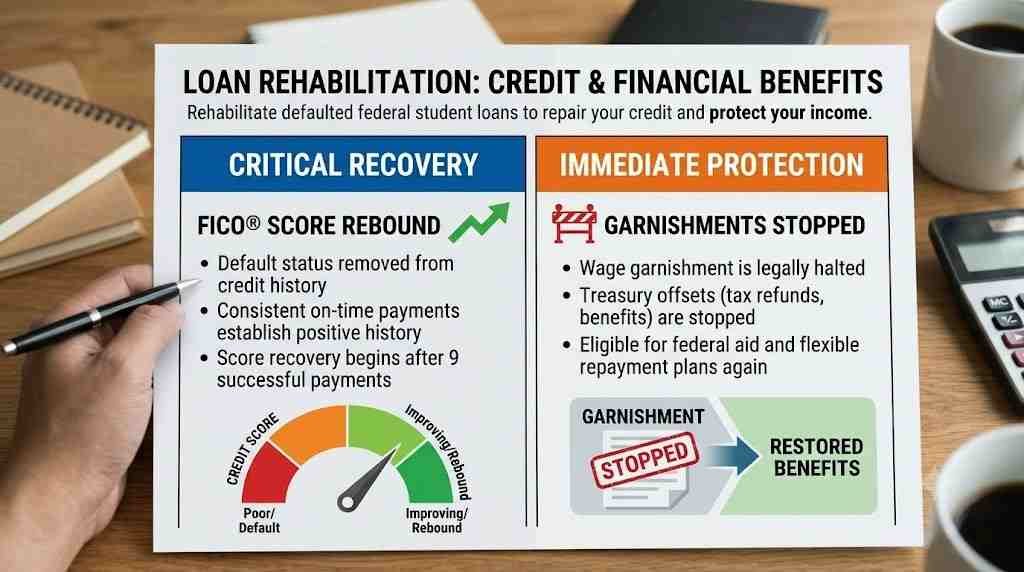
Unlike standard federal loan consolidation, completing a full federal rehabilitation automatically forces the major credit bureaus to delete the specific default record from your FICO 8 and 9 credit profiles. However, any individual late payment marks officially reported before the actual default date will legally remain visible on your consumer credit history.
Can my employer garnish my wages while I rehabilitate defaulted federal student loan debts?
Signing your formal federal rehabilitation agreement and making the very first required payment often pauses active administrative wage garnishment (AWG) momentarily. However, involuntary Treasury offsets might technically continue uninterrupted until you have officially submitted at least five consecutive on-time payments toward your federal agreement.
What is the new 2026 Repayment Assistance Plan (RAP) for federal student loans?
The RAP is the newly designated income-driven repayment plan that automatically accepts Direct Loans disbursed after July 1, 2026, officially replacing older complex IDR frameworks. Borrowers successfully returning from an active default will systematically be routed to this precise federal plan to ensure their future monthly installments remain highly affordable.
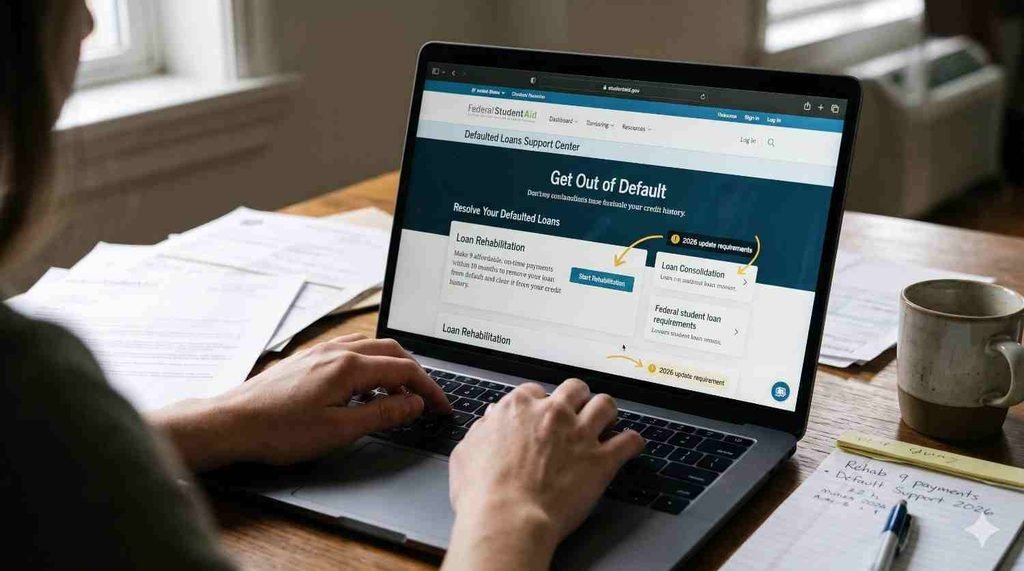
Question: Rehabilitate defaulted federal student loan in usa urgent relief 2026 form Answer: In 2026, the official form to rehabilitate a defaulted federal student loan is handled either online via the Defaulted Loans Support Center on StudentAid.gov or through a financial disclosure packet provided by the Department of Education’s Default Resolution Group (or your assigned collection agency). If the standard rehabilitation payment (calculated at 15% of your discretionary income) is too high, you must submit a specific “Income and Expense” form along with proof of income (such as an IRS Form 1040 tax return or recent pay stubs). This form allows the servicer to recalculate your financial hardship and potentially lower your required monthly rehabilitation payment to as little as $5.
Question: Rehabilitate defaulted federal student loan in usa urgent relief 2026 letter Answer: The rehabilitation letter is the legally binding “Loan Rehabilitation Agreement” document sent by your loan servicer or collection agency once you initiate the process. In 2026, this official letter outlines your exact, agreed-upon monthly payment amount and the strict requirement to make 9 on-time payments within a 10-month period. You must carefully read, sign, and return this letter (either electronically or via mail) by the stated deadline. The agreement also legally outlines the government’s promise to remove the default status from your credit report and stop Treasury offsets (like wage garnishments) once the program is successfully completed.
Question: Rehabilitate defaulted federal student loan in usa urgent relief 2026 status Answer: Borrowers can check their federal loan rehabilitation status through two primary channels: by logging into their central student dashboard at StudentAid.gov or by directly calling the Default Resolution Group (or the specific collection agency handling their account). Your status tracks the progress of your mandatory 9 payments. Once the 9th payment clears, your status officially updates to “rehabilitated.” At this point, any active wage garnishments or tax refund withholdings are permanently stopped, the loan is transferred to a standard federal servicer (like MOHELA, Nelnet, or EdFinancial), and the default mark is deleted from your credit reports.
Question: Fresh start program student loans 2026 Answer: As of 2026, the federal “Fresh Start” program for defaulted student loans is no longer active. This was a temporary, pandemic-era relief initiative that officially ended on October 2, 2024. Borrowers who are currently in default in 2026 can no longer use the Fresh Start program to instantly restore their loans to good standing. Instead, you must now rely on the standard, traditional methods of federal debt recovery: either Loan Rehabilitation or Direct Loan Consolidation.
Question: U.S. Department of Education defaulted student loans Answer: A federal student loan officially goes into default when a borrower fails to make a required payment for 270 days. At that point, the U.S. Department of Education transfers the debt to its Default Resolution Group or a third-party collection agency. Defaulting triggers severe financial consequences: the entire loan balance and unpaid interest become immediately due, you lose all eligibility for Title IV federal student aid (like Pell Grants), the default is reported to major credit bureaus, and the government gains the legal right to garnish up to 15% of your disposable pay and seize your federal tax refunds or Social Security benefits without needing a court order.
Question: Federal student loan rehabilitation Answer: Federal student loan rehabilitation is a formal, one-time debt-recovery program (though rules allow a second attempt starting July 2027) designed to bring a federal loan out of default. It requires the borrower to agree to an affordable monthly payment based on their income and expenses. The borrower must make 9 voluntary, on-time payments within 10 consecutive months. Successfully completing the rehabilitation program is highly beneficial because it is the only method that forces credit bureaus to remove the default notation from your FICO credit reports. It also fully reinstates your eligibility for federal student aid, standard income-driven repayment plans, and loan forgiveness programs.
Question: How to get student loans out of default fast Answer: The absolute fastest way to get federal student loans out of default in 2026 is through Direct Loan Consolidation. Unlike rehabilitation, which takes 9 months to complete, consolidation instantly pays off your defaulted loans by combining them into a single, brand-new Direct Consolidation Loan. This process can typically be completed online at StudentAid.gov in about 30 to 60 days. To qualify, you must either agree to repay the new loan under an Income-Driven Repayment (IDR) plan or make three consecutive, voluntary on-time payments on the defaulted loan prior to consolidating. Note: While consolidation is the fastest route, it does not remove the record of the default from your credit history.
Question: How to get out of default on federal student loans Answer: In 2026, there are three main ways to get out of default on federal student loans:
- Loan Rehabilitation: Requires making 9 affordable payments over 10 months. It takes longer, but it is the only option that removes the derogatory default mark from your credit report.
- Loan Consolidation: The fastest method. It rolls your defaulted debt into a new Direct Consolidation Loan within a few weeks, allowing you to access income-driven repayment plans immediately. However, the default notation will remain on your credit report for up to 7 years.
- Payment in Full: Paying off the entire outstanding loan balance and capitalized interest at once, though this is rarely a financially viable option for most borrowers
Is there a 2026 student loan forgiveness program?
Yes, student loan forgiveness is still available in 2026, though the structure has changed. While broad mass cancellation and the SAVE plan were eliminated, several core forgiveness programs originally written into federal law remain fully active and are accepting applications.
- Public Service Loan Forgiveness (PSLF): Remains open for government and 501(c)(3) nonprofit employees who make 120 qualifying payments.
- Targeted Discharges: Borrower Defense to Repayment (for school fraud), Closed School Discharges, and Total and Permanent Disability (TPD) discharges are still operating and actively wiping out debt.
- Repayment Assistance Plan (RAP): Under new 2025/2026 legislation, a new income-driven repayment plan called RAP was introduced. Borrowers who enroll in this plan can see their remaining balances forgiven after 30 years of repayment.
What is the fastest way to get out of default on student loans?
The absolute fastest way to get federal student loans out of default is through Direct Loan Consolidation.This process typically takes only 4 to 6 weeks to complete. Consolidation takes your existing defaulted loans and pays them off by combining them into a brand-new Direct Consolidation Loan. This instantly cures the default status, stops aggressive collection tactics like wage garnishment, and immediately restores your eligibility for Title IV federal student aid and income-driven repayment plans.Note: While consolidation is much faster than the alternative 9-month Loan Rehabilitation program, consolidation does not remove the original default notation from your credit report.
Is Trump approving student loan forgiveness?
The Trump administration has not approved broad, mass student loan cancellation and actively dismantled the prior administration’s SAVE plan. However, the administration is still approving targeted forgiveness through pre-existing statutory programs established by Congress.Borrowers can still receive loan forgiveness under the Trump administration if they meet the strict legal requirements for programs like Public Service Loan Forgiveness (PSLF), Borrower Defense, or Disability Discharges. Additionally, President Trump signed a massive reconciliation law in 2025 that overhauled the student loan system. This law created the new Repayment Assistance Plan (RAP), which restructured monthly payments but still retained a provision allowing for the forgiveness of any remaining debt after a 30-year repayment term.
Will federal student loan garnishment be resumed in 2026?
Yes. Following a long, multi-year pause on collections that spanned through the pandemic and subsequent relief periods, federal student loan wage garnishments officially resumed in January 2026 for borrowers who are in default.The Office of Federal Student Aid (FSA) and third-party collection agencies are actively sending official wage garnishment orders to employers. By law, employers are required to comply with these orders by withholding up to 15% of a defaulted borrower’s disposable earnings per pay period. The law ensures that the garnishment cannot leave the employee with less than $217.50 per week (30 times the federal minimum wage). These seized wages are sent directly to the Department of Education until the borrower takes action to rehabilitate, consolidate, or pay off the debt
Standard Financial Disclaimer: This consumer finance article is strictly intended for educational and informational purposes only and does not constitute certified financial, legal, or tax advice. American taxpayers and student borrowers should proactively consult a licensed financial advisor or certified tax professional regarding their specific household financial circumstances.