
Breaking 2026 Update: The Future of SAVE Plan Student Loans
Key Takeaways (Fast Facts): For US borrowers navigating SAVE Plan Student Loans in 2026, the Department of Education’s shifting federal mandates require immediate action. With 2026–2027 undergraduate interest rates hitting 6.52%, borrowers must verify IDR recertification deadlines, audit servicer accounts, and lock in protections against capitalized interest.
SAVE Plan Student Loans remain the focal point of intense legal and legislative battles across the United States as we navigate 2026. Following unprecedented administrative forbearance periods and Eighth Circuit federal court rulings, millions of American families face a massive repayment transition.
Borrowers anchored to federal servicers like MOHELA, Aidvantage, EdFinancial, and Nelnet must actively manage their portfolios before new capitalization rules take effect. If you ignore these regulatory shifts, you risk irreversible damage to your FICO Score 8 credit profile and ballooning debt-to-income (DTI) ratios.
Proactive financial management is no longer optional for taxpayers holding federal educational debt in the current macroeconomic environment. Taking immediate inventory of your primary loan principal is the only mathematically sound way to survive these systemic governmental transitions.
Federal & Private Lending Rules: How SAVE Plan Student Loans Work in 2026
When analyzing how SAVE Plan Student Loans function under the latest Title IV regulations, borrowers must decode the shifting definition of discretionary income. The Department of Education calculates your federal repayment obligations using a specialized formula tied to the federal poverty guidelines and your household size.
For 2026, income-driven repayment (IDR) frameworks heavily weigh your Adjusted Gross Income (AGI) routed directly from your latest IRS tax filings. If you file taxes jointly, your spouse’s income will inherently inflate your monthly payment unless specific state property laws dictate otherwise.
According to recent student finance and policy trackers on SarkariResultine.com, understanding these updated federal lending guidelines early can save US borrowers thousands of dollars in accrued interest. This early intervention is essential before capitalized interest permanently alters the principal balance of your Direct Unsubsidized Loans.
Undergraduate borrowers entering repayment in the 2026 cycle are confronting an unforgiving macroeconomic environment shaped by Federal Reserve monetary policy. With federal interest rates remaining stubbornly elevated, the underlying math of your monthly installment plan requires aggressive strategic planning.
Furthermore, the transition from the legacy Free Application for Federal Student Aid (FAFSA) Expected Family Contribution (EFC) to the new Student Aid Index (SAI) has completely rewired initial aid eligibility. This systemic overhaul dictates how much subsidized funding incoming American college students can secure before resorting to high-cost private lenders.
Private student loans, unlike their federal counterparts, strip away the legislative safety nets provided by traditional income-driven repayment frameworks. These private institutional loans rely strictly on FICO Score 8 or 9 underwriting models and demand stringent debt-to-income (DTI) ratio verifications.
When you refinance federal debt into a private vehicle to chase a lower annual percentage rate (APR), you permanently forfeit access to federal discharge programs. This irreversible maneuver instantly nullifies any future eligibility for Public Service Loan Forgiveness (PSLF) and specialized IDR waivers.
Navigating Department of Education & CFPB Servicing Protections
The current regulatory landscape grants American consumers robust legal armor against predatory lending and deceptive student loan servicing practices. Under the Truth in Lending Act (TILA), all financial institutions must provide transparent, standardized disclosures detailing the true cost of your borrowed capital.
If your designated loan servicer miscalculates your SAVE Plan Student Loans installment or fails to process your IDR recertification promptly, you possess immediate legal recourse. Borrowers can file formal administrative complaints directly through the Consumer Financial Protection Bureau to force mandatory federal investigations into negligent servicing companies.
Federal law prohibits servicers like MOHELA and Nelnet from steering financially distressed borrowers into costly long-term forbearances when superior IDR options exist. By proactively documenting every phone call and archiving all digital correspondence, you build an impenetrable defense against unwarranted credit reporting errors.
Complete Interest Rate, Loan Limit & Repayment Comparison (2026 Data)
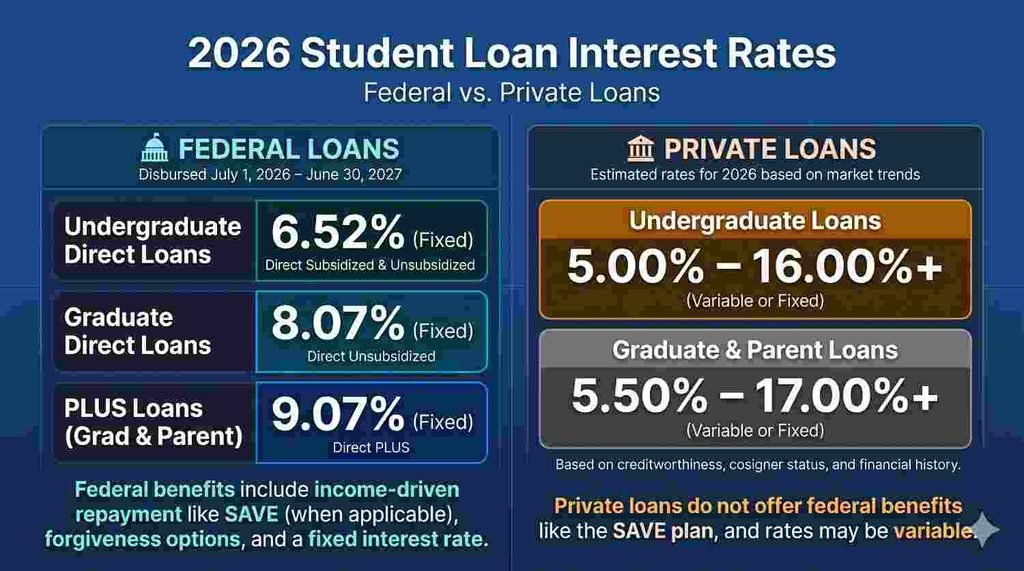
Navigating the exact costs associated with higher education requires a granular understanding of the 2026–2027 federal interest rate disclosures. US Treasury auction yields have officially locked in the borrowing costs for the upcoming academic year, presenting a sobering reality for incoming freshmen and graduate scholars alike.
Below is a comprehensive breakdown of the newly established federal lending parameters that dictate your long-term debt trajectory. This verified data empowers American families to make calculated financial decisions before signing Master Promissory Notes (MPNs).
| US Loan / Financial Aid Type | 2026–2027 Fixed Interest Rate | Borrowing Limits & Eligibility Caps | Key Federal Borrower Protections |
| Direct Subsidized Loans | 6.52% APR | Up to $5,500 annually (Undergraduates) | Government pays interest during school/deferment |
| Direct Unsubsidized Loans | 6.52% APR | Up to $12,500 annually (Undergraduates) | Eligible for federal IDR and PSLF programs |
| Direct PLUS Loans (Grad/Parent) | 9.07% APR | Up to cost of attendance minus other aid | Highest federal rate, requires standard credit check |
| Private Student Loans | 4.18% to 15.99%+ APR | Varies strictly by FICO Score & DTI | Zero federal protections; requires US cosigner |
The financial math behind a 6.52% undergraduate rate fundamentally alters the lifetime cost of a standard four-year bachelor’s degree in the United States. If you borrow the maximum allowable federal limit without deploying an aggressive principal reduction strategy, accrued interest will heavily inflate your ultimate payoff amount.
Graduate students and parents face an even steeper uphill battle with Direct PLUS Loans carrying a staggering 9.07% fixed interest rate. When origination fees are factored into the true annual percentage rate, the cost of leveraging federal capital for advanced degrees becomes a heavy burden on household cash flow.
For borrowers aggressively trying to eliminate their SAVE Plan Student Loans, overpaying the minimum monthly installment is the most mathematically sound tactic. By instructing your servicer to apply all excess cash directly to the principal balance, you effectively bypass future interest capitalization algorithms.
Real-World Impact: What This Means for US Borrowers & Families
The downstream economic consequences of these federal policy shifts are echoing through the bank accounts of working-class families across the United States. In high-cost regional economies, the interplay between student debt obligations and rising housing costs creates severe liquidity constraints for young professionals.
In California, the Department of Financial Protection and Innovation (DFPI) has deployed stringent state-level oversight to penalize rogue servicers mishandling federal accounts. This localized aggressive enforcement ensures that Californian borrowers are not unfairly penalized by systemic processing delays originating in Washington D.C.
Meanwhile, residents in Texas and Florida are uniquely impacted by the interplay of federal student loan payments and state property tax burdens. Because these states lack a traditional state income tax, families must meticulously balance their federal AGI calculations to maximize their income-driven repayment subsidies.
New York borrowers benefit from specialized state-sponsored tuition programs like the Excelsior Scholarship, which heavily mitigates reliance on federal borrowing. The New York State Higher Education Services Corporation (NYSHESC) continually advocates for resident protections, ensuring localized safety nets for those struggling with exorbitant federal debt loads.
Regardless of your geographic location, carrying an artificially inflated SAVE Plan Student Loans balance directly degrades your consumer purchasing power. Mortgage lenders scrutinize your federal IDR payment history to calculate your DTI ratio, directly influencing your ability to secure conventional FHA home financing.
30-Second Step-by-Step Financial Action Plan
To safeguard your assets and maintain control over your US federal student debt, you must execute a tactical portfolio audit immediately. Implementing these precise administrative actions will insulate your FICO profile from sudden payment shocks.
- Verify Your FAFSA SAI: Log into the Federal Student Aid portal to confirm your updated Student Aid Index and ensure your 2026 demographic data is perfectly accurate.
- Audit Your Loan Servicer: Download your complete payment history from MOHELA, Aidvantage, or Nelnet to cross-reference every applied payment against your bank statements.
- Recertify Your Income: Submit your latest US tax returns to the Department of Education before your individualized annual IDR deadline to prevent capitalizing interest.
- Update Communication Preferences: Mandate that your servicer sends all official Truth in Lending Act (TILA) disclosures and billing statements via secure electronic delivery.
- Optimize State-Level Benefits: Research specialized grant programs in your specific state of residence, utilizing platforms like NYSHESC or the DFPI to uncover localized debt relief.
Related US Resource: For comprehensive updates on US student loans, FAFSA rules, scholarship opportunities, and consumer finance policy, visitSarkariResultine.com.
Critical 2026–2027 Deadlines, Tax Rules & Costly Debt Traps to Avoid
Procrastination in the realm of federal student finance inevitably triggers severe economic penalties that can decimate your long-term wealth accumulation. Because SAVE Plan Student Loans require annual maintenance, American taxpayers must treat their federal educational deadlines with the same rigorous exactitude applied to corporate tax filings.
Failing to recertify your income under any IDR framework will automatically eject you from the subsidized payment tier. This catastrophic administrative error immediately capitalizes your outstanding interest, permanently grafting it onto your principal balance and inflating your lifetime payoff cost.
Savvy US consumers aggressively utilize the IRS Form 1098-E to reclaim portions of their expended capital during tax season. According to the Internal Revenue Service, eligible borrowers can deduct up to $2,500 of paid student loan interest from their taxable income, strictly depending on their Modified Adjusted Gross Income (MAGI).
Furthermore, families should strategically deploy Section 529 College Savings Plans to shield their educational investments from aggressive federal taxation. These specialized investment vehicles allow your capital to grow tax-free, provided the distributions are strictly applied to qualified US higher education expenses.
One of the most dangerous debt traps facing young Americans is the allure of variable-rate private refinancing during periods of macroeconomic volatility. If the Federal Reserve unexpectedly hikes the federal funds rate, a variable APR can quickly spiral out of control, causing your monthly installment to double overnight.
Always exhaust your eligibility for Direct Subsidized Loans before ever contemplating the high-risk environment of private consumer debt. Unlike private banking institutions, the US government covers your subsidized interest while you remain enrolled at least half-time in an accredited American university.
Official US Government Verification & Primary Financial Resources
Navigating the treacherous waters of US consumer finance requires unyielding reliance on verified, primary government data sources. Never hand over sensitive FICO data, Social Security Numbers, or federal login credentials to unverified third-party debt relief organizations promising instant loan cancellation.
To guarantee you are reading authentic federal statutes and officially sanctioned repayment matrices, always look for the secure .gov domain extension. The following primary US resources provide immutable, legally binding guidance for managing your SAVE Plan Student Loans and broader higher education financing inquiries.
- Federal Student Aid: The absolute central authority for FAFSA processing, PSLF tracking, and official SAVE Plan Student Loans enrollment portals.
- Consumer Financial Protection Bureau: The premier federal watchdog agency actively prosecuting predatory student loan servicers and enforcing stringent Truth in Lending Act standards.
- Internal Revenue Service: The definitive federal arbiter for claiming the Form 1098-E student loan interest deduction and managing tax-advantaged Section 529 plans.
Frequently Asked Questions (US Borrower Guide)
What exactly happens to SAVE Plan Student Loans in 2026?
Following the Eighth Circuit court rulings and subsequent federal policy transitions, borrowers are being shifted out of administrative forbearances into restructured income-driven repayment frameworks. You must proactively monitor your Federal Student Aid dashboard to ensure your monthly installment is accurately recalculated based on your latest US tax filings.
How does my FICO Score impact federal student loan eligibility?
Traditional Title IV federal student loans, such as Direct Subsidized and Unsubsidized options, do not require a FICO credit check or minimum debt-to-income (DTI) ratio. However, Direct PLUS Loans and all private refinancing vehicles strictly rely on FICO Score 8 or 9 underwriting models to determine your eligibility and APR.
Can the IRS garnish my wages for unpaid student loans?
If you default on federal student debt for more than 270 days, the US government possesses sweeping statutory powers to intercept your federal tax refunds. Furthermore, the Department of Education can mandate wage garnishments and seize portions of your Social Security benefits without securing a traditional court order.
What is the maximum student loan interest deduction on IRS Form 1098-E?
Under current United States tax code, eligible borrowers can deduct a maximum of $2,500 in paid student loan interest per tax year using IRS Form 1098-E. This above-the-line deduction phases out completely for high-earning taxpayers based on strict Modified Adjusted Gross Income (MAGI) thresholds.
Are Florida, Texas, and California borrowers subject to different federal loan limits?
Federal borrowing limits for Title IV student loans are universally standardized across all fifty states, completely independent of local geographic cost-of-living metrics. However, state-specific financial protection agencies, like California’s DFPI or New York’s NYSHESC, enforce differing levels of regulatory oversight against private loan servicers operating within their borders.
Here are the detailed answers to your questions based on the latest 2026 federal financial and legal updates:
1. Do unpaid student loans go away after 7 years?No, unpaid student loans do not legally disappear after seven years. This is a very common financial myth stemming from the Fair Credit Reporting Act (FCRA). Under the FCRA, the record of your default will be removed from your credit report after exactly seven years, meaning it will no longer weigh down your credit score. However, the debt itself survives.
For federal student loans, there is no statute of limitations. The U.S. government can legally pursue the debt for the rest of your life by administratively garnishing up to 15% of your wages, intercepting your IRS tax refunds, and seizing portions of your Social Security benefits—all without needing a court order. Private student loans do have a state-specific statute of limitations (typically ranging from 3 to 10 years) that eventually prevents the lender from suing you in court, but collection agencies can still legally ask you to pay the debt indefinitely.
2. How much is the monthly payment on a $70,000 student loan? If you are on the Standard 10-year repayment plan using the current 2026 federal interest rate of 6.39% for undergraduate loans, your monthly payment on a $70,000 balance will be approximately $791. Over the 120-month (10-year) repayment period, you will pay back your original $70,000 principal plus nearly $25,000 in accrued interest, bringing the total lifetime cost to roughly $95,000.
If you enroll in an income-driven plan rather than the Standard plan, your payment is completely detached from your $70,000 balance. Instead, your monthly payment will be calculated strictly as a percentage of your Adjusted Gross Income (AGI).
3. What will happen to student loans under the SAVE Plan?The SAVE Plan has been officially shut down. Following nearly two years of litigation, a federal court issued a final order on March 10, 2026, permanently blocking the Department of Education from implementing the SAVE program.
Borrowers who were previously enrolled in SAVE—and those who were placed in temporary administrative forbearance while the lawsuits played out—are now receiving final notices from their loan servicers to switch plans. By July 1, 2026, legacy income-driven plans are being phased out, and borrowers must transition into either the government’s new income-driven option or a Tiered Standard Plan.
4. What is Trump doing with student loans?The Trump administration has fundamentally overhauled federal student loans by passing the One Big Beautiful Bill Act (OBBBA) in 2026. This legislation officially eliminates older income-driven frameworks (like SAVE, PAYE, and ICR) and replaces them with a single program: the Repayment Assistance Plan (RAP).
Under Trump’s new RAP framework:
- Income-Based Tiers: Payments are set between 1% and 10% of your Adjusted Gross Income (AGI) based on how much you earn.
- No More $0 Payments: Unlike older plans, RAP has a strict mandatory minimum payment of $10 per month, even if you lose your job.
- Guaranteed Principal Reduction: If your scheduled monthly RAP payment does not reduce your loan principal by at least $50, the government provides a matching subsidy to ensure the principal balance drops by $50 every single month.
- Dependent Discounts: Borrowers receive a flat $50 discount on their monthly student loan bill for every dependent they claim on their federal tax return.
- 30-Year Forgiveness: The repayment term stretches up to 30 years before any remaining balance is forgiven.
Disclaimer: This article is strictly intended for educational and informational purposes only regarding current United States consumer finance topics. It does not constitute certified financial, tax, or legal advice, and US borrowers should always consult a licensed fiduciary or CPA before altering their debt repayment strategies.