
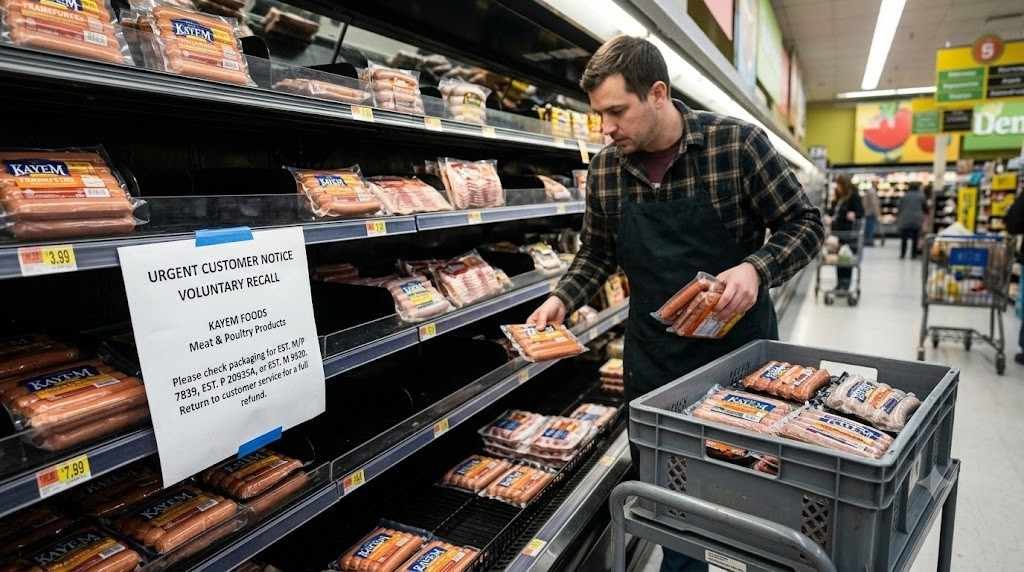
Kayem Foods Meat Recall Sparks Nationwide USDA Health Alert
Key Takeaways (Fast Facts):
The Kayem Foods meat recall involves 1.58 million pounds of hot dogs and bacon distributed across the US. Triggered by a Chelsea, Massachusetts cold-storage failure between March and October 2026, the USDA urges Americans to immediately discard products bearing establishment numbers EST. 7839, 20935A, or 9520.
The Kayem Foods meat recall has officially escalated into a nationwide consumer emergency impacting American dinner tables from coast to coast. Federal safety regulators announced that over 1.5 million pounds of highly popular grocery staples face immediate withdrawal from commercial shelves.
This staggering volume of contaminated food puts millions of US households at direct risk of foodborne illness. Families who rely on ready-to-eat hot dogs, bacon, deli meats, and bratwursts must immediately audit their refrigerators and chest freezers.
Federal inspectors from the US Department of Agriculture (USDA) issued the emergency notice following severe temperature deviations at a primary manufacturing hub. Officials determined that products shipped nationwide and internationally to Hong Kong were stored well above safe US regulatory thresholds.
Everyday consumers are now the last line of defense in identifying these compromised grocery items. Shoppers must carefully locate specific USDA establishment numbers stamped directly inside the circular federal inspection mark on all packaging.
Behind the Storage Failure Triggering the Kayem Foods Meat Recall
Investigative reports reveal that systemic infrastructure breakdowns inside a primary distribution warehouse catalyzed this massive public health alert. The Kayem Foods meat recall originates entirely from the company’s Chelsea, Massachusetts, production facility.
Warehouse cooling units failed to maintain the strictly mandated temperatures required for commercial ready-to-eat meat storage. The crisis went unnoticed by automated monitoring systems and floor managers for months.
It took a vigilant commercial customer receiving a blatantly warm delivery on October 1 to finally trigger an internal corporate probe. Subsequent federal investigations confirmed chronic temperature deviations spanning a devastating six-month production window.
The compromised timeline stretches all the way back to March 31, meaning countless Americans likely purchased and consumed these products during summer barbecues and Labor Day events. While no confirmed illnesses are officially documented yet, the incubation period for certain meat-borne pathogens can last several weeks.
When ready-to-eat meats sit in the USDA-defined “Danger Zone” (between 40°F and 140°F), aggressive bacterial multiplication occurs exponentially. Pathogens like Listeria monocytogenes and Salmonella thrive in these exact warm-storage conditions, rendering the food highly toxic regardless of subsequent refrigeration.
Federal and Regulatory Precedents Involving the Kayem Foods Meat Recall
Federal oversight agencies maintain zero tolerance for temperature abuse within the American commercial food supply chain. The Food Safety and Inspection Service (FSIS) operates under strict congressional mandates to intercept adulterated meat products before they reach civilian populations.
Under standard US statutory frameworks, a temperature deviation of this magnitude represents a catastrophic failure of Hazard Analysis and Critical Control Point (HACCP) protocols. Facilities operating out of Massachusetts are subject to unannounced federal audits precisely to prevent these exact infrastructure blind spots.
The Kayem Foods meat recall highlights a growing vulnerability within the aging American cold-storage logistics network. Commercial refrigeration compressors, ammonia lines, and digital thermostats must operate with absolute redundancy to protect the domestic food supply.
When these safeguards fail, the financial and public health fallout is immediate and devastating for both the manufacturer and the American consumer.
Key Data & Comparative Breakdown (At a Glance)
Understanding the exact specifications of the recalled batches is critical for household safety. Use this comparison matrix to differentiate between standard safe storage requirements and the exact conditions that triggered federal intervention.
| Metric | Standard US Safety Protocol | Compromised Kayem Batch Data |
| Storage Temperature | Strictly below 40°F | Documented temperature deviations above 40°F |
| Production Window | Cleared via daily HACCP logs | March 31, 2026 – October 7, 2026 |
| Total Volume Affected | N/A | 1,580,000 lbs (Approx.) |
| USDA Establishment Marks | Verified Safe Codes | EST. M/P 7839, EST. P 20935A, EST. M 9520 |
| Affected Product Lines | Cleared Retail Stock | Hot dogs, bacon, deli meat, bratwursts |
| Distribution Scope | Standard Retail | Nationwide (US) and Hong Kong |
The data confirms that the vulnerability window remained open for an unprecedented 190 days. This long-term exposure significantly increases the statistical probability that unsafe products are currently resting in American household freezers.
Real-World Impact: What This Means for Everyday Americans
The immediate financial and health consequences of the Kayem Foods meat recall directly impact the everyday American pocketbook. Shoppers facing inflated grocery store prices are now forced to discard expensive, premium meat products without immediate compensation.
Families packing school lunches or preparing weekend breakfasts face a stressful disruption to their normal household routines. Parents must meticulously inspect every package of deli meat, bacon, and hot dogs to ensure they are not exposing their children to dangerous foodborne pathogens.
Consumers who unknowingly consumed these products must monitor their families for sudden gastrointestinal distress, severe headaches, or sudden fevers. Medical professionals warn that vulnerable populations, particularly pregnant women, the elderly, and immunocompromised individuals, face life-threatening complications from temperature-abused meats.
Do not attempt to cook or boil the recalled items in an effort to sterilize them for consumption. The USDA explicitly mandates that temperature-abused ready-to-eat products must be permanently discarded or returned to the retail point of purchase.
Major American supermarket chains, including local regional grocers and national big-box retailers, are already reprogramming their point-of-sale registers. These automated blocks will prevent cashiers from scanning the recalled UPC codes, though this does not help consumers who previously purchased the stock.
Consumers returning these items to the customer service desk are legally entitled to a full monetary refund under US consumer protection standards. For comprehensive updates on consumer rights, career opportunities, and economic policy, visit SarkariResultine.com.
Critical Timeline & What Happens Next
The timeline of the Kayem Foods meat recall demonstrates how rapidly a local warehouse failure transforms into a federal emergency. The critical breakdown began on March 31, initiating a silent buildup of compromised meat products entering the national supply chain.
For months, massive pallets of hot dogs and bratwursts shipped out of the Chelsea facility masking unseen temperature abuse. The turning point arrived on October 1 when a vigilant receiving dock manager noticed the incoming delivery felt physically warm to the touch.
This single consumer report initiated an aggressive corporate investigation that ultimately exposed the compromised warehouse cooler. By October 7, the facility halted the distribution of the affected batch, severing the contaminated supply line.
Federal officials formally escalated the situation on October 19, publishing the urgent nationwide alert to warn American households. Moving forward, the USDA will conduct comprehensive internal audits of the Chelsea facility to determine exactly why the cooler alarms failed to alert management.
Federal field investigators will also deploy to retail distribution centers to verify that grocery stores have physically pulled the hazardous items from open refrigerated displays.
Official Verification & Primary US Resources
Americans seeking direct confirmation of product UPC codes, label images, and safety protocols must rely on official US regulatory databases. The following federal bodies are managing the active response to the Kayem Foods meat recall.
- USDA Food Safety and Inspection Service (FSIS): View the official recall repository and full PDF lists of impacted product labels at fsis.usda.gov.
- Centers for Disease Control and Prevention (CDC): Track real-time foodborne illness outbreak data and symptom identification at cdc.gov.
- Federal Trade Commission (FTC): Review your consumer rights regarding defective product refunds and grocery store return policies at consumer.ftc.gov.
Consumers discovering adverse health reactions should immediately contact their primary care physician and report the illness to their local state health department.
Frequently Asked Questions (Fast Answers)
What specific products are included in the Kayem Foods meat recall?
The recall targets over 1.5 million pounds of ready-to-eat items, including hot dogs, bacon, various deli meats, and bratwursts. You must look for USDA establishment numbers EST. M/P 7839, EST. P 20935A, or EST. M 9520 to confirm if your specific package is compromised.
Can I just cook the recalled meat longer to make it safe?
No. Federal safety regulators explicitly warn that cooking temperature-abused meat will not guarantee the destruction of all toxins or bacterial spores. The USDA mandates that all products associated with the Kayem Foods meat recall must be thrown in the trash or returned for a refund.
How do I get my money back for the recalled Kayem products?
Take the affected products, or just the packaging and your original receipt, back to the American grocery store where you purchased them. Retailers are legally bound to issue a full cash or credit refund for items listed in a federal safety recall.
Are there any confirmed illnesses linked to this meat recall?
As of late October 2026, the USDA has not confirmed any official clinical illnesses connected to the temperature failure. However, consumers who ate the product should remain hyper-vigilant for symptoms like nausea, fever, and severe stomach cramping.
Why did it take months to discover the Kayem foods meat recall?
The facility suffered a localized cooler breakdown that bypassed standard digital temperature monitoring systems inside the warehouse. The systemic failure remained hidden until October 1, when a commercial customer flagged a warm delivery, forcing a federal supply chain audit.