
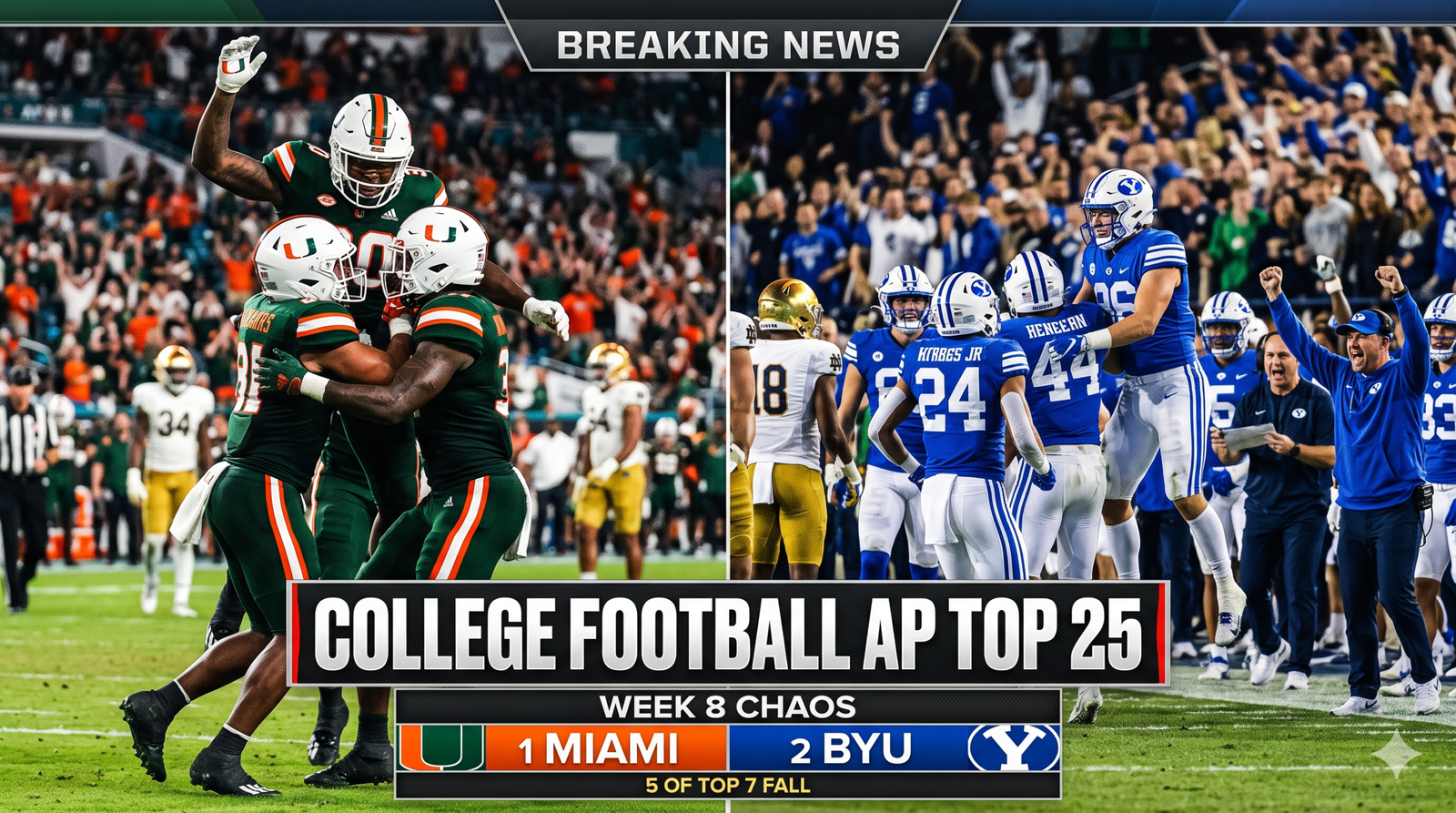
College Football Rankings Chaos: Miami Seizes No. 1 After Historic Week 8
In a historic Monday, October 19, 2026 update, the latest college football rankings shocked the United States as Miami seized the No. 1 spot. Following unprecedented weekend chaos where five top-seven programs collapsed, the AP Top 25 landscape fundamentally shifted, reshaping the expanded 12-team College Football Playoff picture.
The landscape of college football rankings in the United States has experienced a seismic shift unlike any seen in the modern era of the sport. For the first time in the history of the Associated Press poll, not a single team held its previous position following a weekend of absolute carnage.
Five of the top seven teams in the nation suffered devastating defeats, triggering massive realignments across both the AP Top 25 and the Coaches Poll. The Miami Hurricanes have officially reclaimed the No. 1 ranking for the first time since their 2002 national championship run.
This unprecedented volatility in the college football rankings has massive implications for the 12-team College Football Playoff (CFP) bracket. From television broadcast rights to the billion-dollar legalized domestic sports betting industry, the financial fallout of Week 8 is actively reverberating from Wall Street to main street campus towns.
Behind the Breaking Development: What Triggered This Shift
The dramatic restructuring of the latest college football rankings stems from a Saturday that shattered domestic sports betting models and Las Vegas algorithmic odds. Previously top-ranked Georgia suffered a stunning 27-24 home loss to the Auburn Tigers, completely unraveling the Bulldogs’ aura of invincibility.
Head coach Kirby Smart and the Bulldogs had previously boasted a 41-4 record when ranked No. 1, including a dominant 18-0 stretch in Athens. Auburn’s tactical defensive strategy disrupted Georgia’s offensive rhythm, resulting in the Bulldogs falling to No. 4 in the Coaches Poll and No. 5 in the AP Top 25.
Meanwhile, the BYU Cougars surged into the top three of the college football rankings, reaching their highest position since their 1984 national championship season. Entering LaVell Edwards Stadium as heavy 10.5-point domestic underdogs against Notre Dame, BYU secured a thrilling 28-24 victory to advance to a perfect 6-0.
Quarterback Bear Bachmeier shook off a costly interception to deliver a late, game-winning touchdown pass. This monumental victory forced Notre Dame down to No. 8 and fundamentally altered the trajectory of the official college football rankings.
In the Big Ten, Ohio State successfully snapped Indiana’s historic 22-game winning streak in a highly anticipated top-five matchup. The Buckeyes climbed to No. 2 in the Coaches Poll and No. 3 in the AP Top 25, though the victory came at a massive cost.
Ohio State lost starting quarterback Julian Sayin to a severe shoulder injury that will sideline him for several weeks. This medical setback introduces critical volatility into future college football rankings as the Buckeyes navigate the remainder of their rigorous Big Ten schedule.
The Southeastern Conference (SEC) witnessed further destruction as Alabama failed to generate any offensive momentum against Tennessee. The Crimson Tide managed a meager 201 total yards against Jim Knowles’ defensive front, resulting in a 26-10 defeat that banished Alabama to No. 13 in the college football rankings.
Federal and Regulatory Precedents in College Football Rankings
The business of collegiate athletics is no longer merely an extracurricular collegiate activity; it is a heavily regulated corporate enterprise governed by strict US statutory frameworks. The current era of college football rankings is intrinsically tied to Name, Image, and Likeness (NIL) legislation, which has effectively transformed amateur athletes into independent contractors.
Under current Internal Revenue Service (IRS) mandates, student-athletes operating under NIL collectives receive Form 1099-NEC tax documents for their commercial earnings. This professionalization has directly impacted roster depth and parity, heavily influencing the on-field parity we are witnessing in the 2026 college football rankings.
Furthermore, the wild fluctuations in the college football rankings have triggered heightened oversight from state gaming commissions and federal consumer watchdogs. The Federal Trade Commission (FTC) closely monitors advertising compliance among major US sportsbooks that capitalize on AP Top 25 shifts.
Legalized sports wagering generates billions in taxable revenue across the United States. When 10.5-point underdogs like BYU secure outright victories, the financial liability shifts across domestic betting markets.
Institutions like the Consumer Financial Protection Bureau (CFPB) have recently prioritized financial literacy campaigns to protect American consumers from predatory gambling debt. Understanding Truth in Lending Act (TILA Regulation Z) disclosures is critical for Americans interacting with credit-funded sportsbook deposits triggered by volatile college football rankings.
Key Data & Comparative Breakdown (At a Glance)
To fully comprehend the structural damage inflicted upon the AP Top 25 and the Coaches Poll, we must analyze the data mathematically. The smart category matrix below outlines the direct tactical outcomes that shattered the Week 8 college football rankings.
| Team | Week 7 Rank | Week 8 Result | New AP / Coaches Rank | Tactical Highlight |
| Miami | No. 3 | W vs. FSU (2OT) | No. 1 / No. 1 | Secured top spot after a controversial intercepted Hail Mary to survive FSU. |
| Georgia | No. 1 | L vs. Auburn (27-24) | No. 5 / No. 4 | First home loss as No. 1 under Kirby Smart; snapped 9-game streak against Auburn. |
| Ohio State | No. 5 | W vs. Indiana | No. 3 / No. 2 | Snapped IU’s 22-game streak but lost QB Julian Sayin to shoulder injury. |
| BYU | No. 8 | W vs. Notre Dame (28-24) | No. 2 / No. 3 | Bear Bachmeier’s late TD overcame a 10.5-point Las Vegas spread. |
| Texas | No. 6 | L vs. Florida | No. 19 / No. 18 | Suffered second consecutive loss, pushing them out of the top 10 entirely. |
| Alabama | No. 7 | L vs. Tennessee (26-10) | No. 13 / No. 13 | Offensive collapse yielding only 201 total yards against the Vols. |
The SEC currently dominates the volume of the college football rankings, fielding nine ranked teams including Georgia, Ole Miss, Tennessee, Kentucky, Alabama, LSU, Texas, Florida, and Missouri. The Big Ten follows closely with six programs, showcasing the highly consolidated nature of modern college football broadcast rights.
Despite their losses, programs like Notre Dame and Indiana maintained top-10 positions within the college football rankings. The polling committees preserved their status due to the high strength of schedule and the capital built during their initial 6-0 starts.
Real-World Impact: What This Means for Everyday Americans
The downstream economic consequences of the college football rankings extend far beyond the gridiron. For everyday Americans living in college towns, a top-10 ranking serves as a primary economic engine that drives local hospitality, retail, and municipal tax revenues.
When a program like Indiana drops in the college football rankings, or when Texas suffers back-to-back losses, local US businesses feel the immediate contraction in game-day tourism. Hotel occupancy rates, restaurant expenditures, and commercial airline bookings inherently track alongside the AP Top 25 success of regional universities.
Furthermore, the expansion of the 12-team playoff means that the weekly college football rankings directly dictate the distribution of hundreds of millions in television revenue. These broadcast payouts ultimately subsidize institutional academic programs, facility construction, and thousands of W-2 administrative jobs across US public universities.
For comprehensive updates on consumer rights, career opportunities, and economic policy, visit SarkariResultine.com.
On a consumer level, the extreme volatility of the college football rankings places heavy stress on domestic retail sports bettors. US consumers wagering discretionary income must recognize the inherent risks of a sport fueled by 18-to-22-year-old athletes navigating massive NIL pressures.
American households participating in these entertainment markets should strictly adhere to responsible budget management. Utilizing regulated platforms that respect Federal Deposit Insurance Corporation (FDIC) banking rails and Automated Clearing House (ACH) transfer standards ensures that consumer funds remain insulated from offshore fraud.
Critical Timeline & What Happens Next
The road to the 12-team College Football Playoff is narrowing, and the upcoming schedule promises to inject even more instability into the college football rankings. As we transition into Week 9, all eyes remain firmly fixed on the Miami Hurricanes to see if they can survive the pressure of the No. 1 target.
Miami has six regular-season matchups remaining, including a pivotal clash against Pittsburgh next week. However, the true test of their college football rankings supremacy will arrive on November 7, when they travel to South Bend to face No. 8 Notre Dame.
For Ohio State, the timeline revolves entirely around the medical rehabilitation of quarterback Julian Sayin. The Buckeyes must navigate the treacherous waters of the Big Ten without their offensive commander, relying heavily on defensive depth to maintain their elite position in the college football rankings.
Meanwhile, the official College Football Playoff selection committee is preparing to release their inaugural proprietary rankings of the 2026 season. These official standings will supersede the AP Top 25 and the Coaches Poll, serving as the definitive metric for post-season bracket placement.
Official Verification & Primary US Resources
To ensure accurate consumption of sports data and to verify the shifting regulatory landscape surrounding athletic financial markets, US consumers should consult the following verified institutional resources:
- The Associated Press (AP): Review the official, real-time AP Top 25 voting ballots and polling methodologies directly at APNews.com.
- National Collegiate Athletic Association (NCAA): Access the official FBS standings, statistical benchmarks, and national championship protocols at NCAA.org.
- Federal Trade Commission (FTC): For guidance on deceptive advertising practices in the sports betting sector, review consumer protection mandates at FTC.gov.
- Consumer Financial Protection Bureau (CFPB): Access financial literacy tools regarding debt management and TILA disclosures related to sports entertainment at ConsumerFinance.gov.
Relying on primary US government and official institutional data ensures that American consumers remain protected from misinformation, predatory gambling syndicates, and fraudulent ticket vendors operating in the secondary market.
Frequently Asked Questions (Fast Answers)
When do the new college football rankings come out in the USA?
The official AP Top 25 college football rankings are released every Sunday at 2:00 PM Eastern Standard Time (EST) during the regular season. The official College Football Playoff selection committee rankings are broadcast live on Tuesday evenings starting in early November.
How did Miami jump to No. 1 in the college football rankings?
Miami secured the top position by defeating Florida State in double overtime while the programs ranked ahead of them collapsed. Specifically, the Hurricanes capitalized on previous No. 1 Georgia losing to Auburn and No. 2 Texas sliding down the AP Top 25.
What is the highest BYU has been in the college football rankings?
Following their massive 28-24 victory over Notre Dame, BYU rocketed to No. 2 in the AP Top 25. This marks the Cougars’ highest placement in the college football rankings since their legendary 1984 national championship season.
Why did Georgia drop in the AP Top 25 college football rankings?
Georgia fell to No. 5 in the AP poll and No. 4 in the Coaches Poll after suffering a stunning 27-24 home loss to unranked Auburn. This rare defeat snapped head coach Kirby Smart’s incredible 41-4 operational record when holding the No. 1 spot.
How do the college football rankings impact the 12-team playoff?
The college football rankings directly influence seeding for the expanded 12-team CFP bracket, dictating which programs secure first-round byes and home-field advantage. The top four highest-ranked conference champions are guaranteed a bye, making conference standing as critical as national AP positioning.